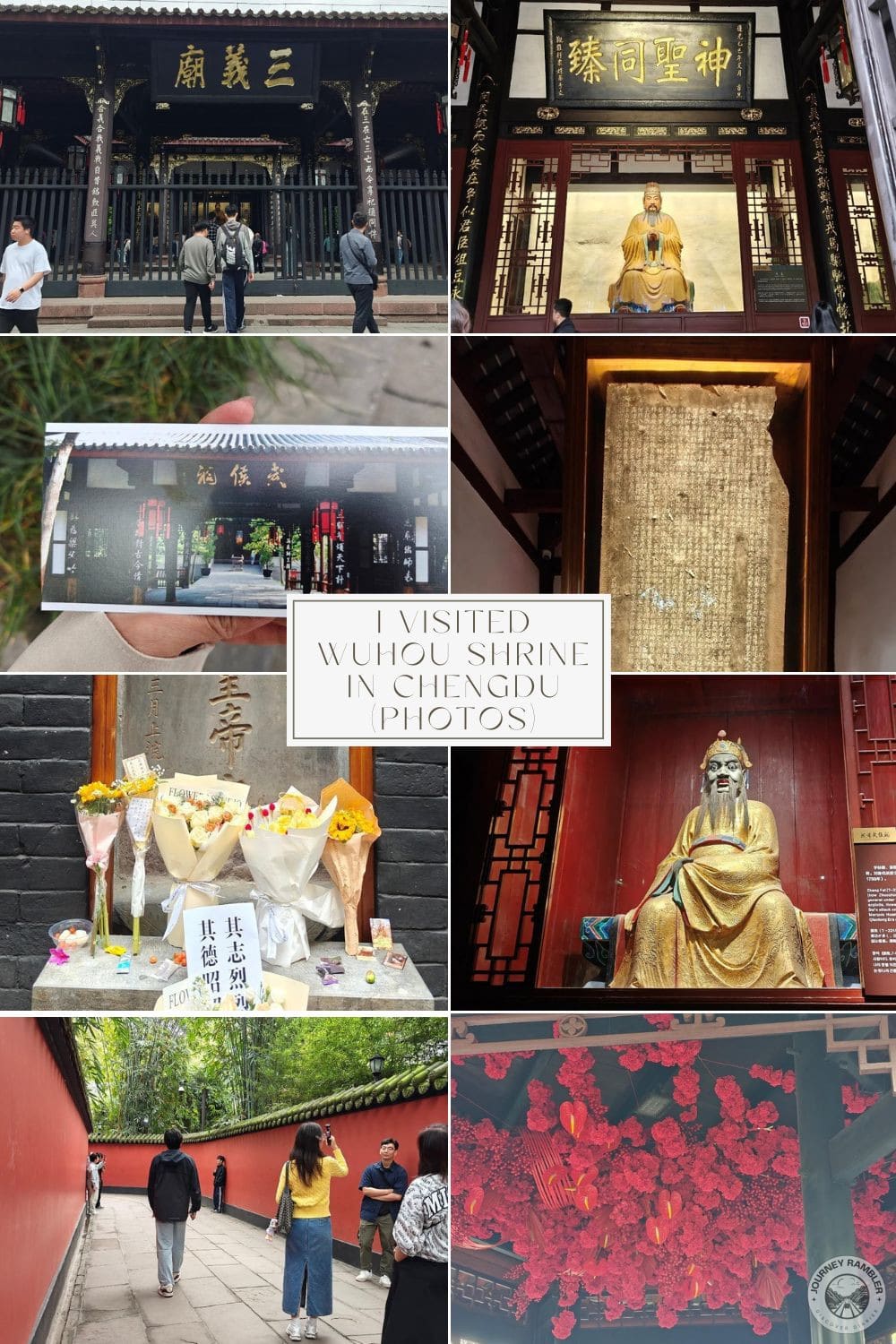
Other than Wenshu Yuan, Wuhou Shrine in Chengdu was another notable attraction that I had the good fortune of being able to visit. Unlike Wenshu Yuan though, this isn’t a religious site but rather a memorial for one of the . If you’ve read Romance of the Three Kingdoms then you’re undoubtedly familiar most popular historical figures in China: Zhuge Liangwith this name. Other than the master strategist, the site also memorializes his liege, Liu Bei.
Wuhou Shrine in Chengdu: A Must Visit for the Fans of the Romance of the Three Kingdoms
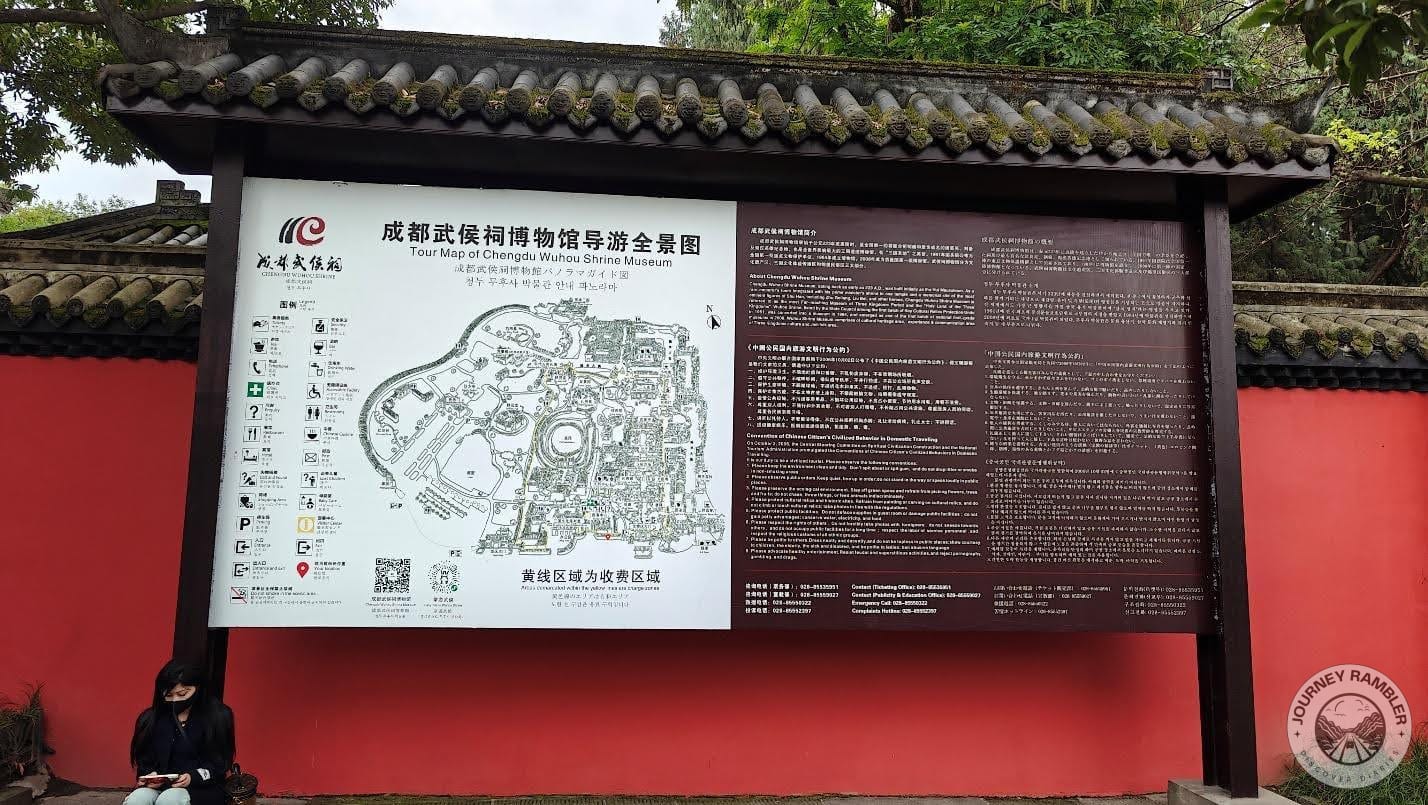
The shrine is actually quite large. Here you can see the guide map that’s found just outside its walls. Other than a memorial, there’s also a museum here that’s replete with plenty of relics, statues, and even calligraphy.
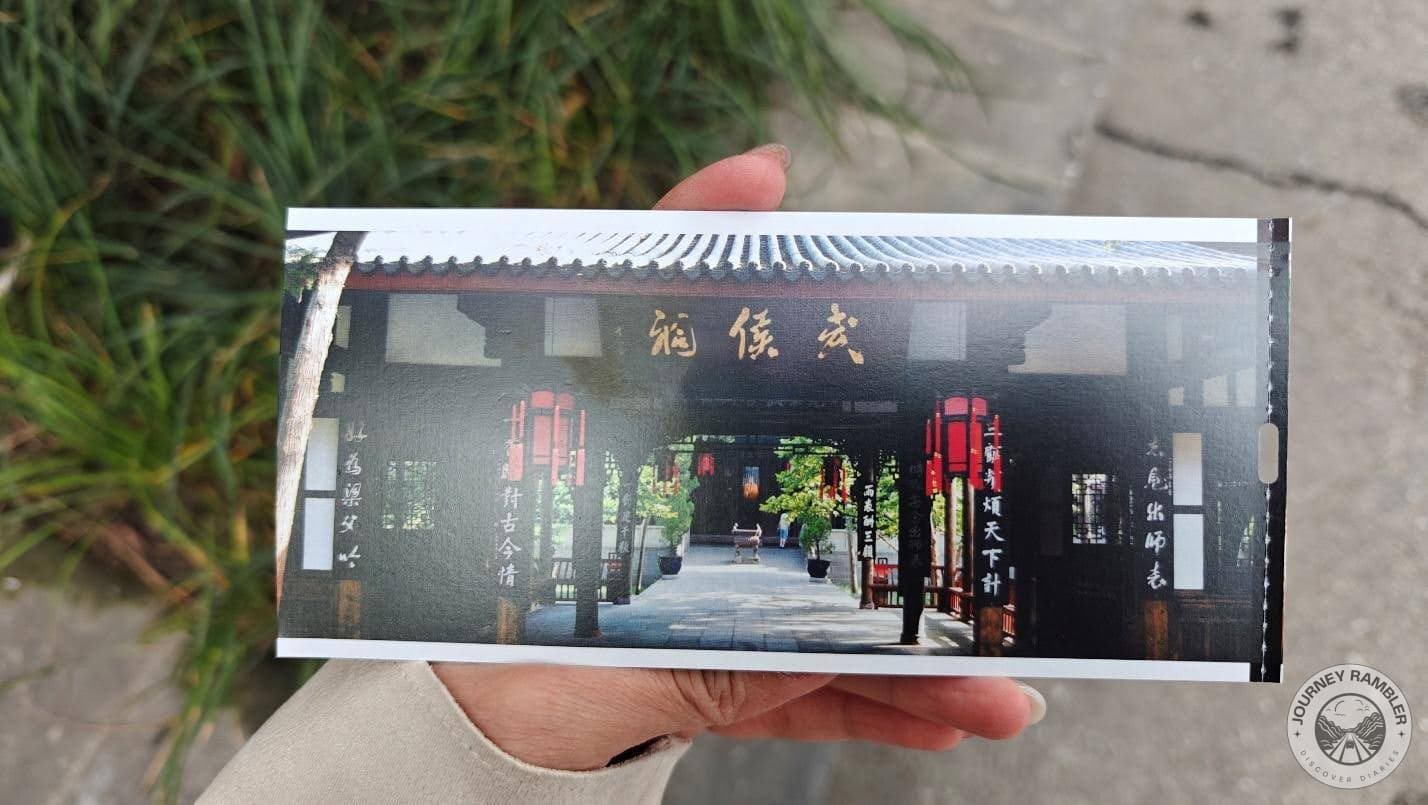
To get inside Wuhou Shrine though, you’ll need to first purchase a general admission ticket. There’s a ticket booth near the entrance where you can buy one though it’s recommended that you book online instead. Lines can be quite long during holidays or special occasions so you might want to consider this when planning your trip as well.
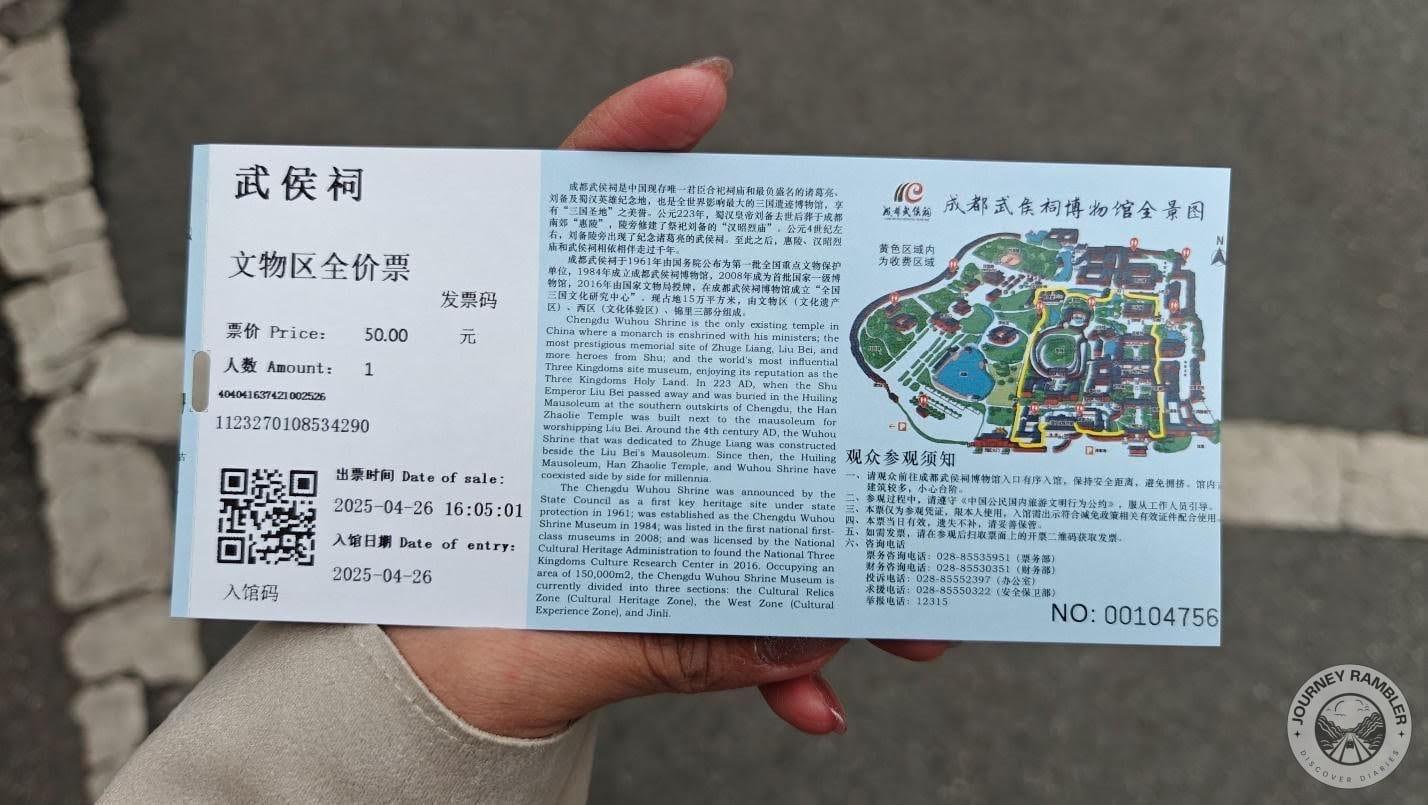
Here’s the back of the ticket with a short summary of the shrine’s history and what you can expect during your visit. At just 50 CNY, it’s actually quite affordable considering you will have access to nearly everything here. As for its business hours, the shrine usually opens from 8:00AM-9:00AM and closes at 5:00PM or 8:00PM depending on the season.
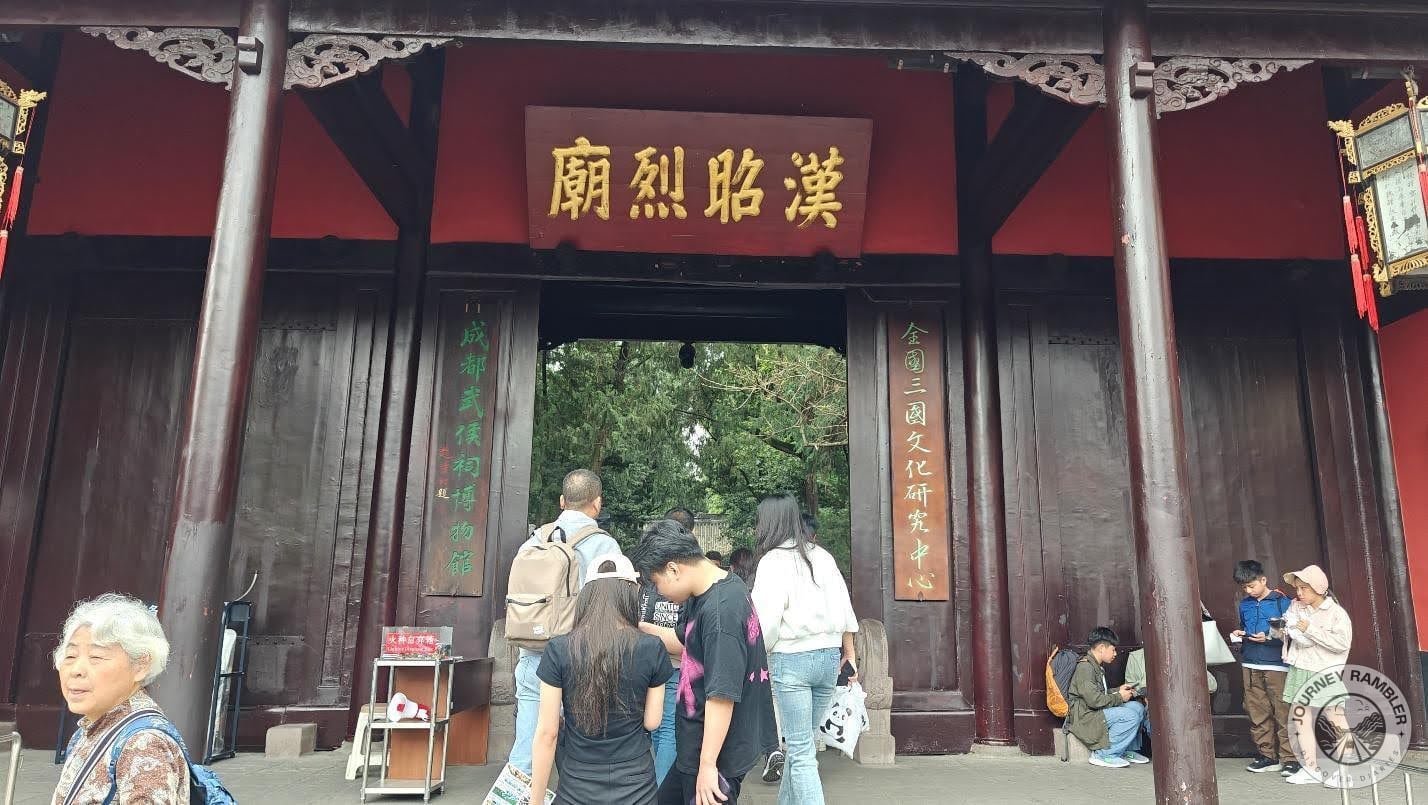
When I arrived here it didn’t seem busy at first. The Main Gate entrance actually looked modest and it seemed like there would be nothing much inside. Of course, I ended up being wrong as there were actually lots of things here that are worth checking out.
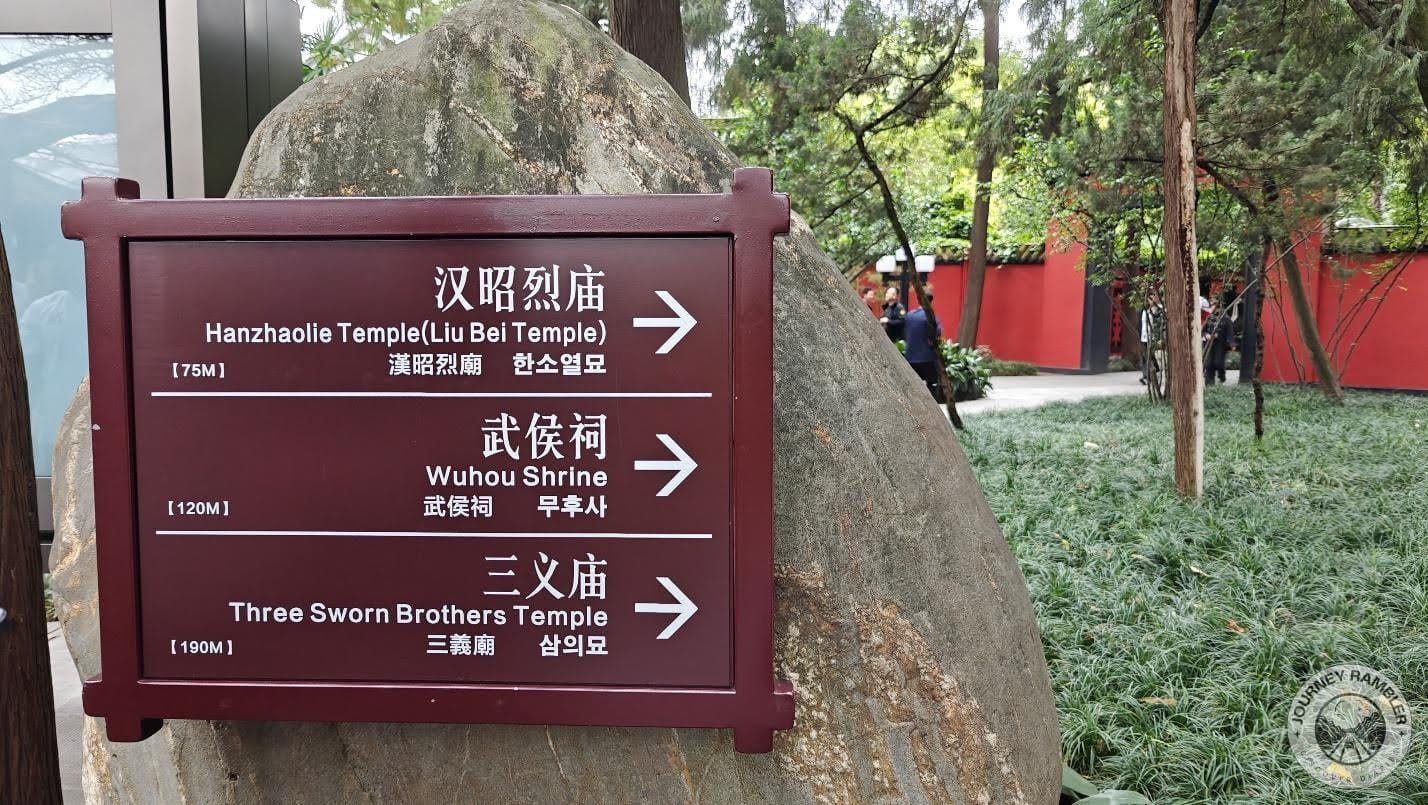
Here is a sign with directions pointing to the three major sections of the Wuhou Shrine complex. The closest from this point is Liu Bei’s Temple followed by Wuhou Shrine itself. The farthest is the temple dedicated to Liu Bei, Zhang Fei, and Guan Yu which is also called the Three Sworn Brothers Temple.
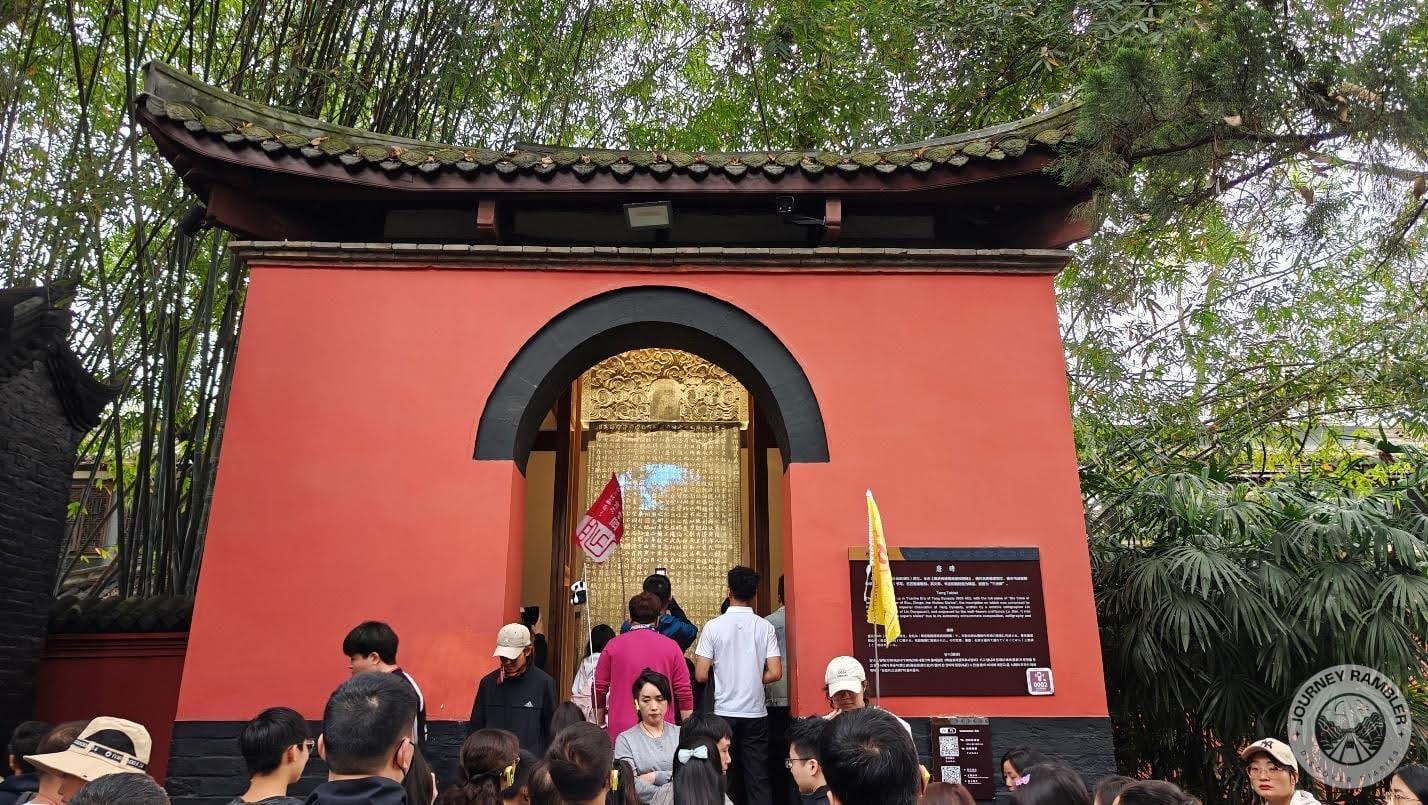
From the entrance, one of the first notable attractions you’ll notice is this small shed with what seems like a large tablet with inscriptions in it. There were noticeably more people here and it seemed like they were all lining up to get inside the shed/pavilion. I also decided to move closer since I was curious about what it was.
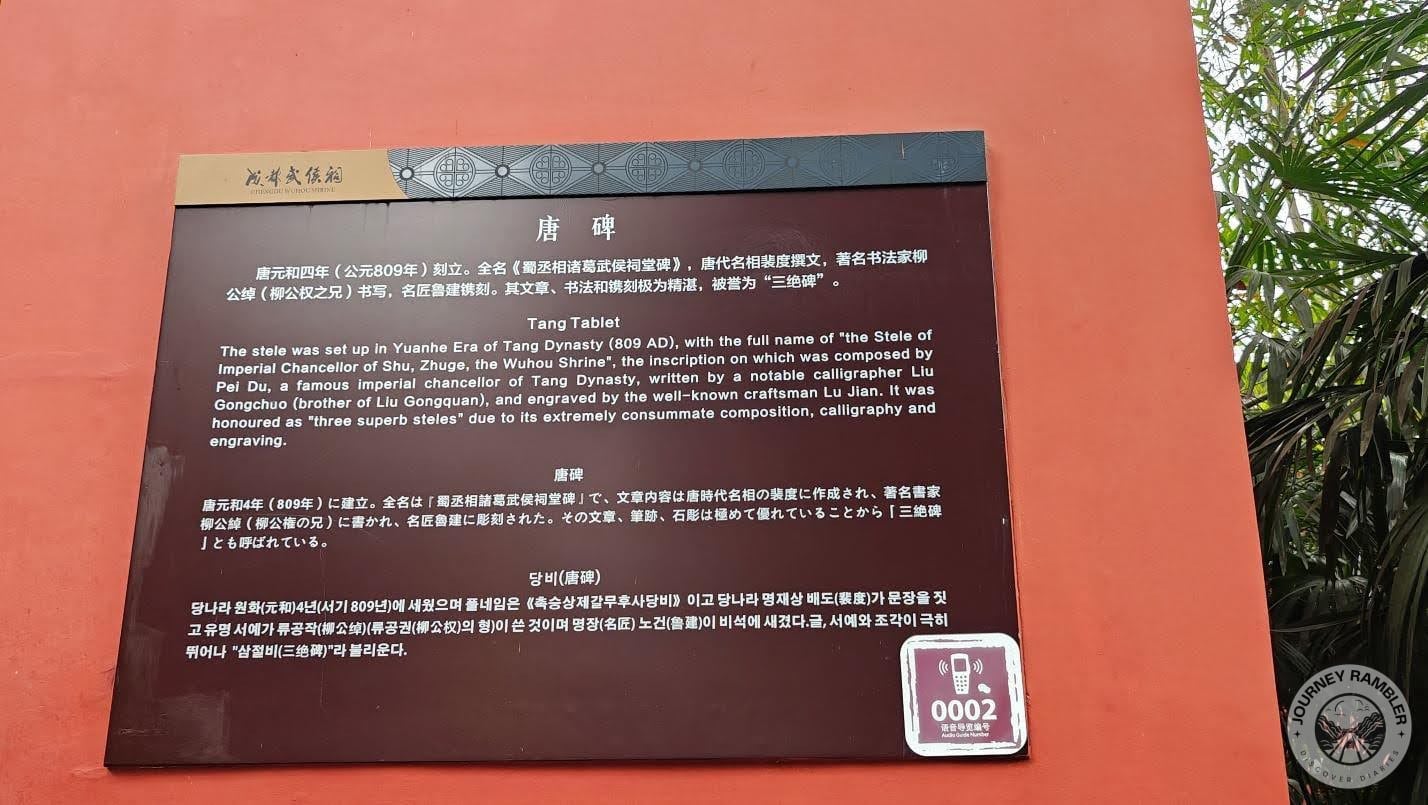
So the tablet is actually called the Tang Tablet and apparently it was composed in honor of Zhuge Liang by another chancellor named Pei Du of the Tang Dynasty. The calligraphy on the tablet was by a calligrapher named Liu Gongchou and the engraving was by Lu Jian. The tablet was put up in 809 AD and at that time it was more than half a millennia after Zhuge Liang’s death (234 AD).
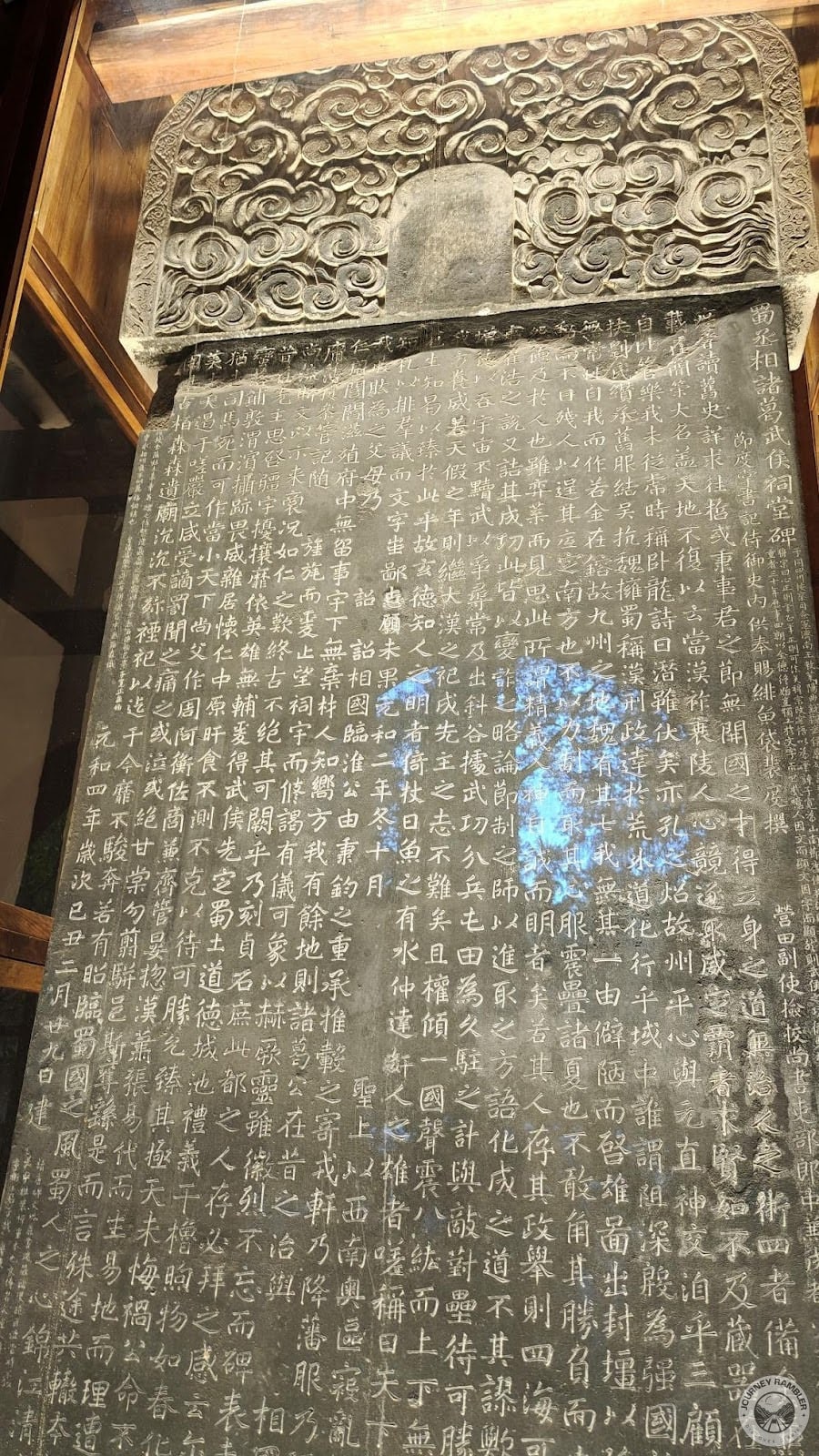
Here’s the tablet up close. If I’m not mistaken, this is a eulogy praising the achievements and governing philosophy of the master strategist. I must say, for something that’s over a thousand years old, the stele looks like it’s still in pristine condition.
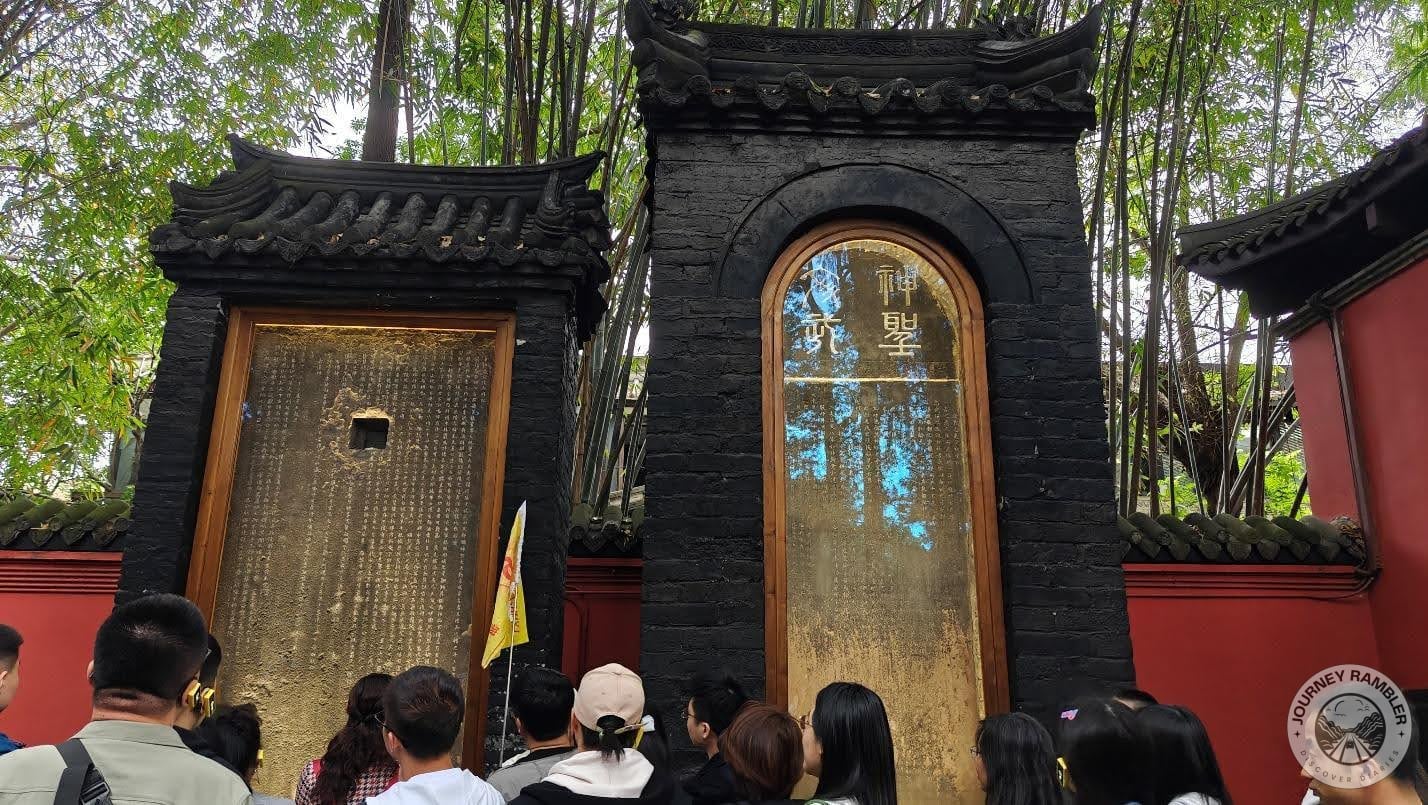
Another name for the Tang Tablet is the Stele of Three Insuperabilities. It’s called this because of how it was deemed perfect in the three art forms that were highly valued in China: literature, calligraphy, and sculpture. The individuals who contributed to the creation of the tablet were essentially some of the most brilliant minds in their fields when it was made.
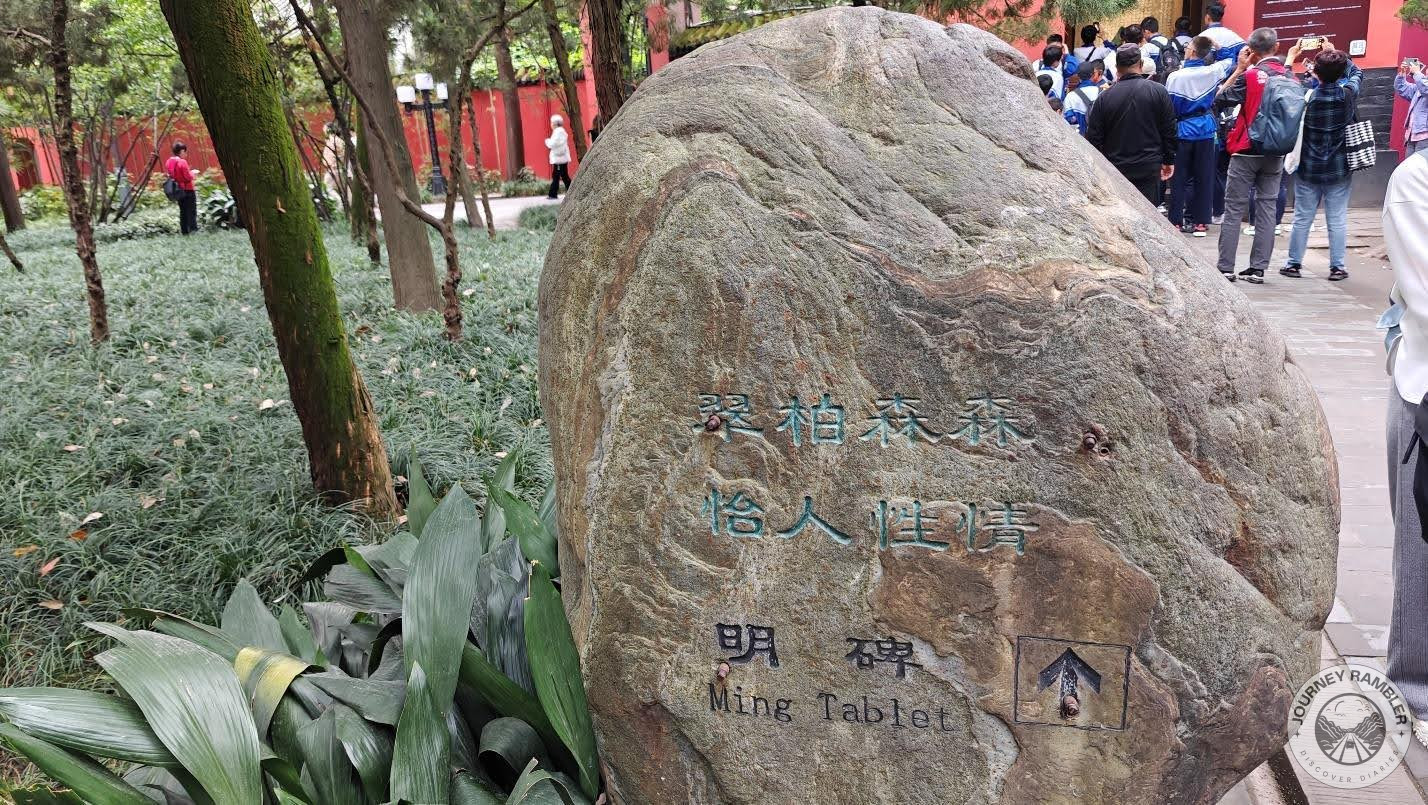
After the Tang tablet, I headed to another tablet that was attracting people. I followed this sign on a large rock to where the Ming Tablet was.
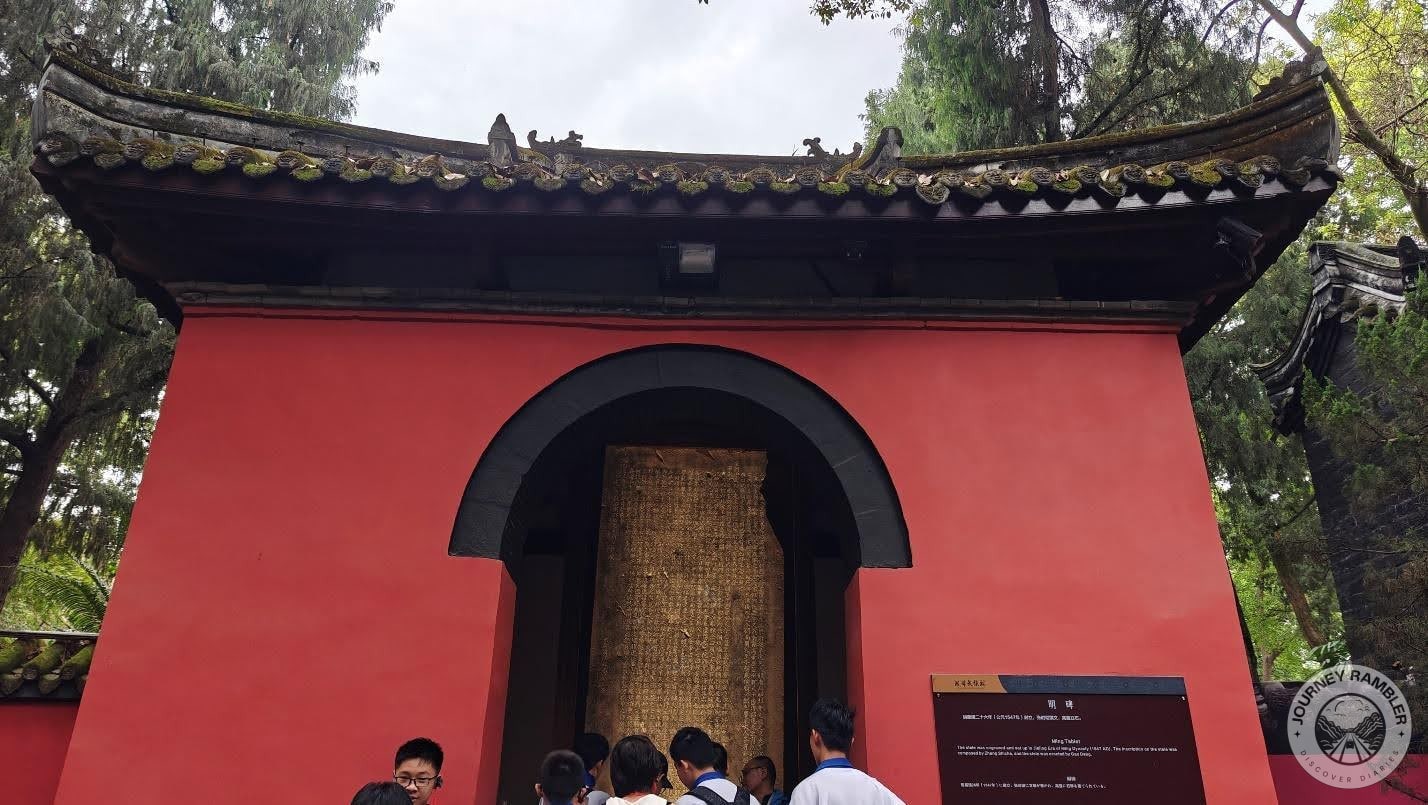
Much like the Tang Tablet, the Ming Tablet was housed in a shed/pavilion of its own. I will say though that it didn’t seem as busy as the previous attraction. Curious, I tried to wait for my turn to get inside.
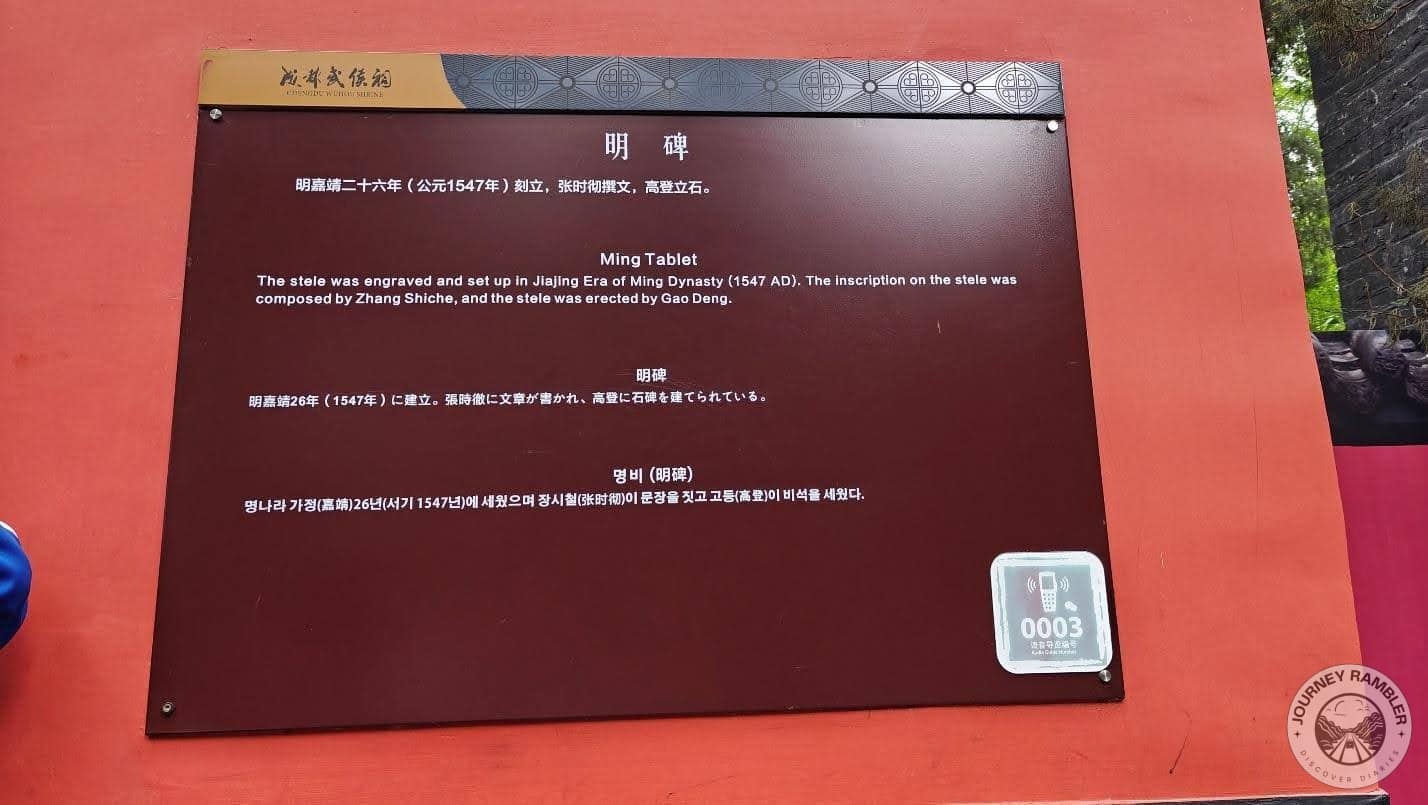
Outside, there was a sign “detailing” the tablet’s history. I ironically placed detailing in quotation marks because the details were really sparse. The description talks about when the tablet was made (1547 AD) as well as who wrote (Zhang Shiche) and erected (Gao Deng) it.
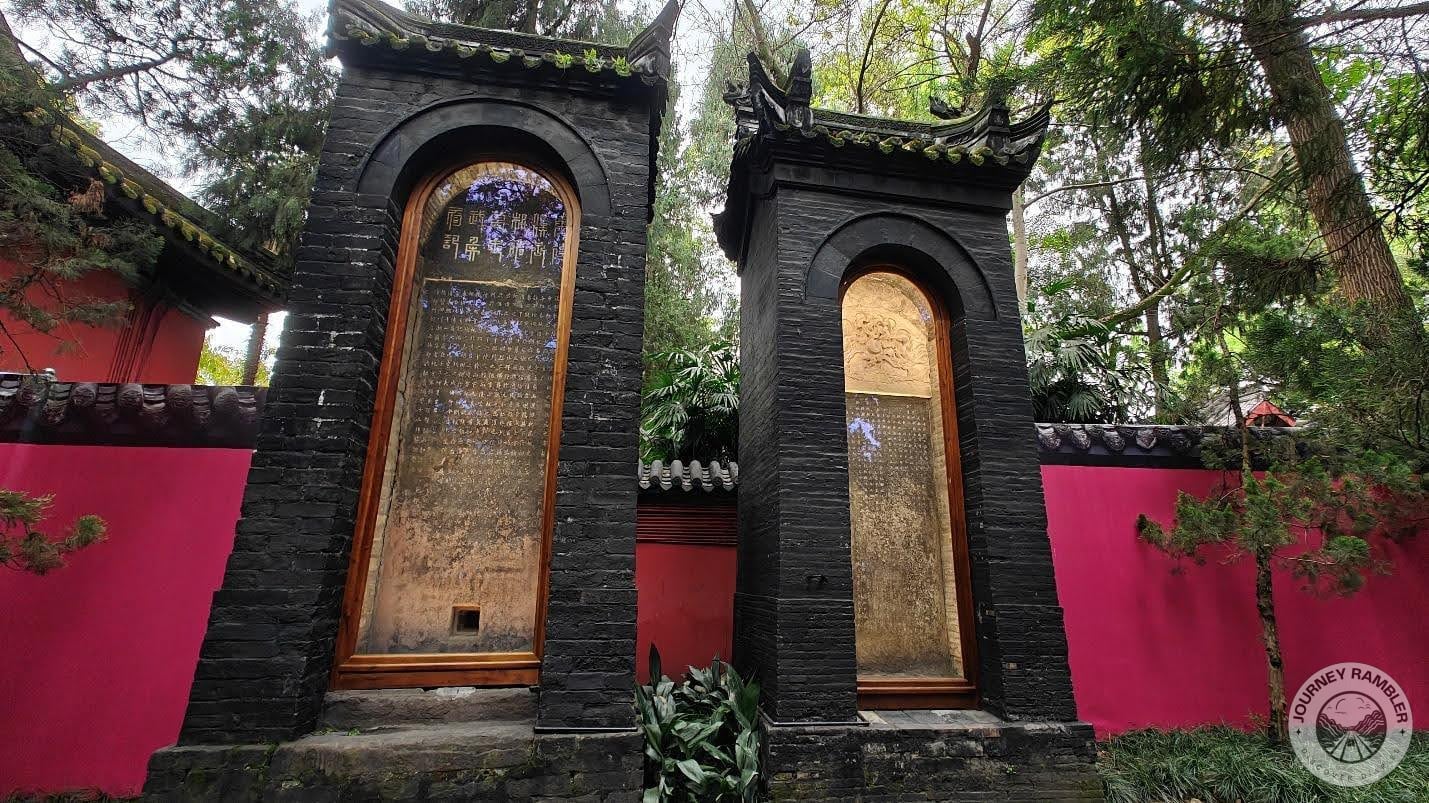
I’m not quite sure what’s written here but it mirrors the ones I found near the Tang Tablet. Much like those, these were also off to the side of the Ming Tablet’s pavilion/shed. I tried searching online but a lot of the sources and sites in English that I saw tend to confuse these with the Stele of Three Insuperabilities for some reason.
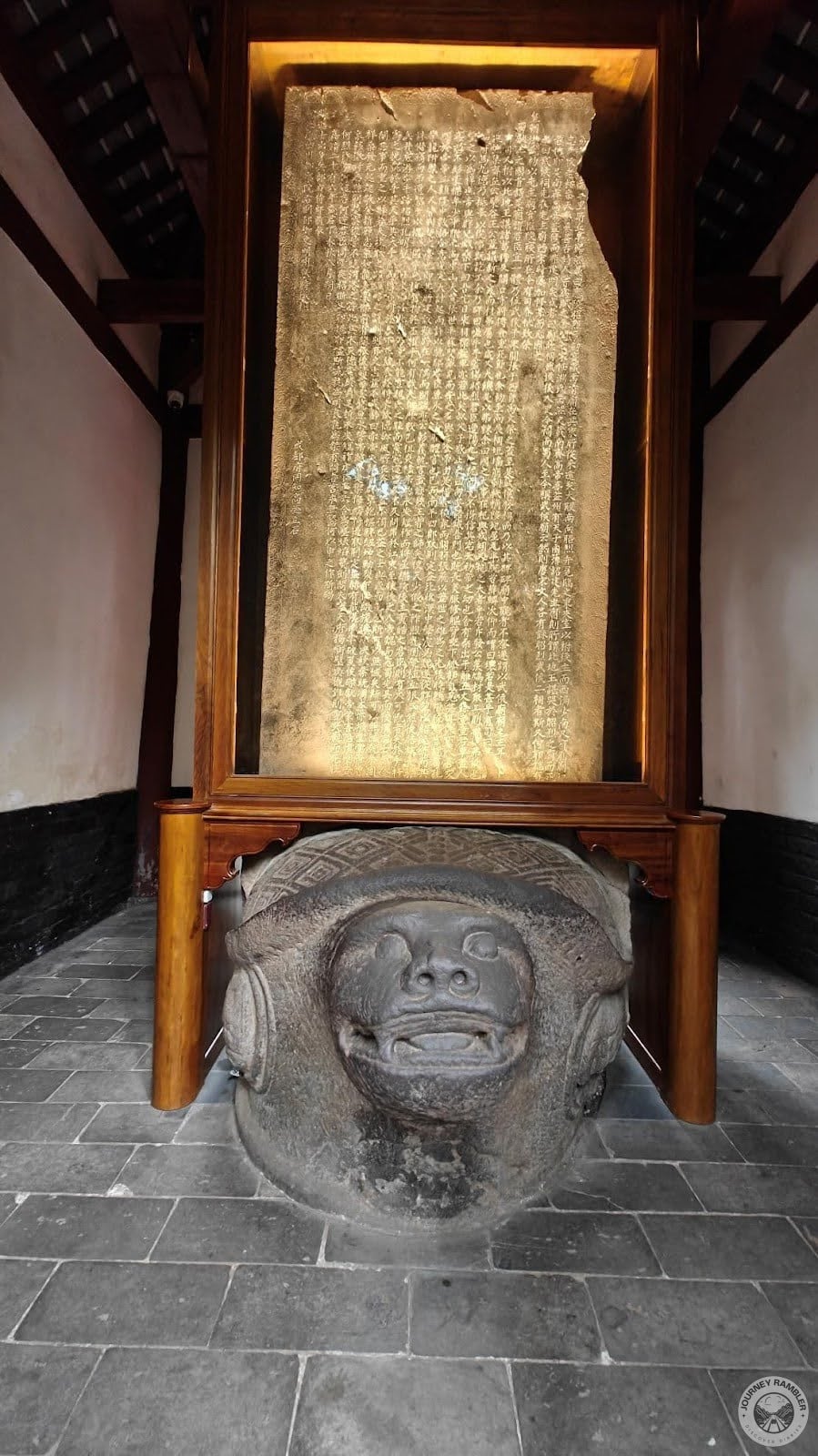
Here’s the Ming Tablet up close. It doesn’t look as well maintained as the Tang Tablet but it still looks impressive. What really caught my attention though is the sculpture/carving at its base. I’m not sure what animal this was but it definitely surprised me when I got inside.
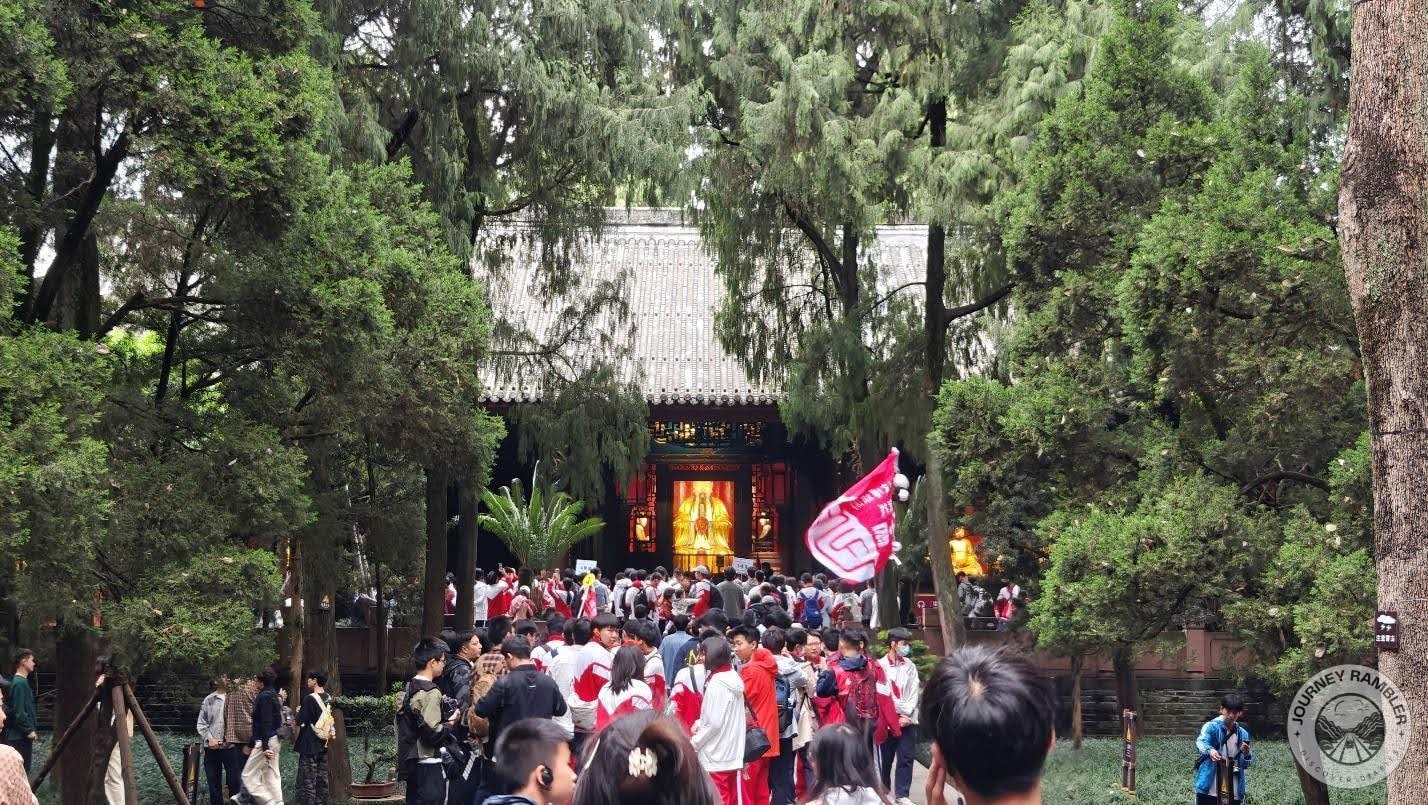
Here you can see Hanzhaolie Temple with the statue of Liu Bei seemingly glowing in the distance. As you’ve probably noticed there are plenty of people here and I noticed that the majority of them were school kids likely on a field trip since they had their uniforms on. From what I understand, this is actually a pretty tame crowd size and it could end up getting bigger with the holidays.
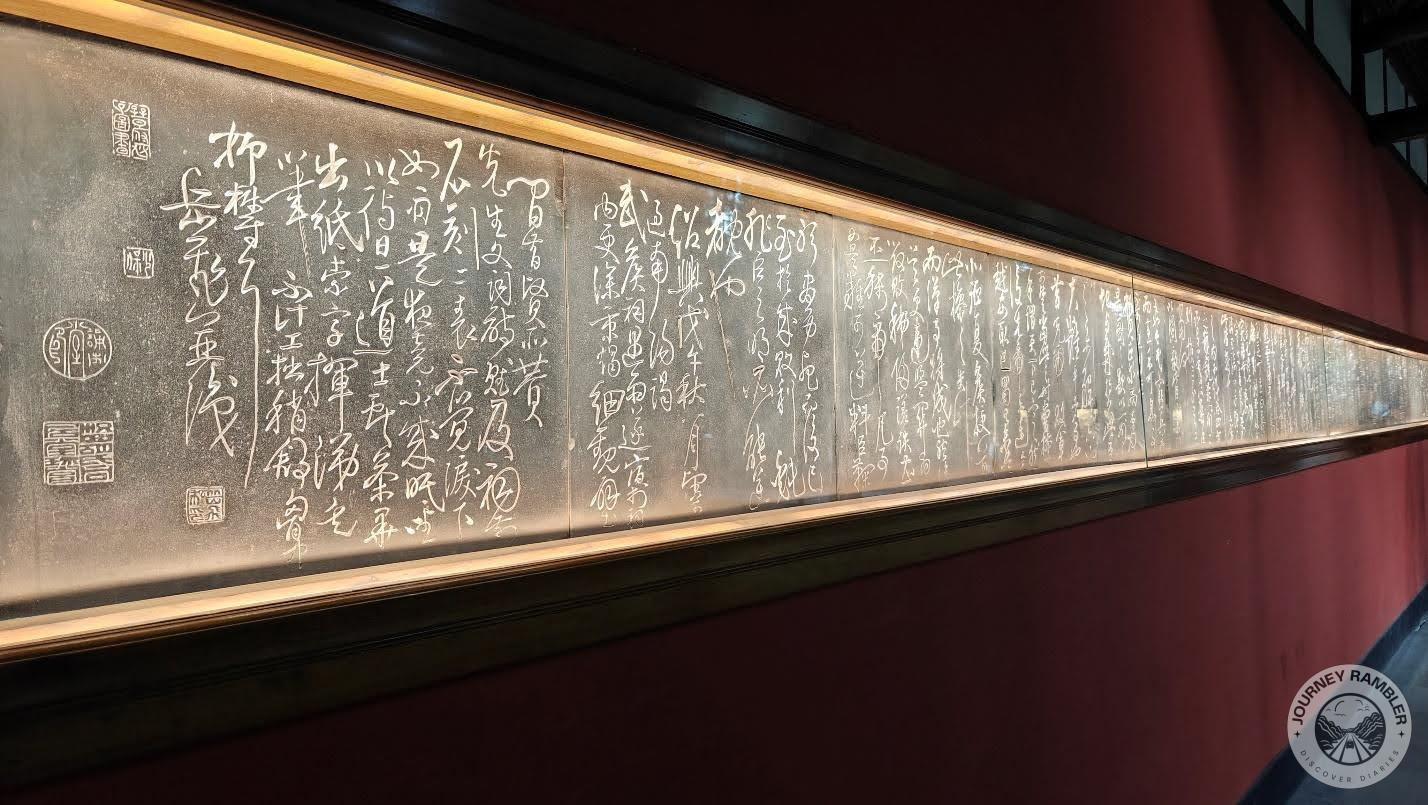
Before I got up close to the statue though, I explored the buildings/pavilions that comprised the Civil Officer Gallery. The text on this series of stele is calligraphy made by the Song Dynasty general Yue Fei though the content is from Zhuge Liang’s Chu Shi Biao. If you’re wondering why a general is doing calligraphy, it’s actually a discipline that’s closely related and complementary to the martial arts.
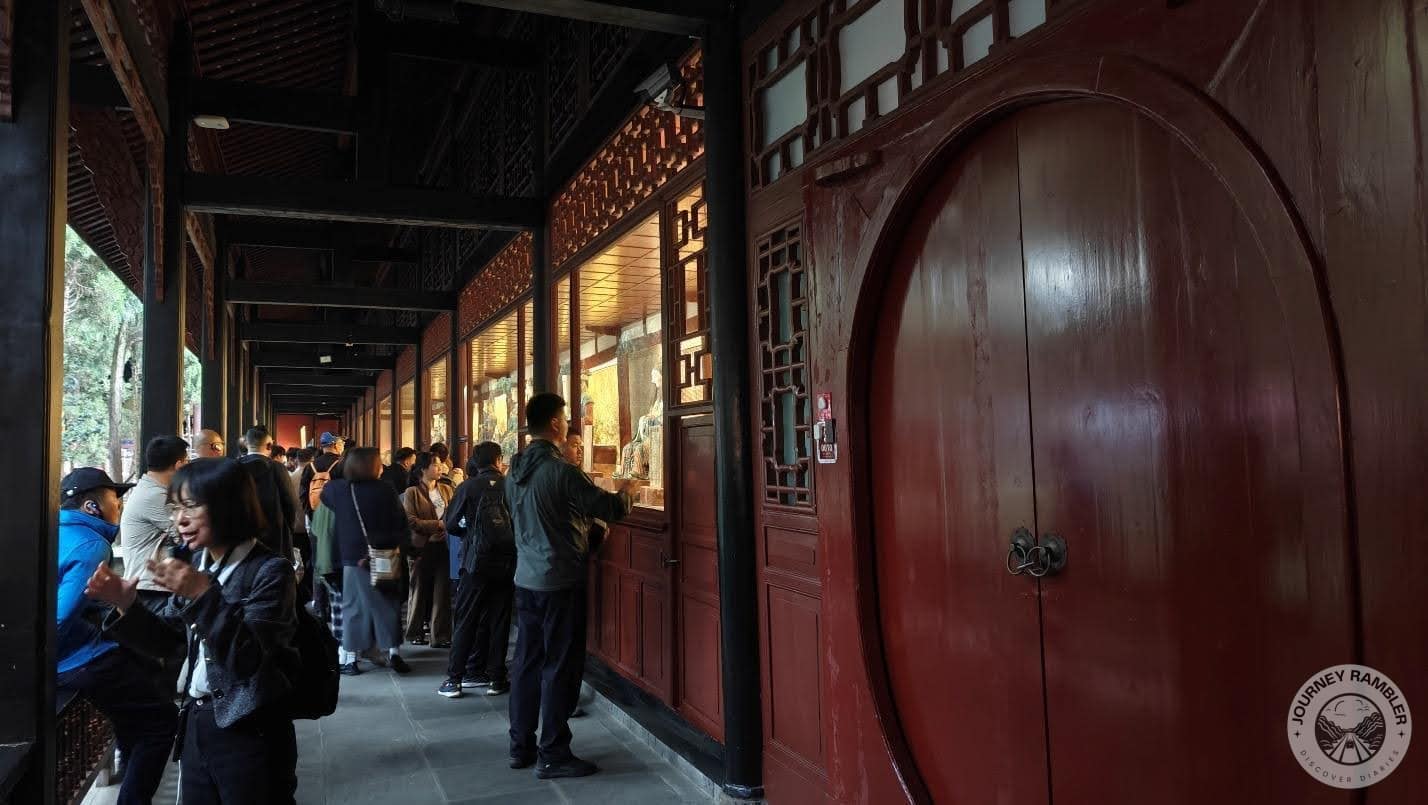
So this is the Civil and Military Officer Gallery. As its name implies, it’s a corridor with displays of the statues of the government officials in Liu Bei’s Shu Han Kingdom. If you’re familiar with the Romance of the Three Kingdoms then you’ll probably recognize them as they’re also featured in the novel.
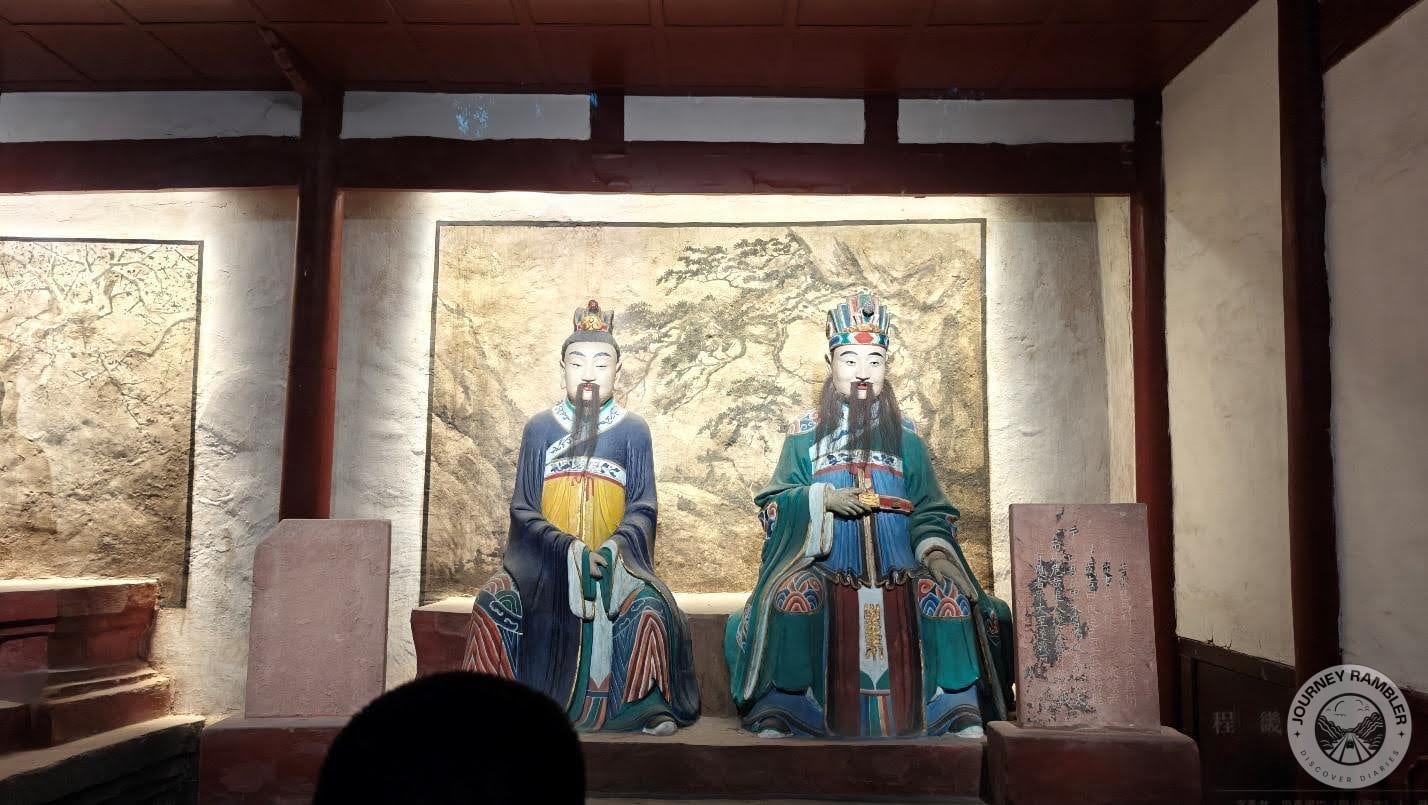
These were the first two officials that I came across. On the left is Ma Liang and beside him is Cheng Ji. The statues here were made back in the mid-1800s during the time of the Qing/Manchus. Despite their age, they kind of look fairly new which is probably a testament to the maintenance done here by the shrine’s caretakers.
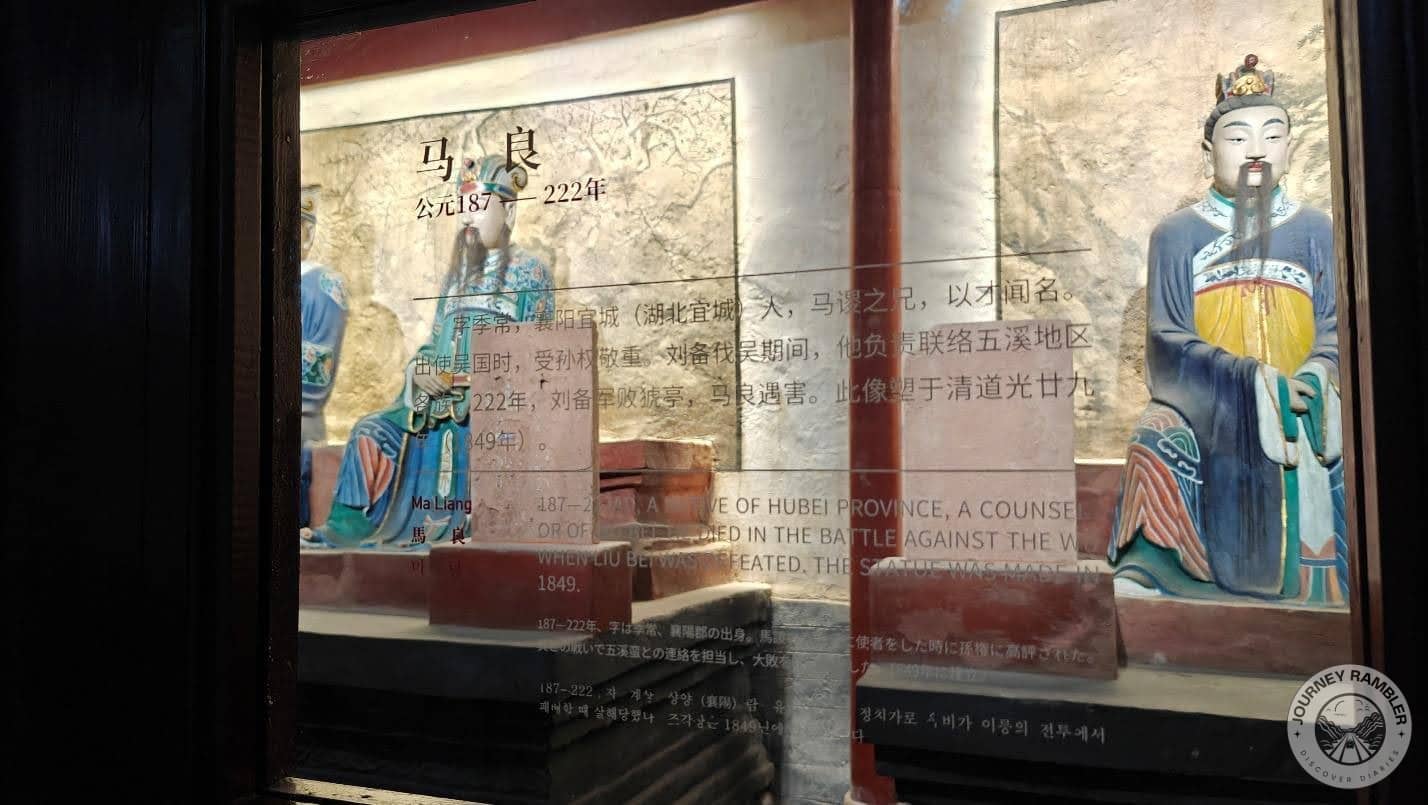
On the glass, there are inscriptions in Chinese, English, Japanese, and Korean of the officials’ histories and notable accomplishments. In this image you can (sort of) see the summary for Ma Liang (the rightmost sculpture in the background). It describes him as a Native of Hubei who counseled Liu Bei and died during his liege’s defeat against Sun Quan and the state of Wu.
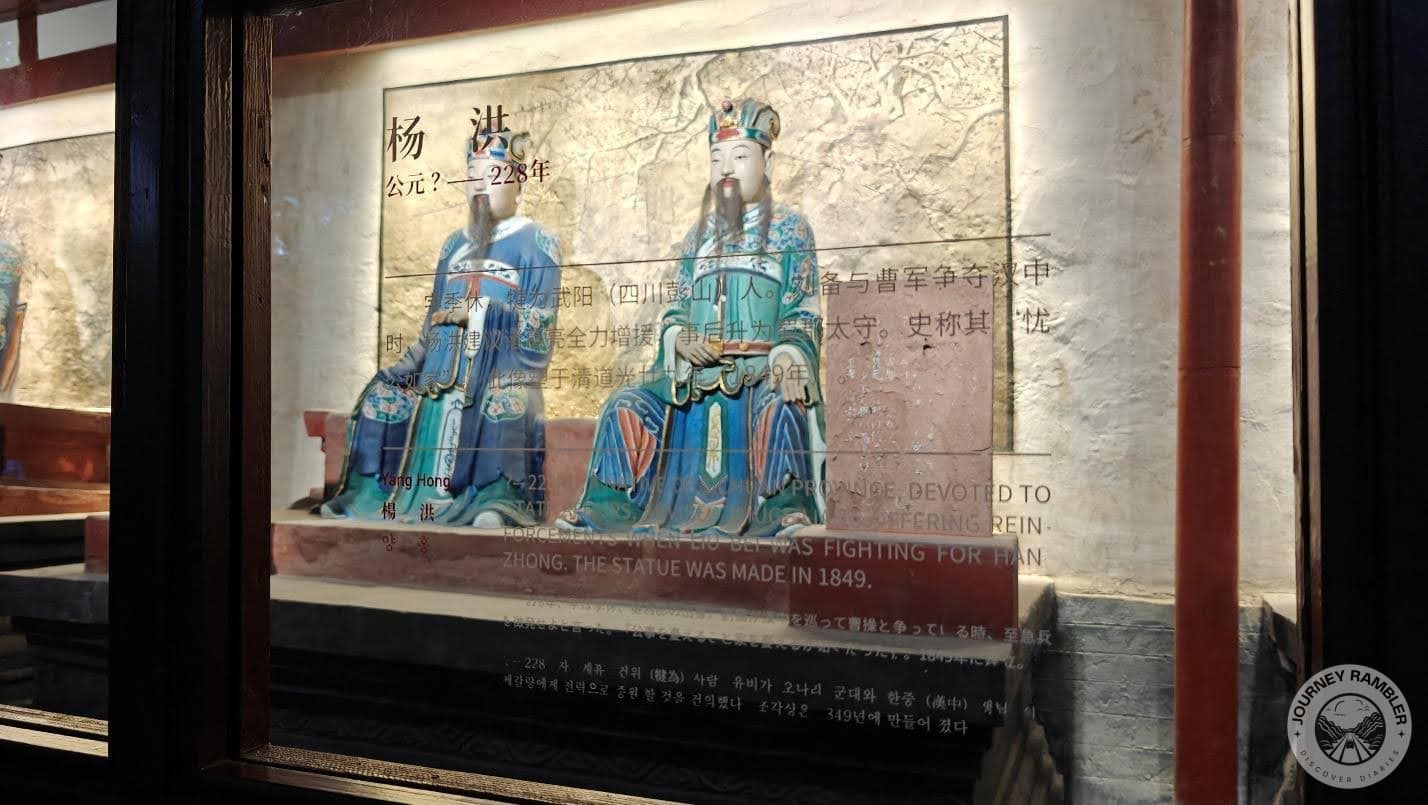
This is the description for Yang Hong (right sculpture in the background). Much like Ma Liang, he was also an official of Shu. His expertise was in state affairs and he also advised Zhuge Liang when it came to offering reinforcements to Liu Bei when he campaigned against Cao Cao in Han Zhong.
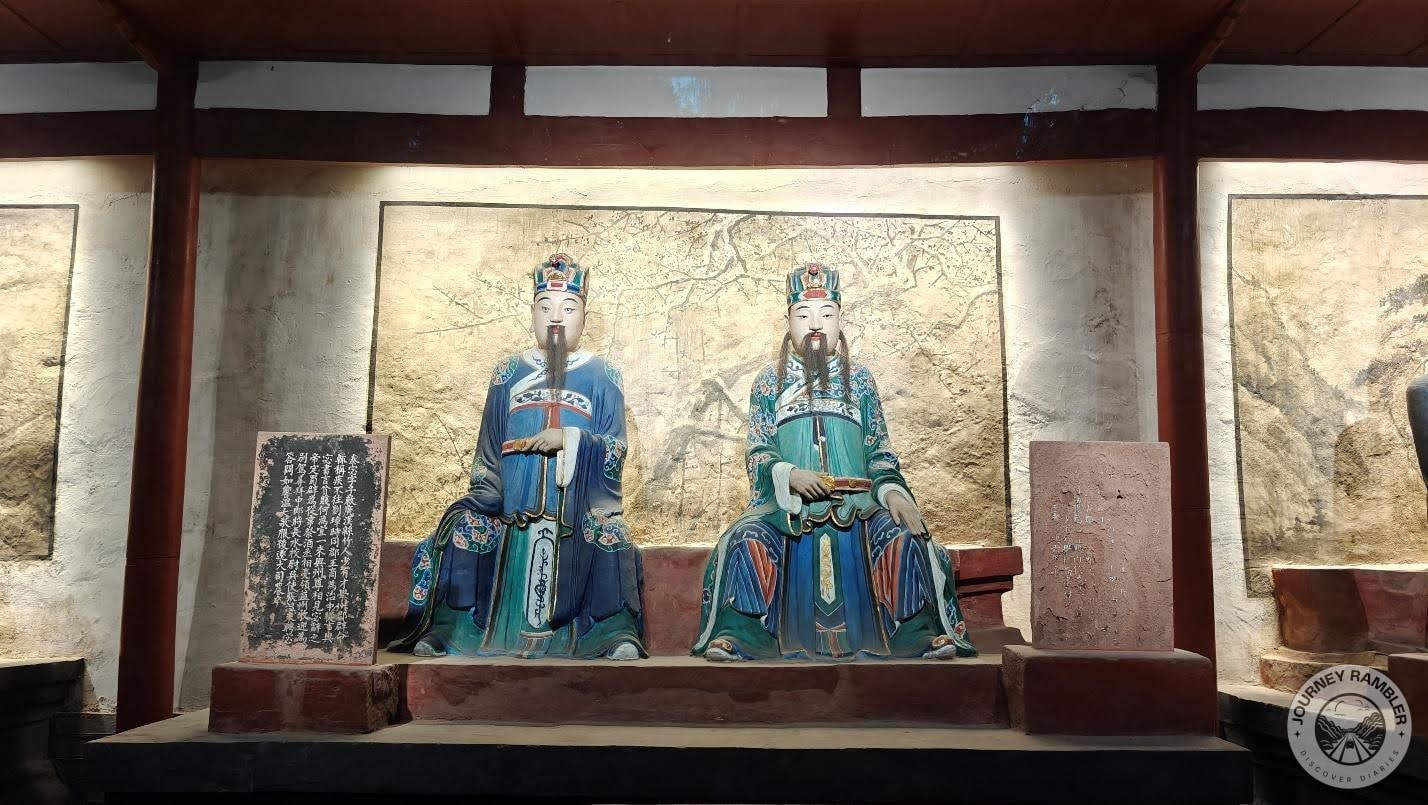
Here you’ll see Qin Mi on the left and Yang Hong beside him. I will say, it can be hard identifying some of these sculptures without the descriptions on the glass. A lot of the sculptures look the same and oftentimes their only identifying features are their hand placement and the clothes they’re wearing.
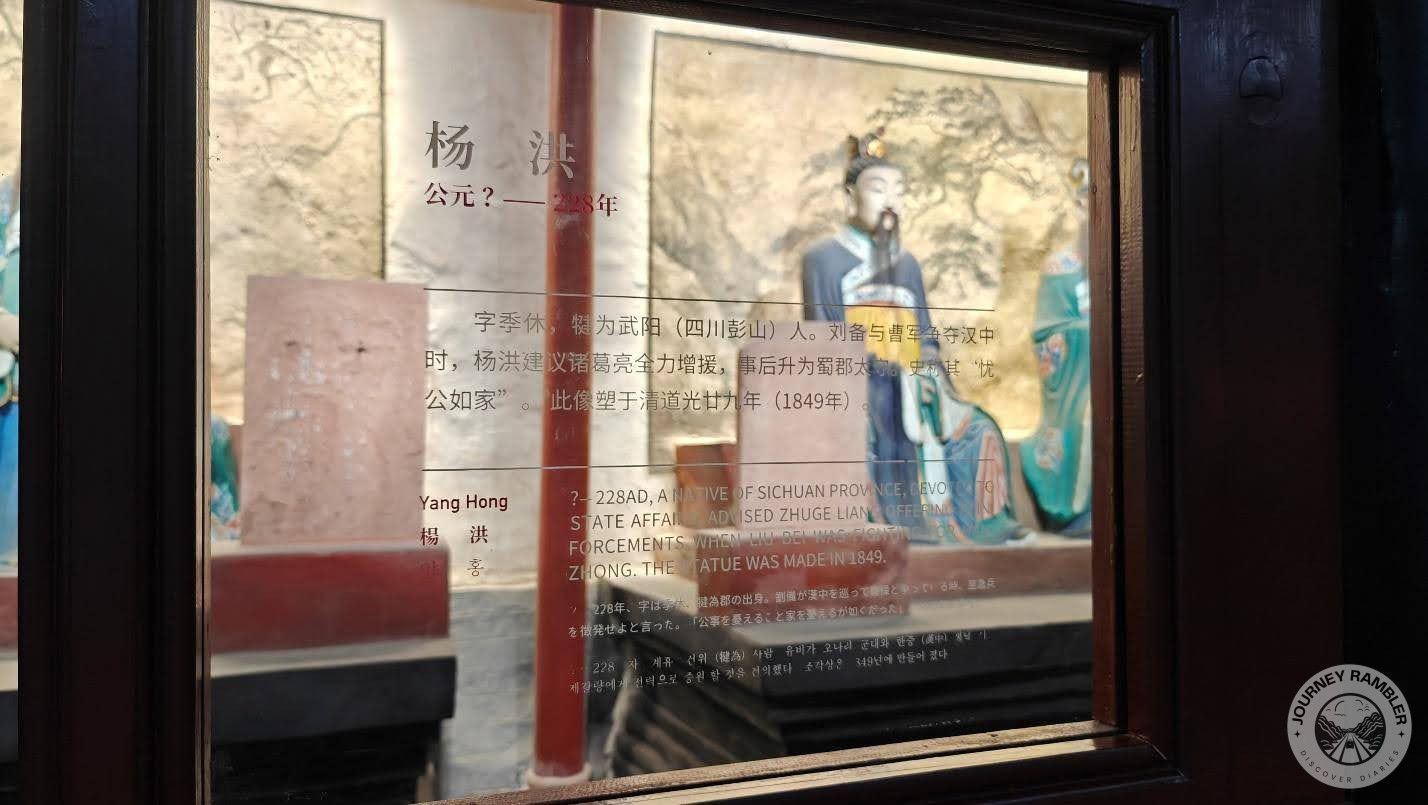
Anyway, here’s another look at Yang Hong’s inscription on the glass. You’ll also notice in the background the sculpture of Ma Liang from earlier. On a side note, I really liked how detailed the clothes here are and they kind of give each sculpture some much needed character.
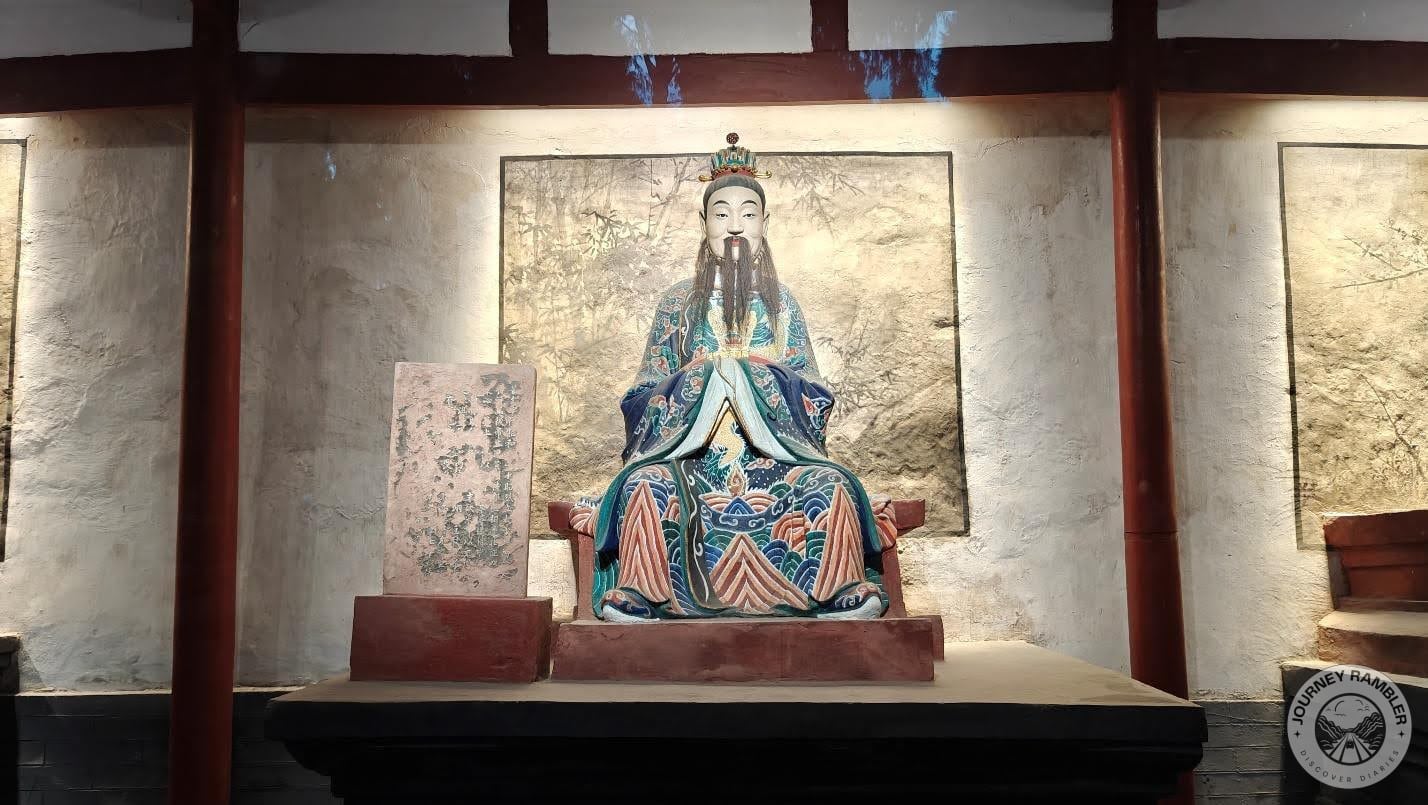
This next sculpture is of Dong Yun. Interestingly enough, his sculpture actually looks kind of similar to that of another civil officer that’s also here called Lu Kai. Honestly, if it wasn’t for the Lu Kai sculpture having its hand out I wouldn’t have been able to differentiate between the two.
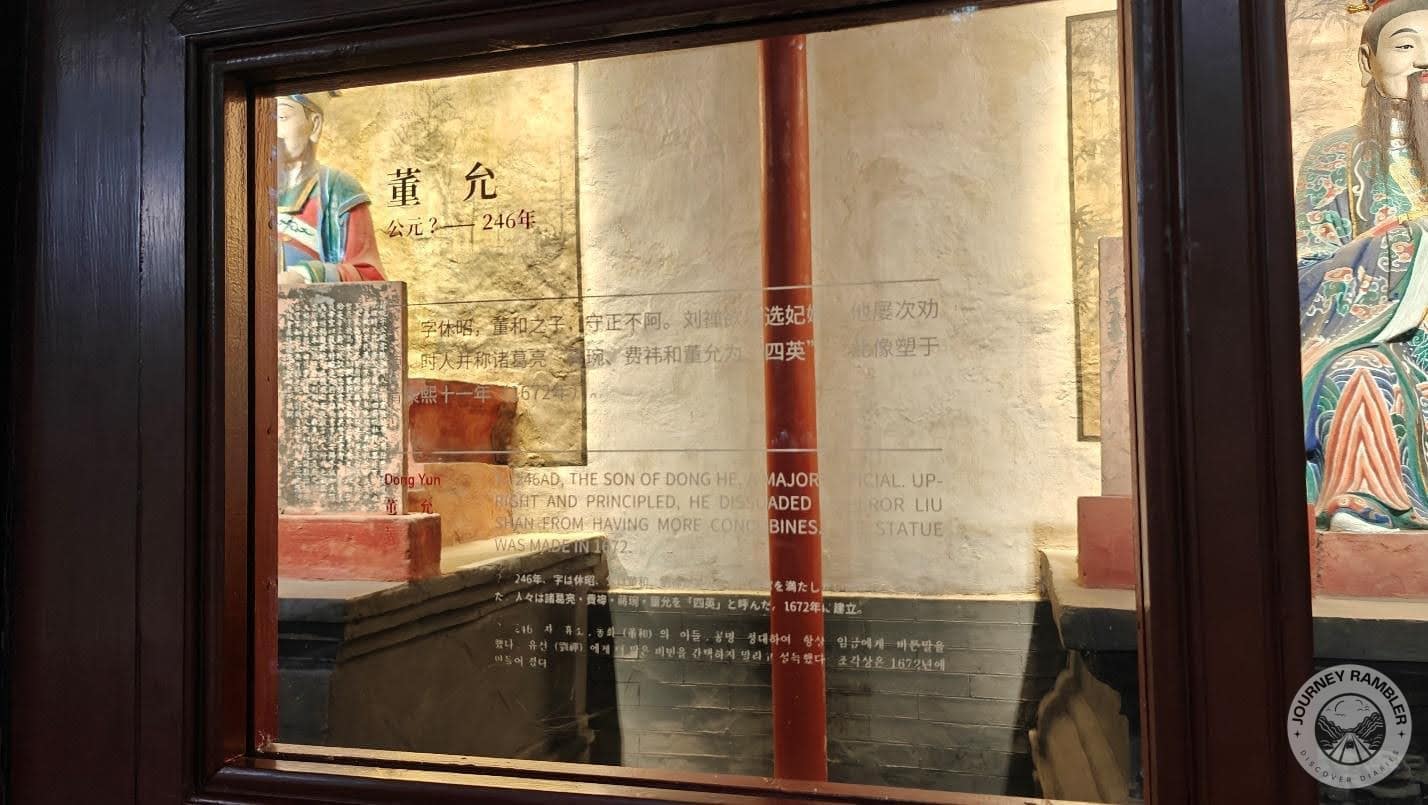
Anyway, here’s a short summary and history of Dong Yun. It seems like he was a powerful figure in the Shu Han court as he was able to dissuade Emperor Liu Shan (Liu Bei’s son and successor) from taking more concubines. Considering how powerful the concubines became later in China’s history, his advice showed a lot of forethought and wisdom.
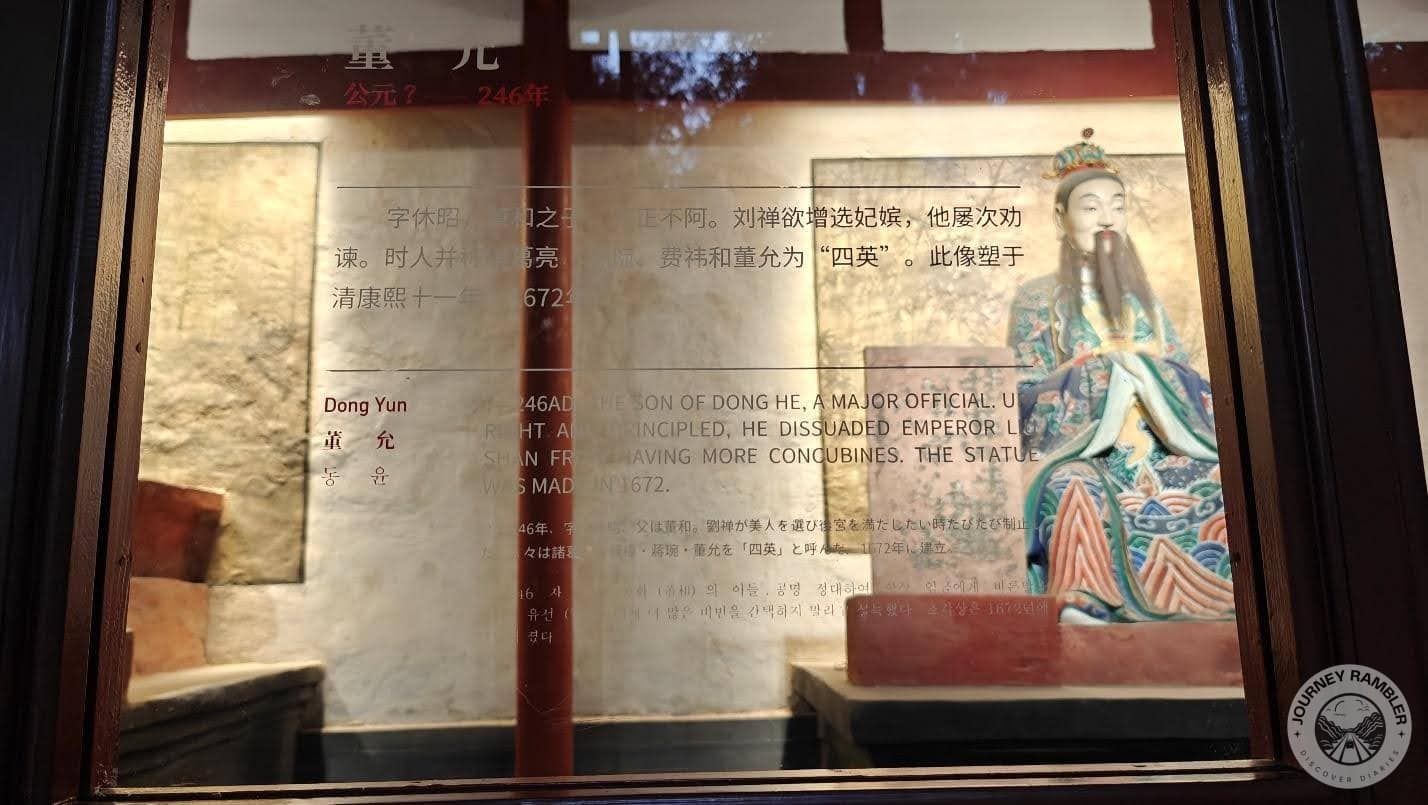
As for his role in The Romance of the Three Kingdoms, Dong Yun was recognized as one of the stabilizers of the Shu Han Kingdom after Zhuge Liang’s death. He was instrumental in opposing a eunuch named Huang Hao who was trying to influence the young Liu Shan as he ascended the throne following his father’s death.
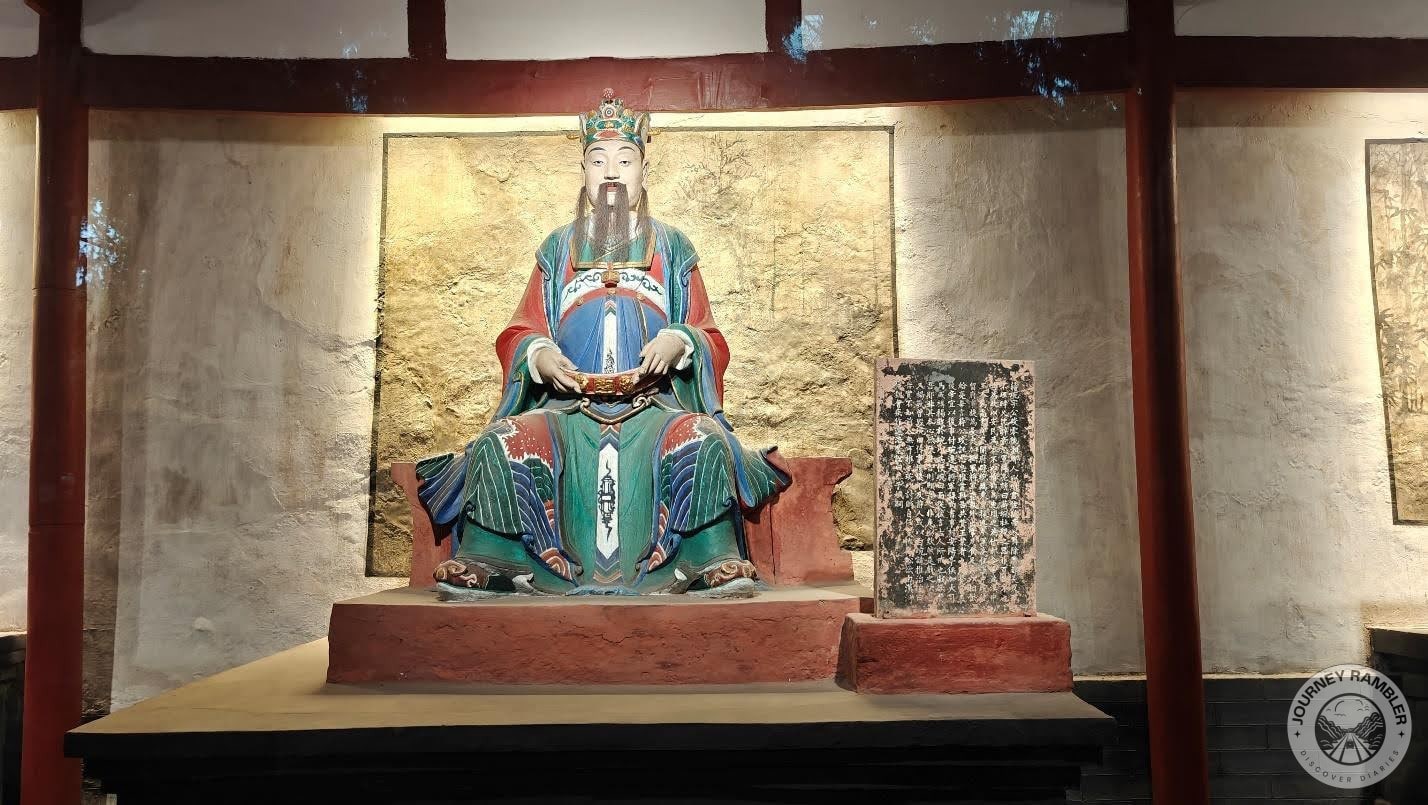
The other contemporary of Dong Yun who helped stabilize Shu Han was Jiang Wan. Shown here, he also looks similar to Dong Yun with the difference between them being that both his hands are shown. Perhaps the reason for this similarity is that both statues were made at roughly the same time (in 1672).
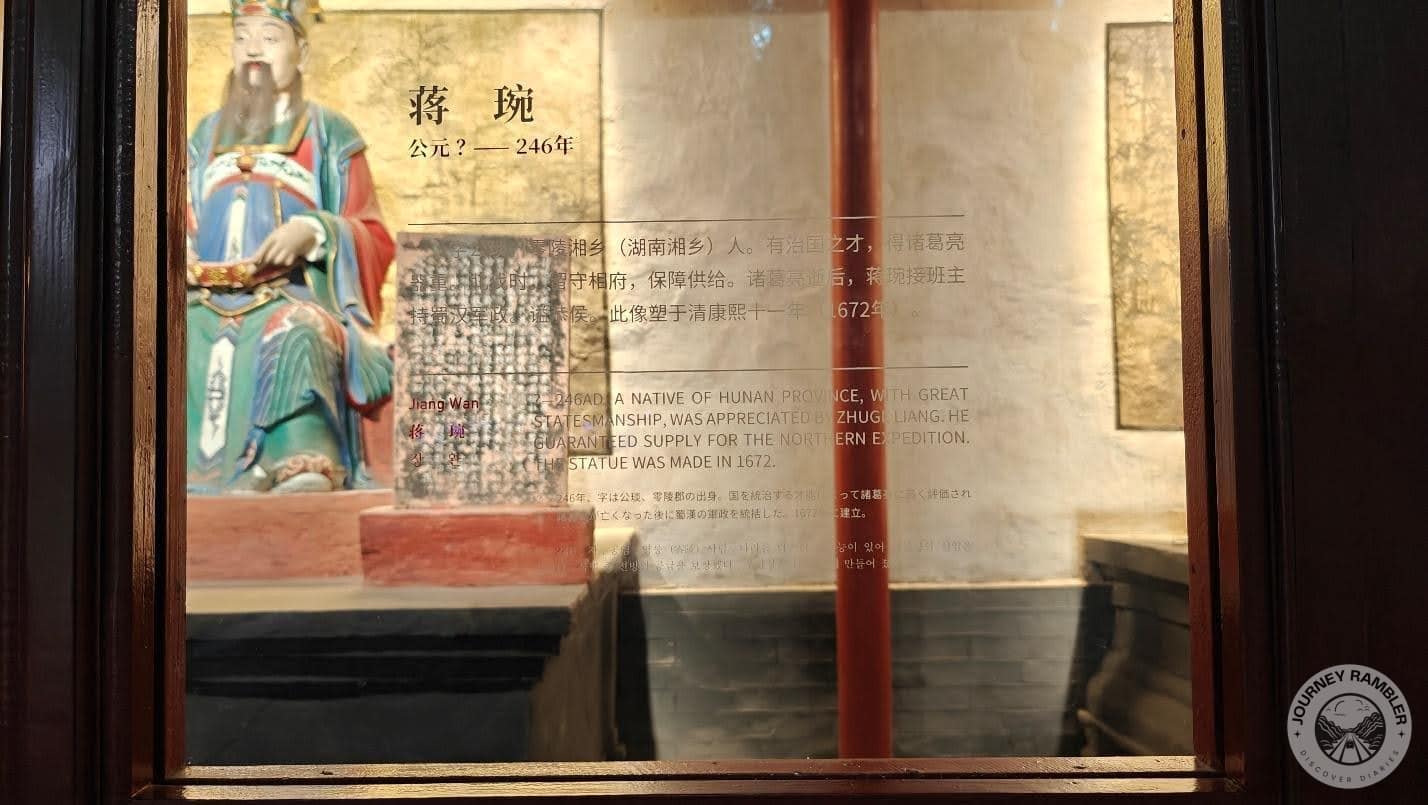
Jiang Wan was older than Dong Yun and initially, he held more responsibilities as the primary regent. As his health declined, he ceded more of his responsibilities to Dong Yun and Fei Yi who were both his deputies. Interestingly enough, both him and Dong Yun actually died in the same year (246 AD).
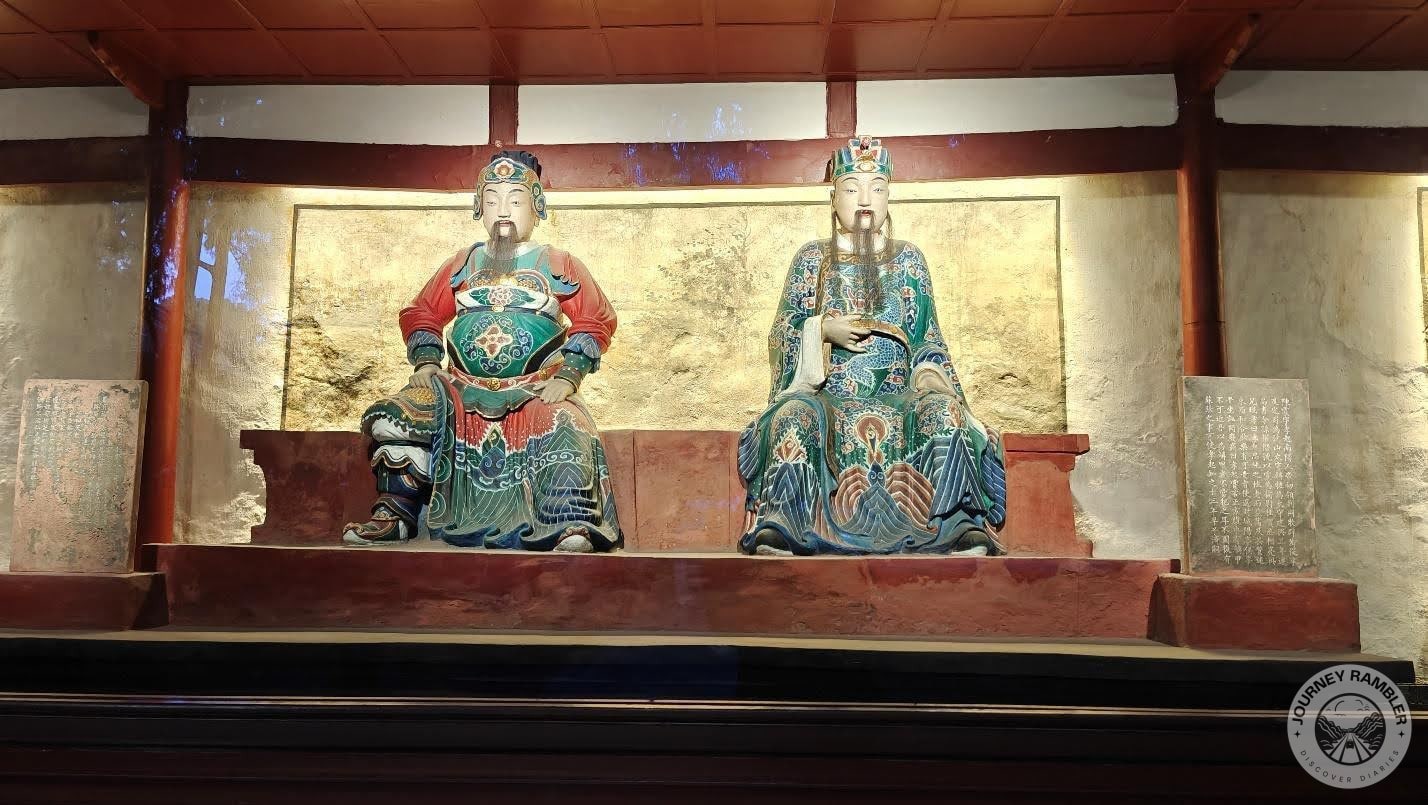
This pair of statues is of Deng Zhi (left) and Chen Zhen (right). Both served Liu Bei and Shu Han even before Jiang Wan. Deng Zhi actually served as a general though he’s more known for his diplomatic efforts in re-establishing an alliance with Eastern Wu just after Liu Bei died.
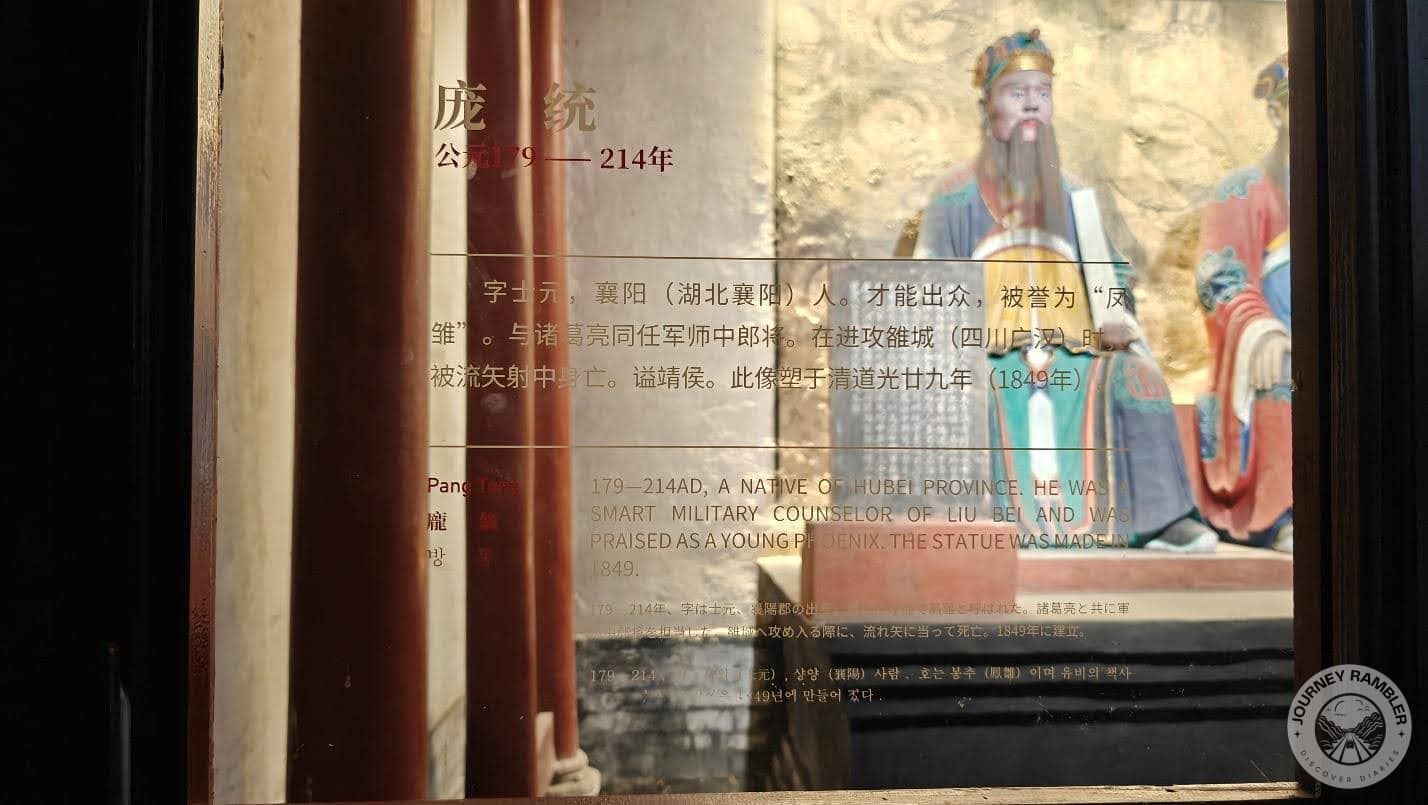
This is a description for Pang Tong represented by the statue in the background. He was actually sort of an equal to Zhuge Liang as he also served as Liu Bei’s military adviser general. Unfortunately, he was killed by a stray arrow during Liu Bei’s Yi Province campaign.
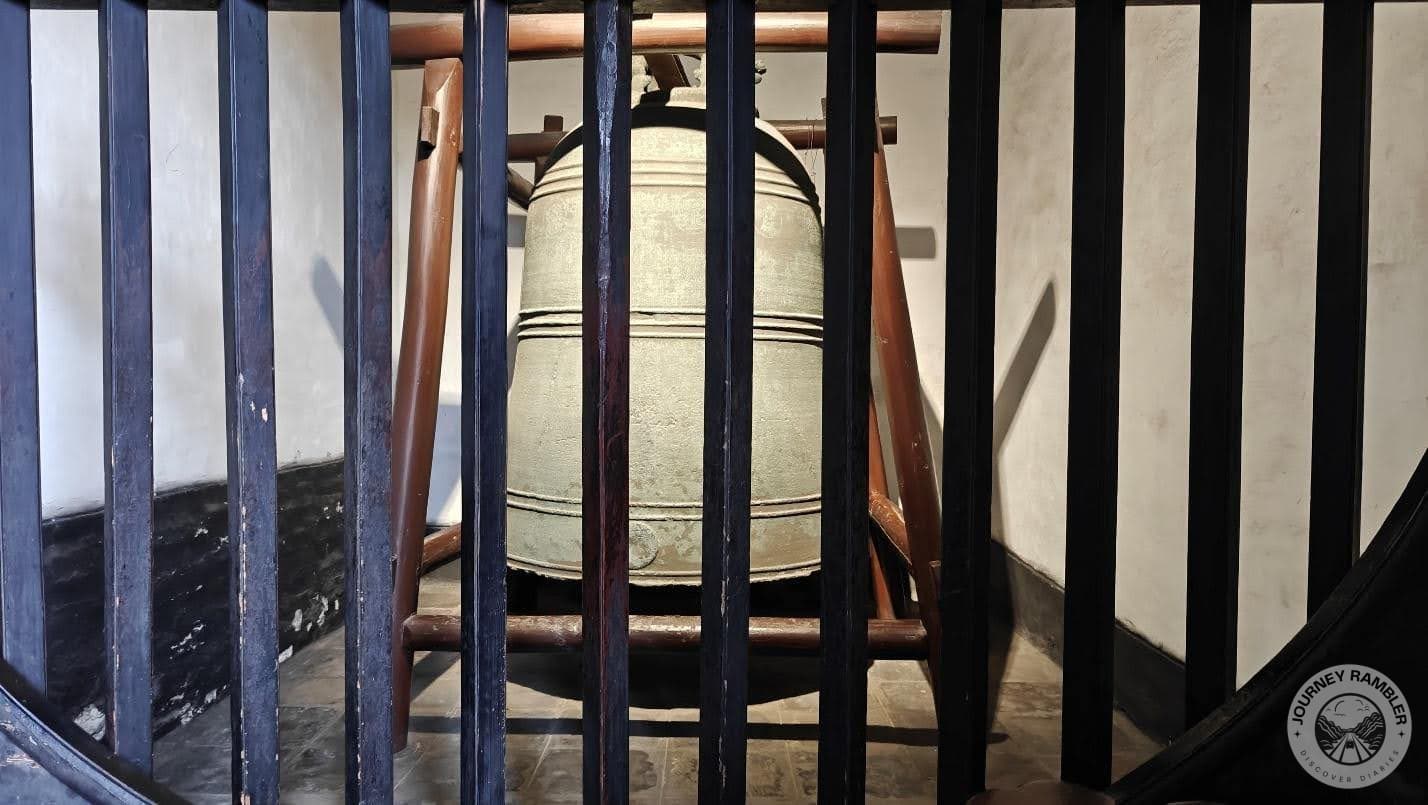
Now I’m not sure what the significance of this bell is but it does remind me of the bonsho (or temple bells) that I saw at the temples and shrines I visited in Japan. Unlike those though, I don’t think this is being used anymore. Moreover, this also looks like it’s much older though still well maintained.
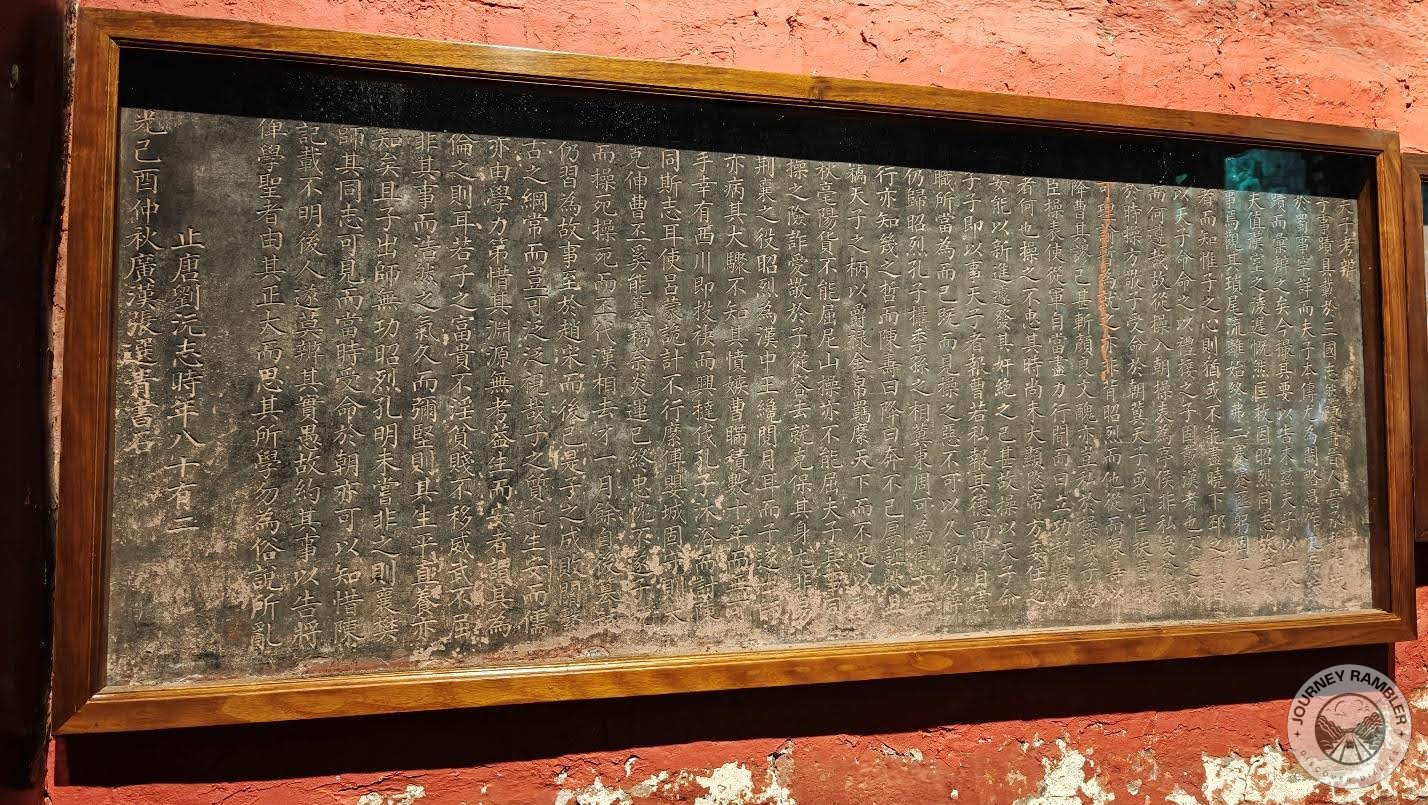
Other notable relics that you’ll find here include this stone tablet that I unfortunately was unable to fully decipher with Google Lens. From what little my app was able to translate, it would seem like this is talking about Liu Bei, Cao Cao, and Sun Quan. As for the author, it only really mentions that it was written on stone by someone named Biao Genggui of Guanghan.
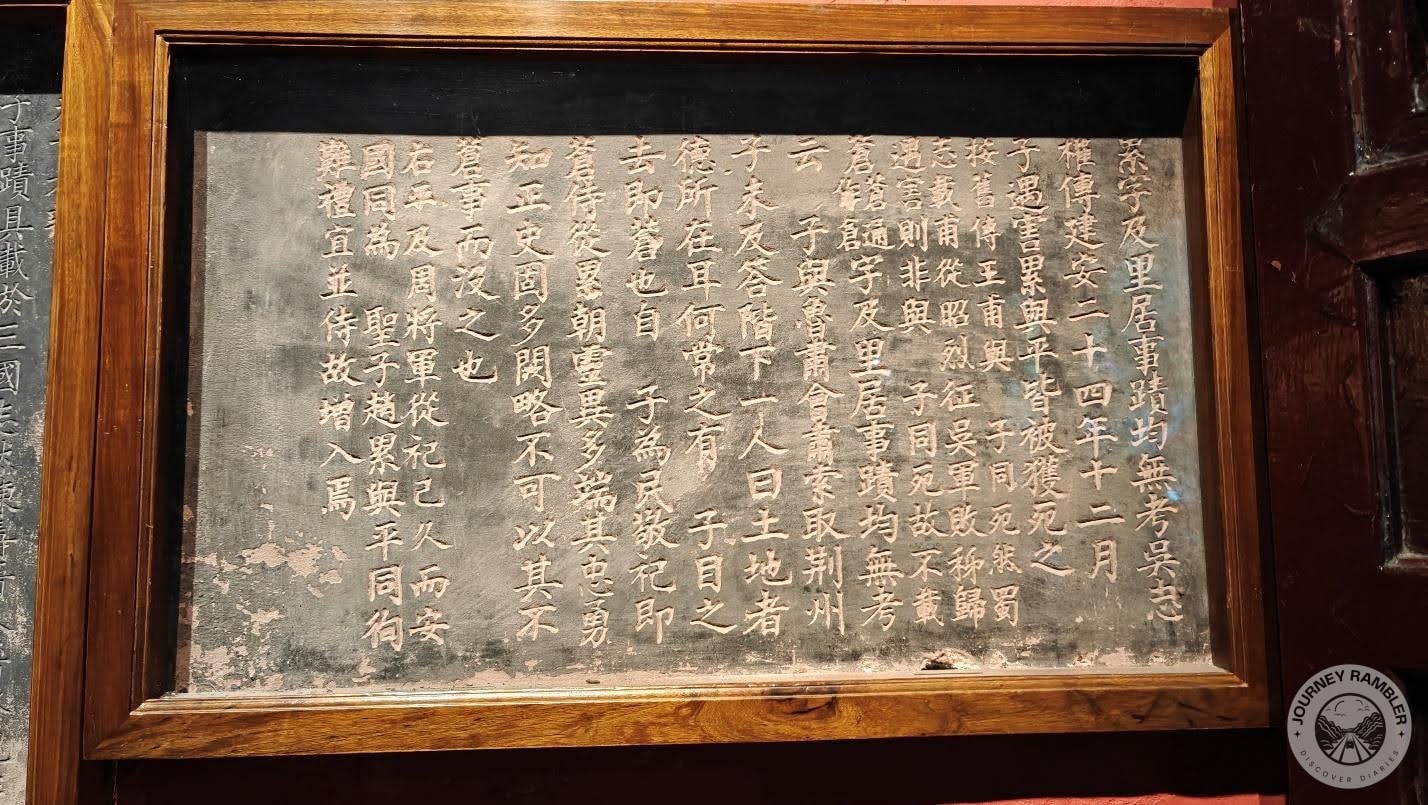
Here’s a smaller tablet that talks about Guan Yu, Wang Fu, and Zhou Cang. Specifically, it talks about historical facts and how some legends about these figures lack evidence.
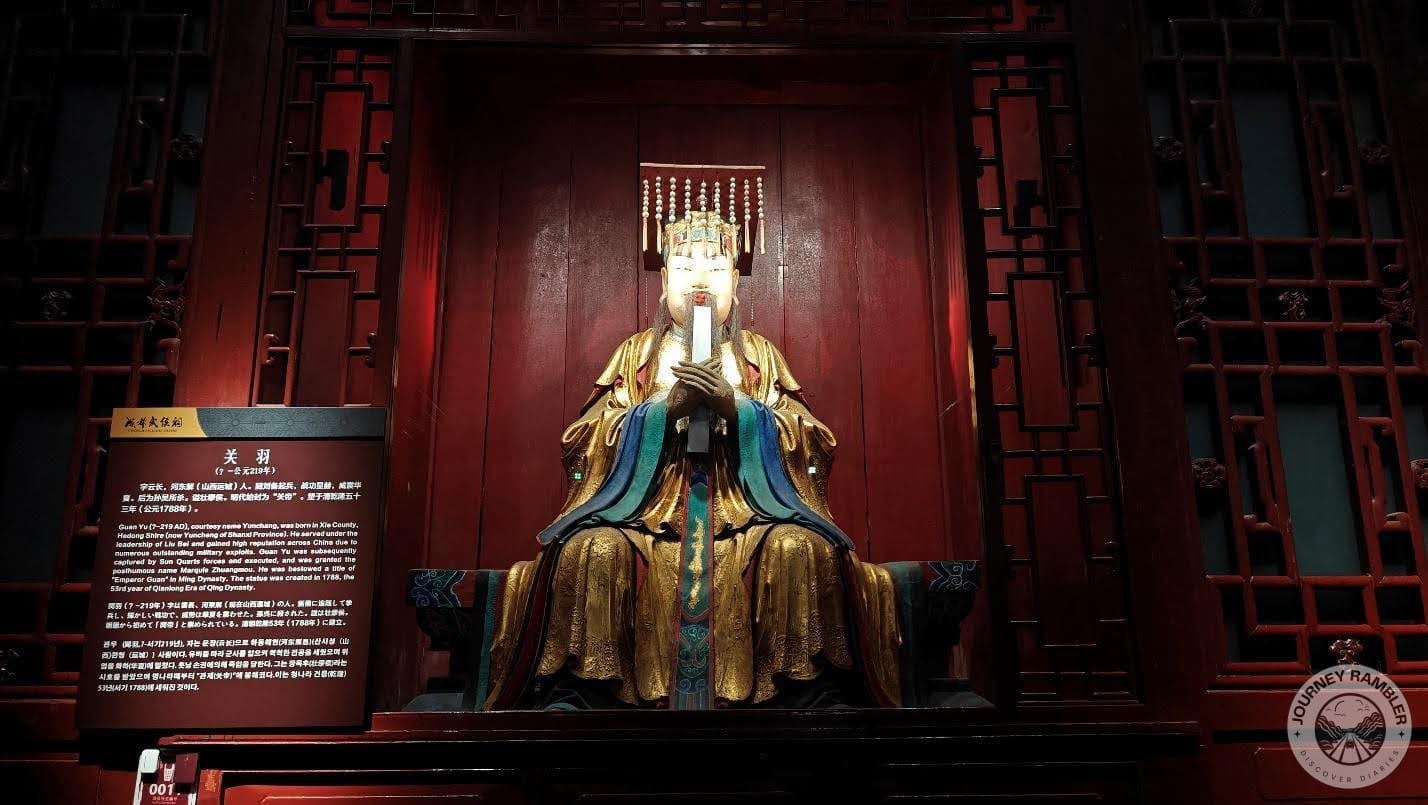
Speaking of Guan Yu, here’s his statue. I must say, he looks a little less fierce than how he’s usually portrayed in modern media. If you’ve ever played Dynasty Warriors then the difference between this statue and his depiction in that game is like night and day.
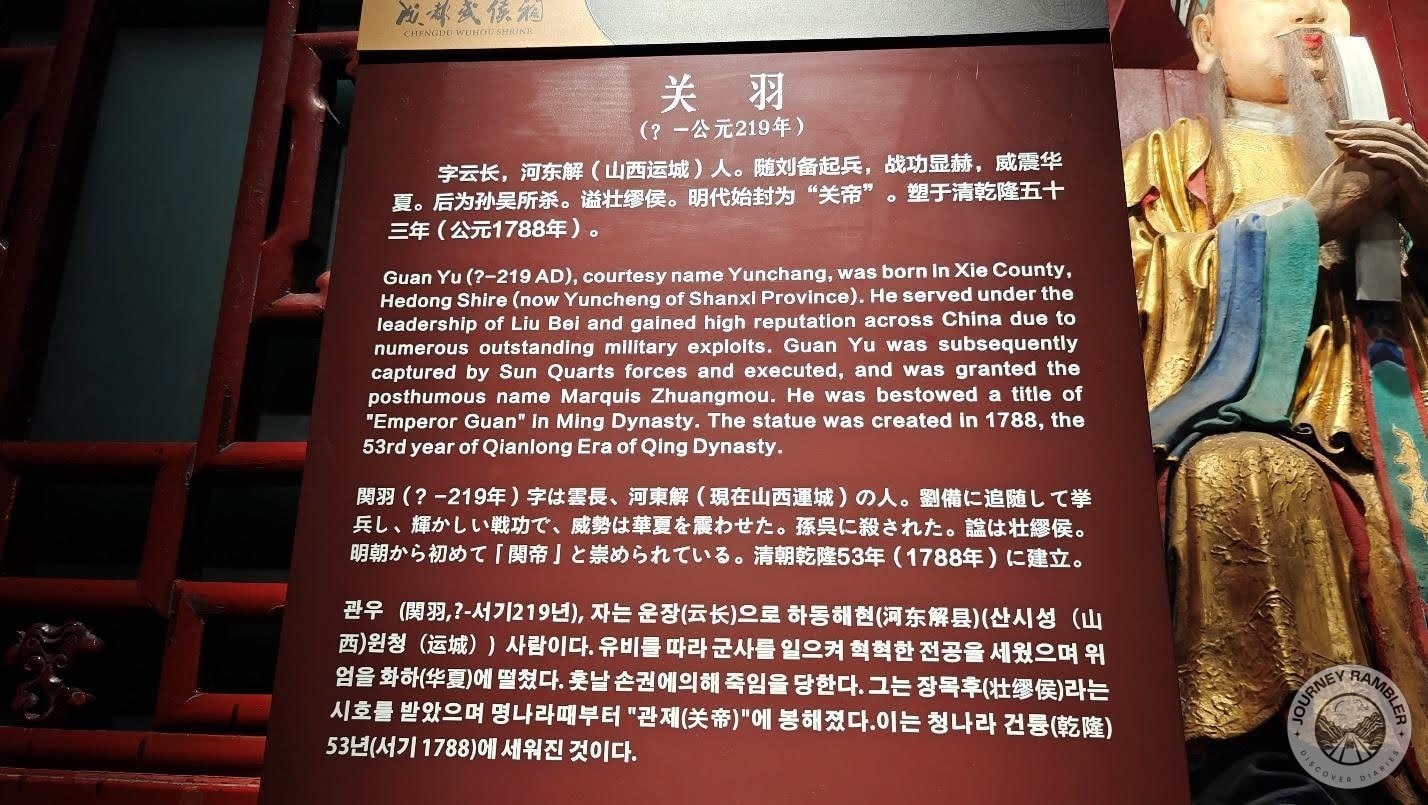
Here’s a much more detailed description of Guan Yu’s life. He was a brilliant general who served under Liu Bei and was known for two core Chinese cultural virtues: Loyalty and Righteousness. Together with Liu Bei and Zhang Fei, they formed the Three Sworn Brothers which as you probably read earlier has its own dedicated temple/hall here in the Wuhou Shrine complex.
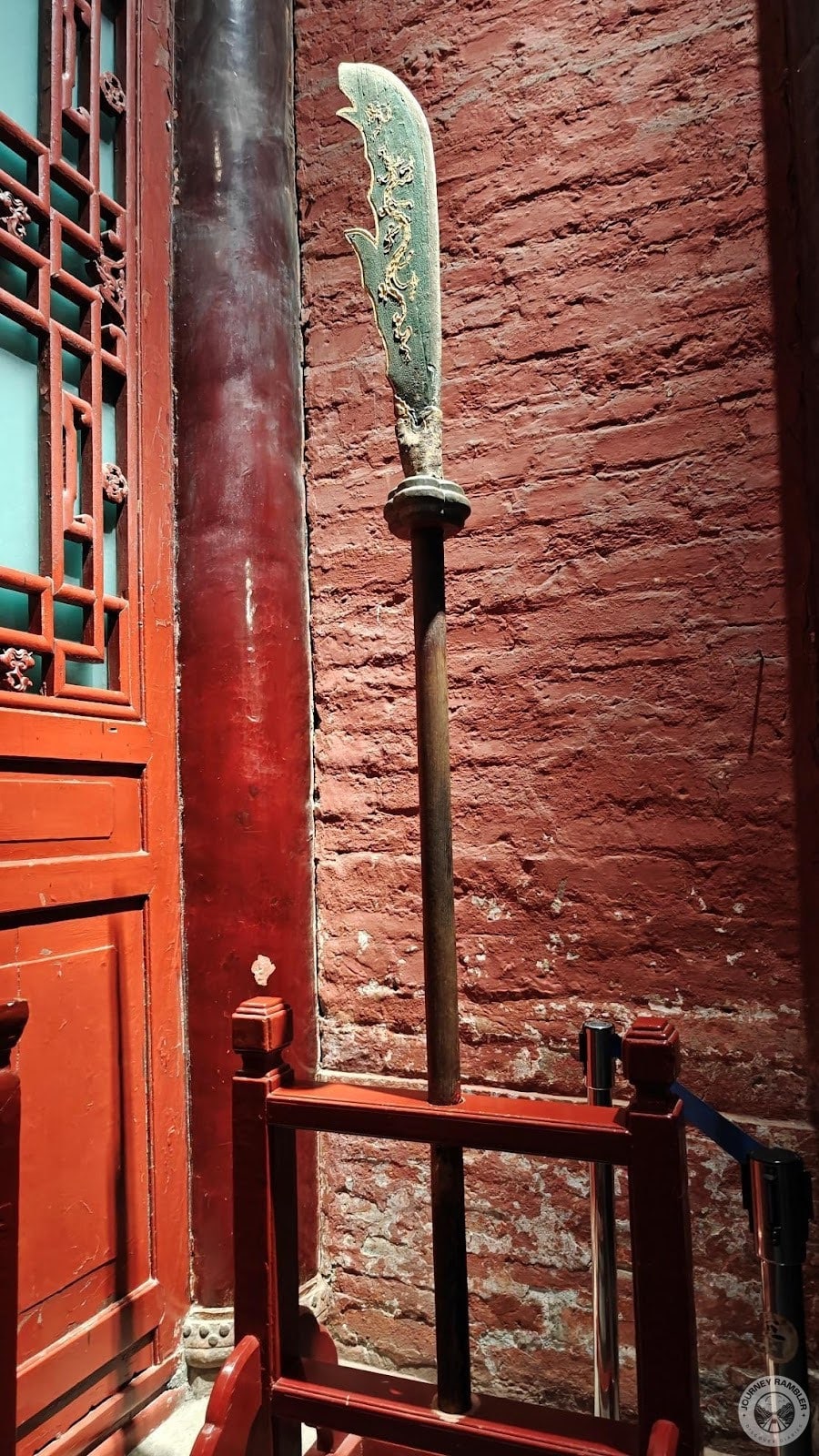
Perhaps as famous as Guan Yu is his signature weapon which is called the Green Crescent Dragon Blade (such a cool name!) and is also displayed here. This type of weapon is called a Guandao and it unsurprisingly got this name from Guan Yu (it translates to General Guan’s blade). Now I’m not quite sure if this is the real deal but it’s still cool to see nonetheless.
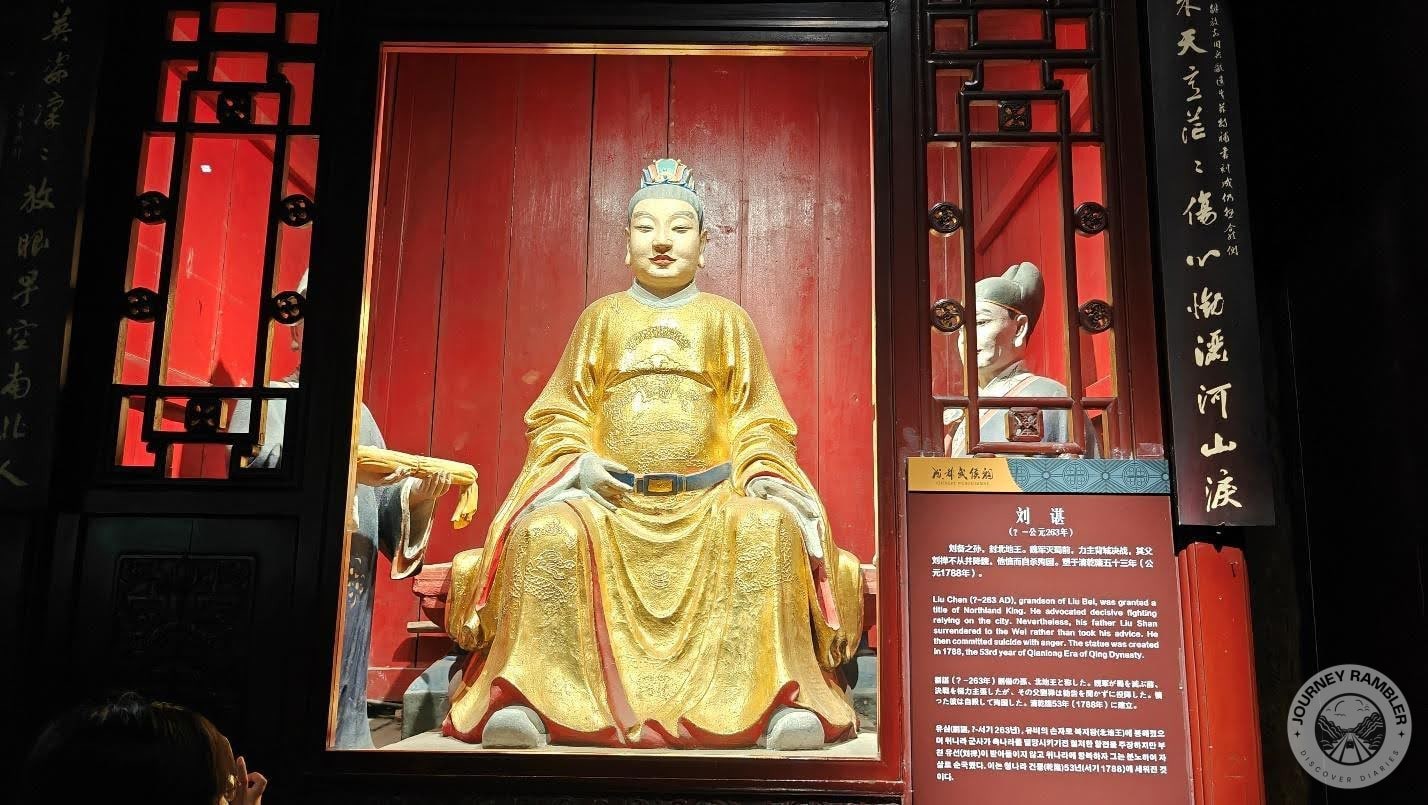
This is a statue of Liu Chen who probably has one of the more tragic fates in the Romance of the Three Kingdoms. You’ll notice that his is one of the few statues of Shu Han officials depicted without a beard. This is likely because he was quite young when he met his demise.
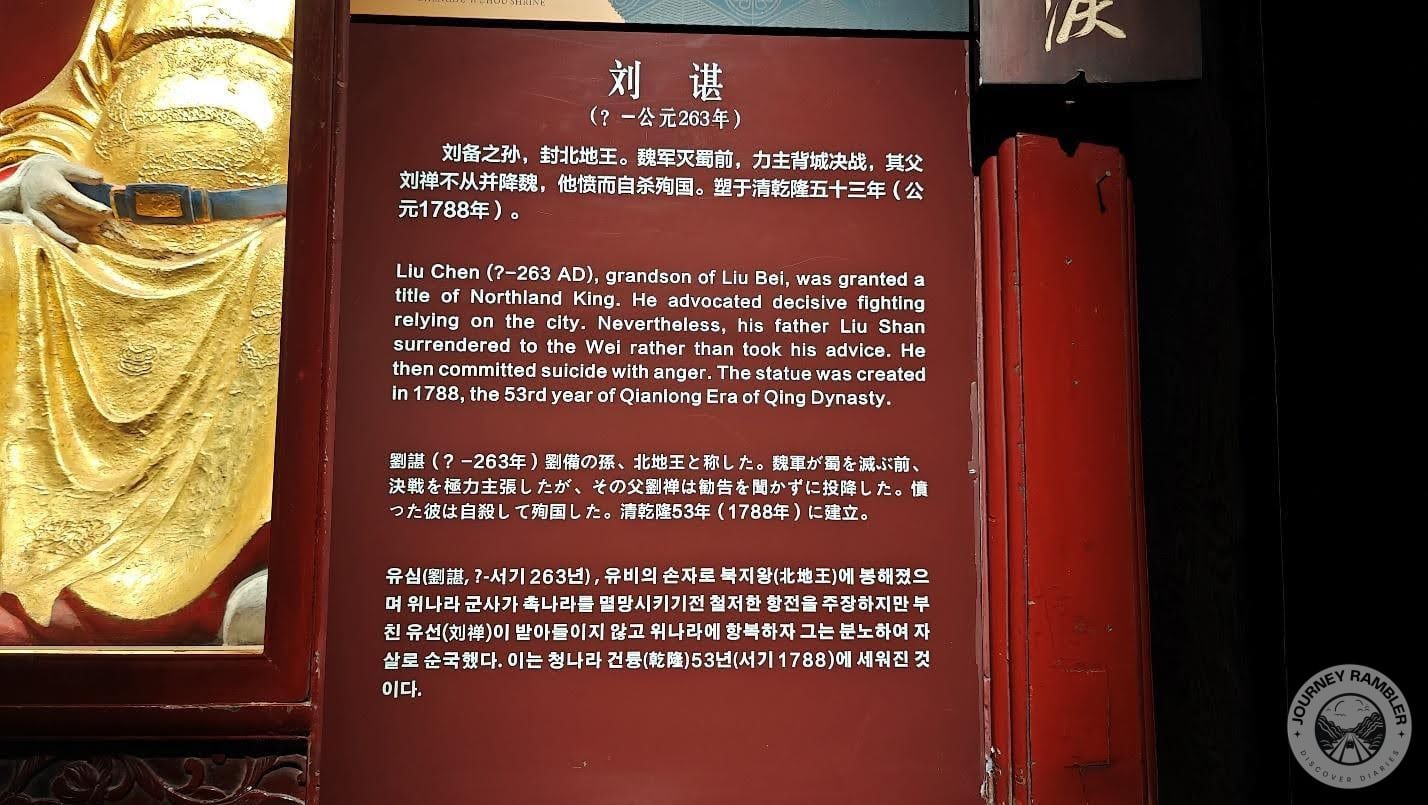
The grandson of Liu Bei and the fifth son of Liu Shan, Liu Chen was one of the few who advocated to continue fighting against Cao Wei. His father though didn’t heed his calls for resistance. Rather than surrender and see the Shu Han empire fall, he chose to go to Liu Bei’s ancestral temple and then killed his family and himself.
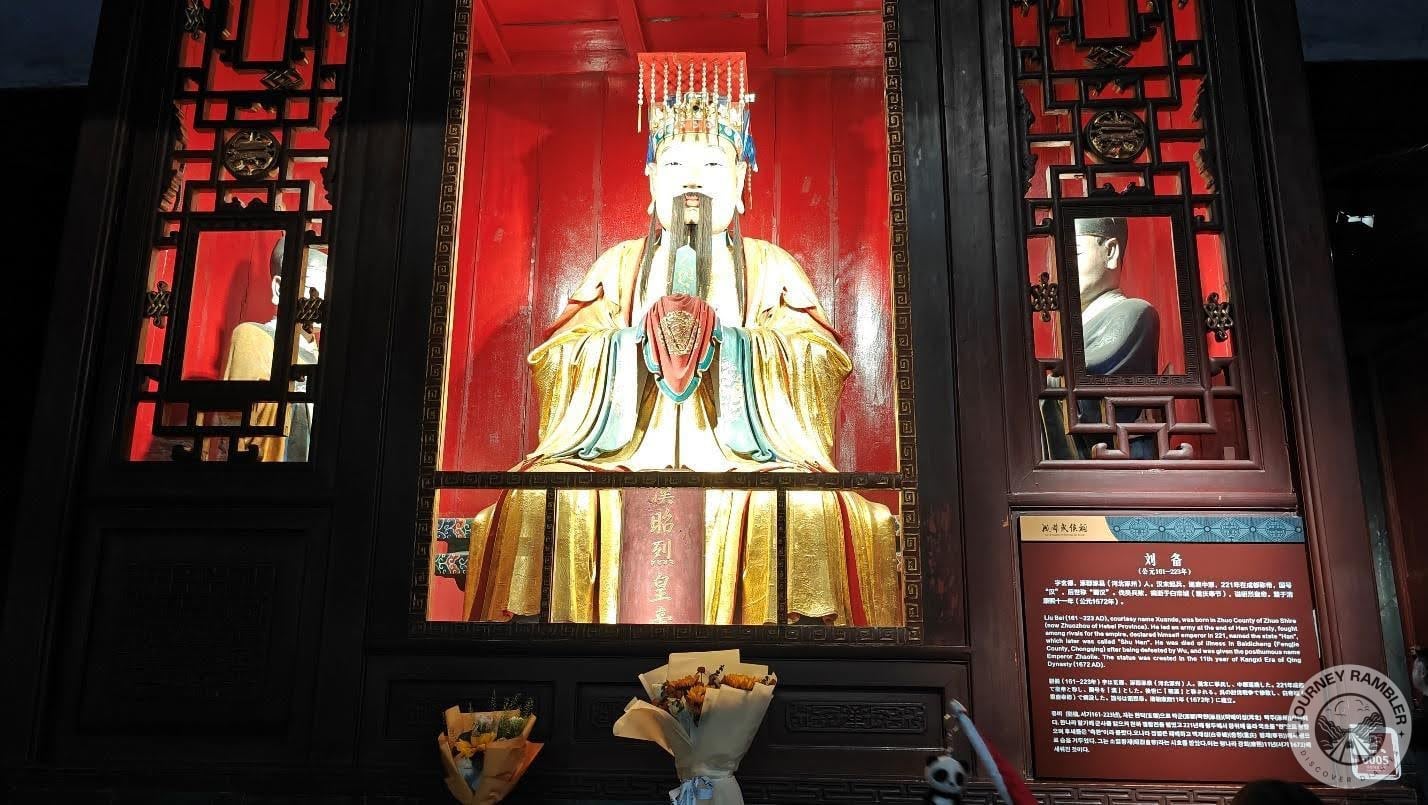
Of course, the main attraction of this part of Wuhou Shrine is this statue of Liu Bei. I’m not sure why but this seemed to be the most life-like of the statues here. If not for its size, I actually thought that there was a real man sitting inside the display.
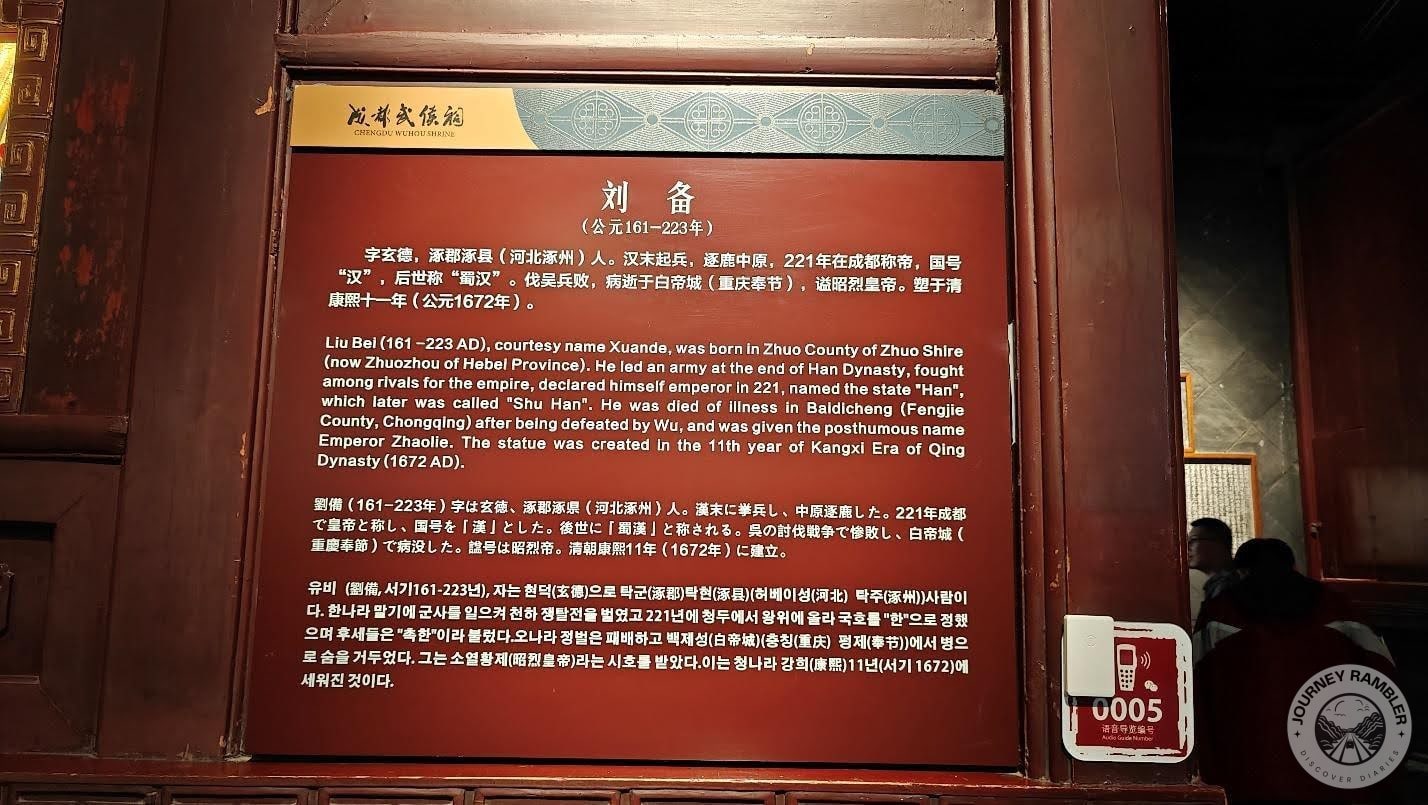
Anyway, I don’t think Liu Bei needs any more introductions as I’ve been talking about and referencing him for the last couple of images now. He’s probably the most popular of the three primary warlords of the Romance of the Three Kingdoms likely due to his humble beginnings. Additionally, he was also very charismatic and was portrayed as a humane and benevolent ruler.
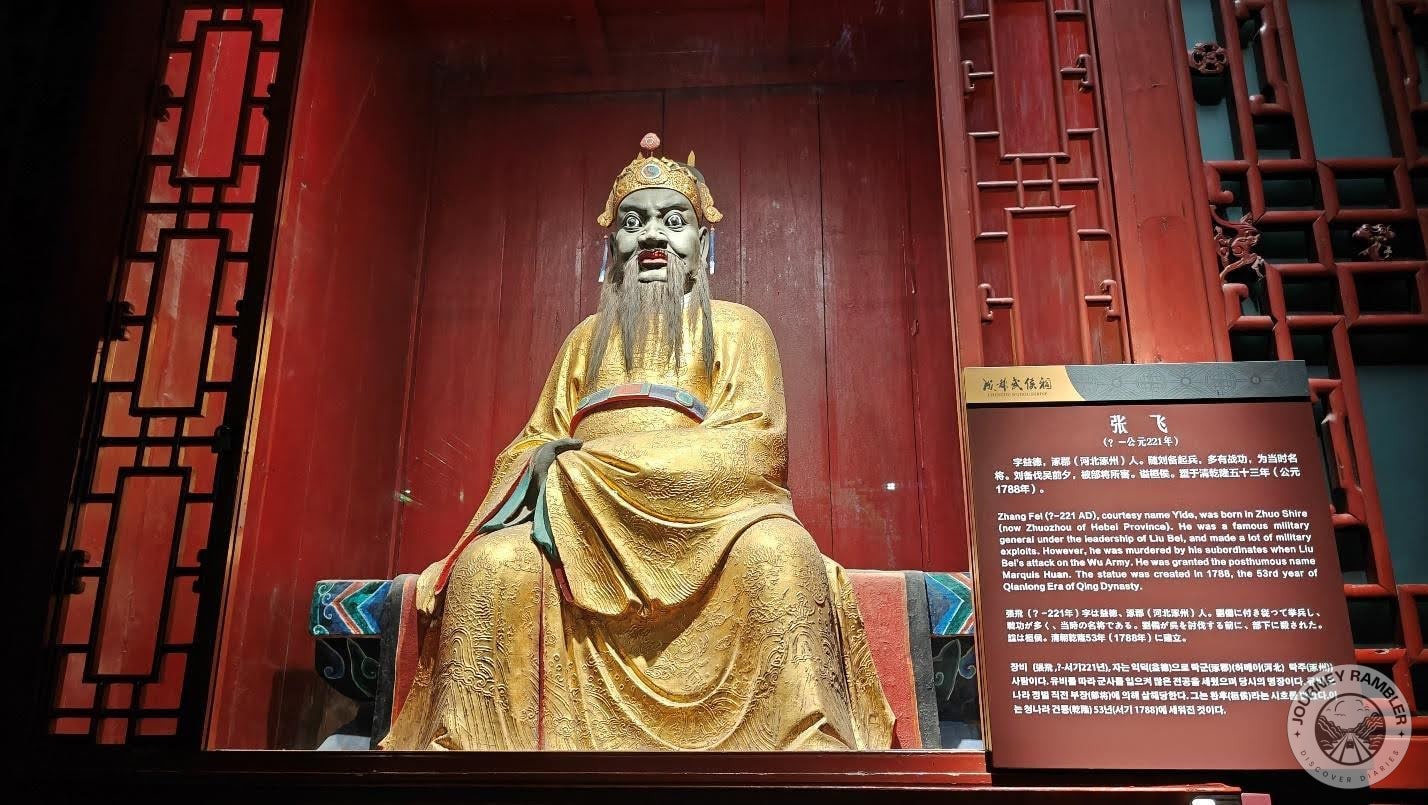
Finally, we have the last of the Three Sworn Brothers: Zhang Fei. Of the three, he looks the most fierce and there’s actually a reason for this. In life, he was said to have a fiery temper, treated his soldiers harshly, and drank heavily.
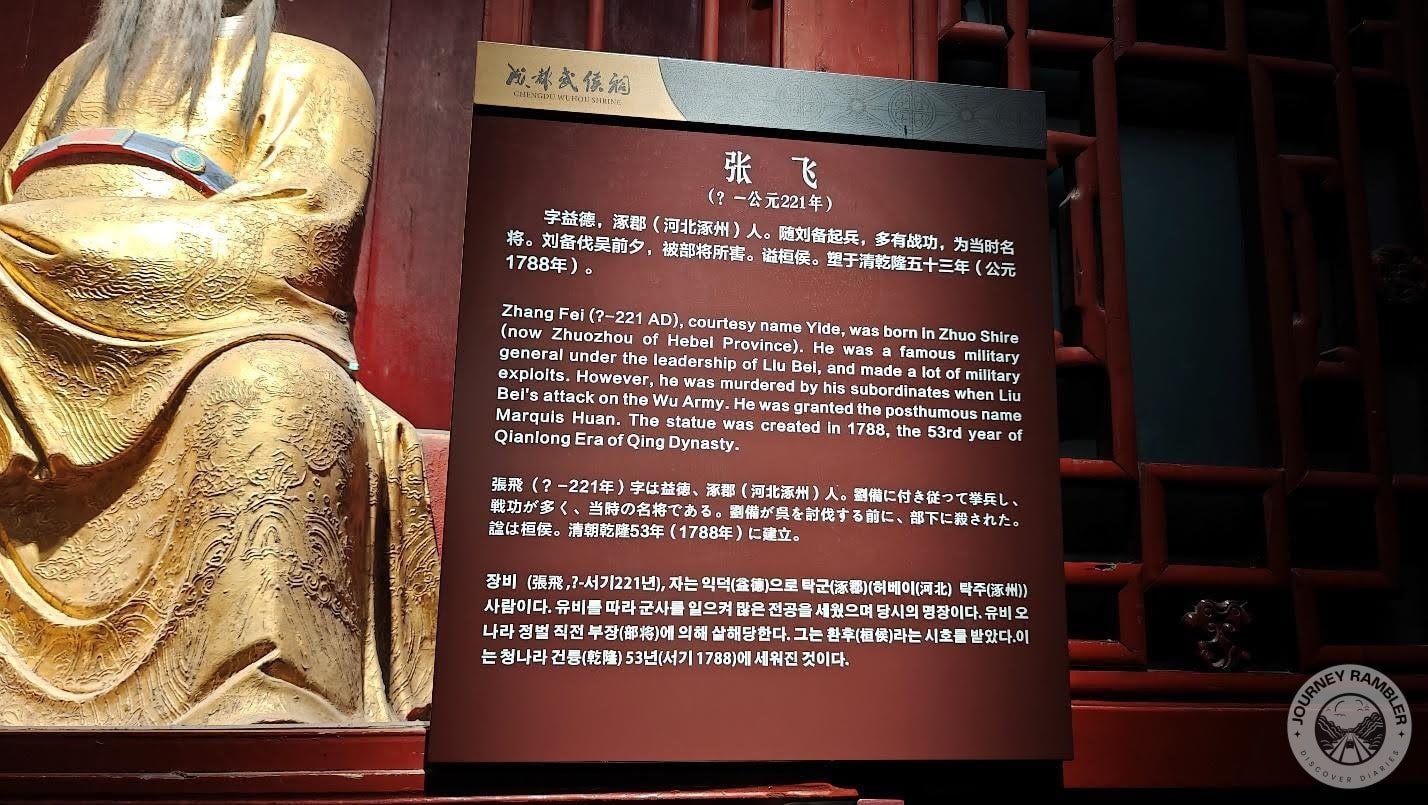
As a result of his unsavory reputation (as well as other factors), he ended up being assassinated by his soldiers. Now despite this, he’s still considered a paragon of loyalty due to how he never betrayed Liu Bei until the very end. It’s also probably due to his and Guan Yu’s loyalty that made Liu Bei so popular among the three warlords of that era.
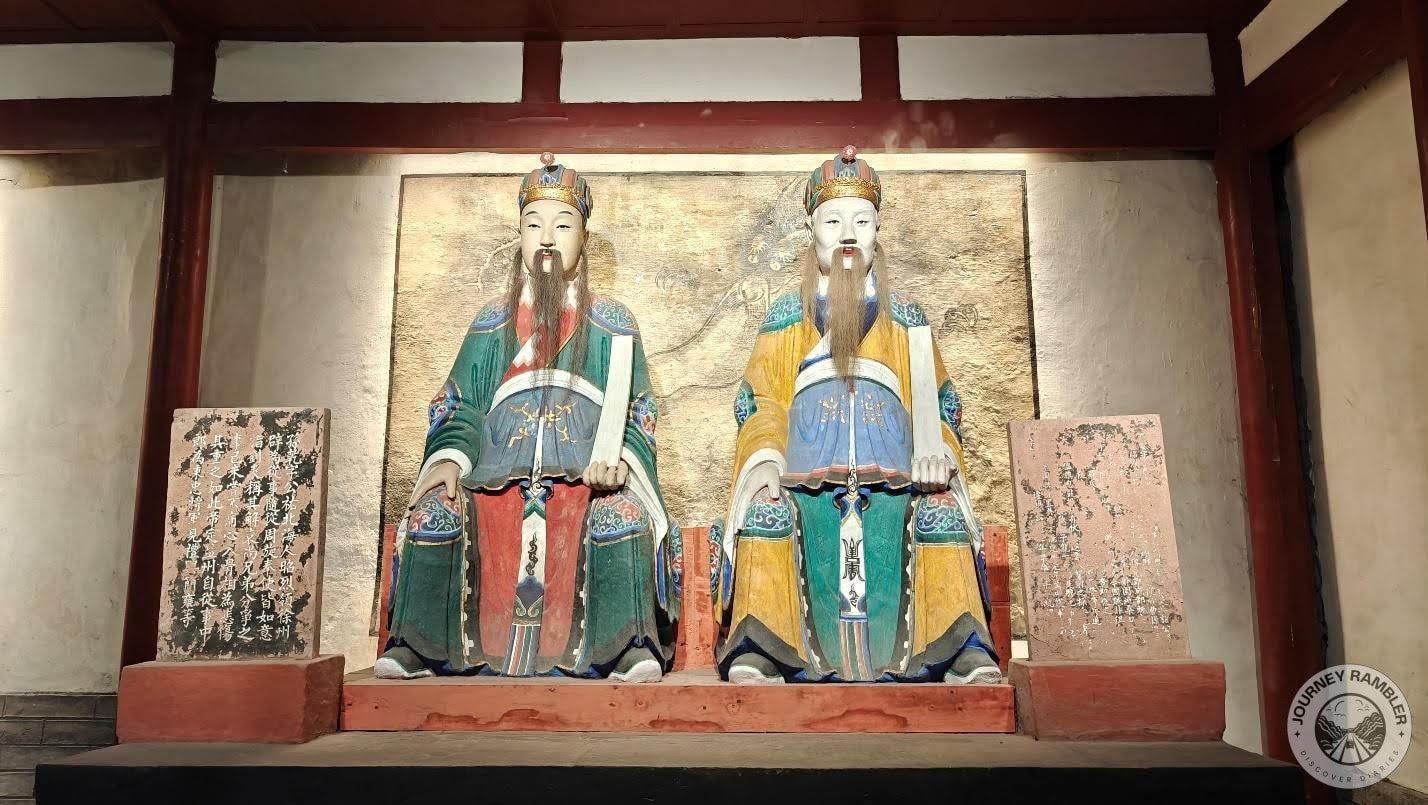
Now after the Civil Officers Gallery and the statues of the Three Sworn Brothers, I then went to the Military Officers Gallery. This is a pavilion opposite the Civil Officers Gallery and as its name implies, the statues here consist mainly of generals and warriors in the Shu Han army. The first of these that I came across are the statues of Zhao Yun (right) and Sun Qian (left).
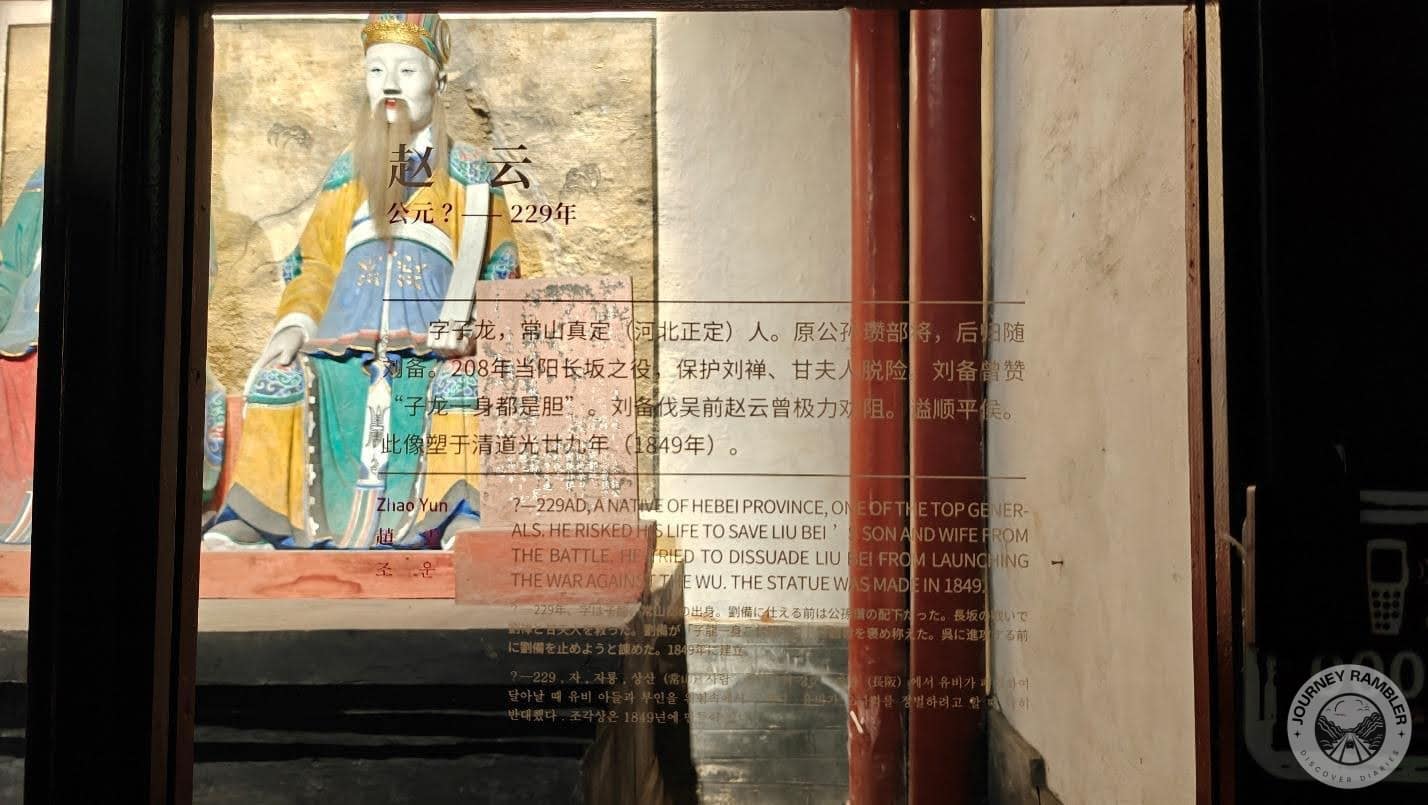
Considered one of the most loyal generals of Shu Han, Zhao Yun served Liu Bei faithfully as his general for decades. His single most notable act of loyalty was when he charged alone against the enemy in Changban just so he could rescue Liu Bei’s wife and son (Liu Shan). As a reward for his loyalty, Liu Bei awarded Zhao Yun with the rank of General of the Standard.
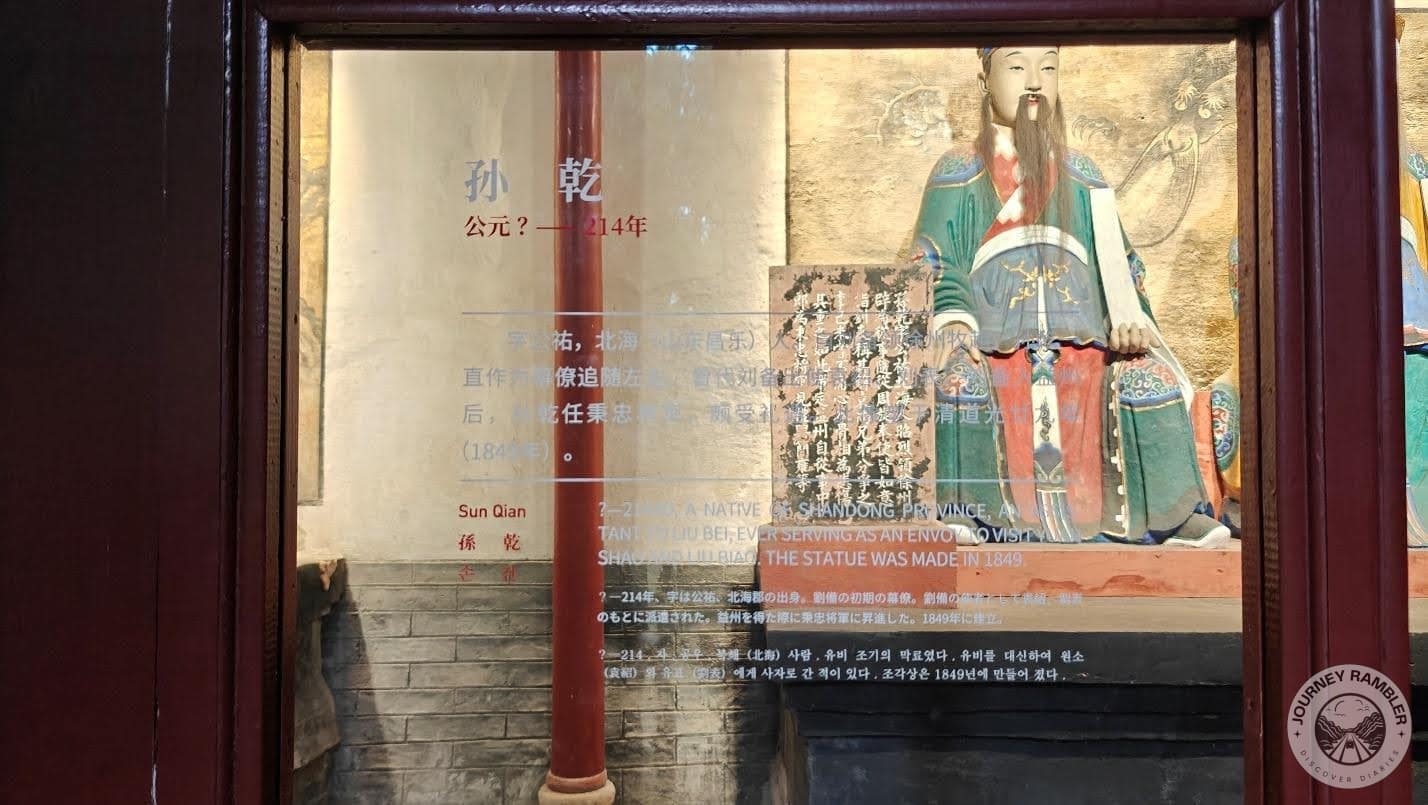
Sun Qian was more of a diplomat than a general. He served as an envoy who skillfully negotiated alliances with other warlords such as Sun Quan, Liu Biao, and Yuan Shao (among others). Eventually, he was given the title of General of Compromising Loyalty though this is more honorary as opposed to a proper military position.
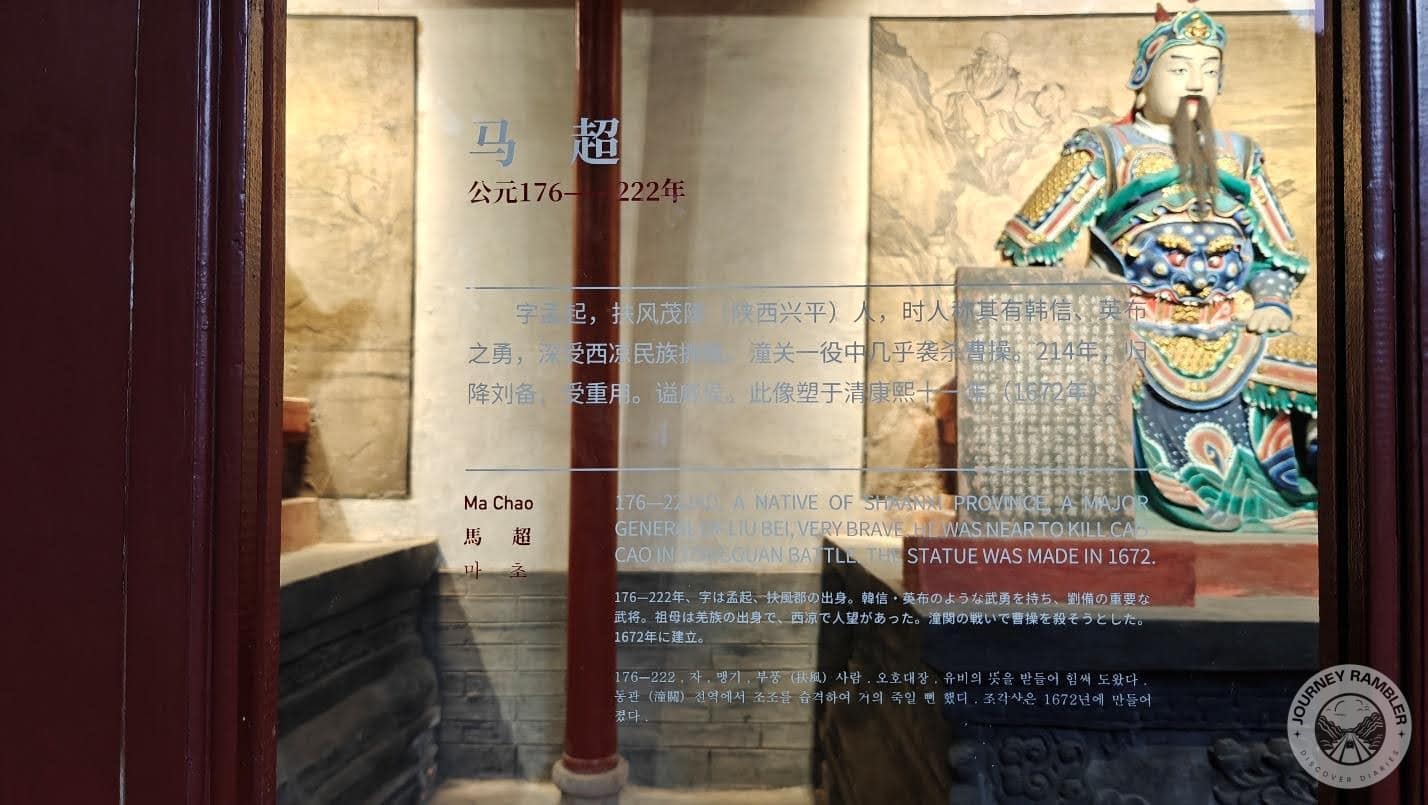
Another general of Shu Han that was considered one of the most skilled of his time, Ma Chao struck fear even amongst warlords like Cao Cao. In fact, he almost managed to kill Cao Cao in Tong Pass were it not for the actions of the latter’s bodyguard, Xu Chu. You can see Ma Chao’s statue in the background.
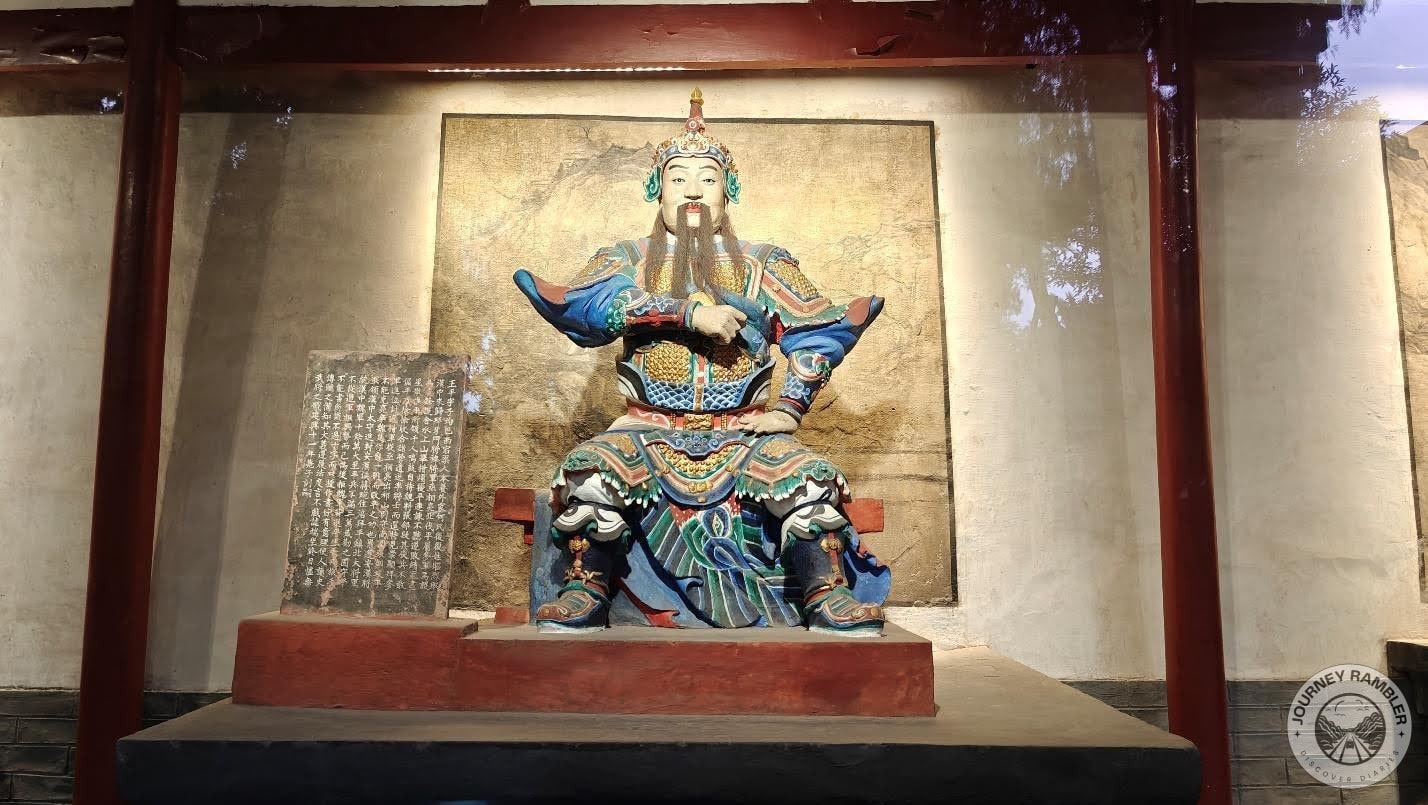
One of the last statues that I took a picture of here at the Military Officers Gallery was this one of Wang Ping. A former general of Wei, Wang Ping defected to ensure he could remain in his territory as Wei was having a hard time providing his army with supplies. He eventually gained the trust of even Zhuge Liang and was promoted to the overall commander of Shu’s forces in Hangzhong.
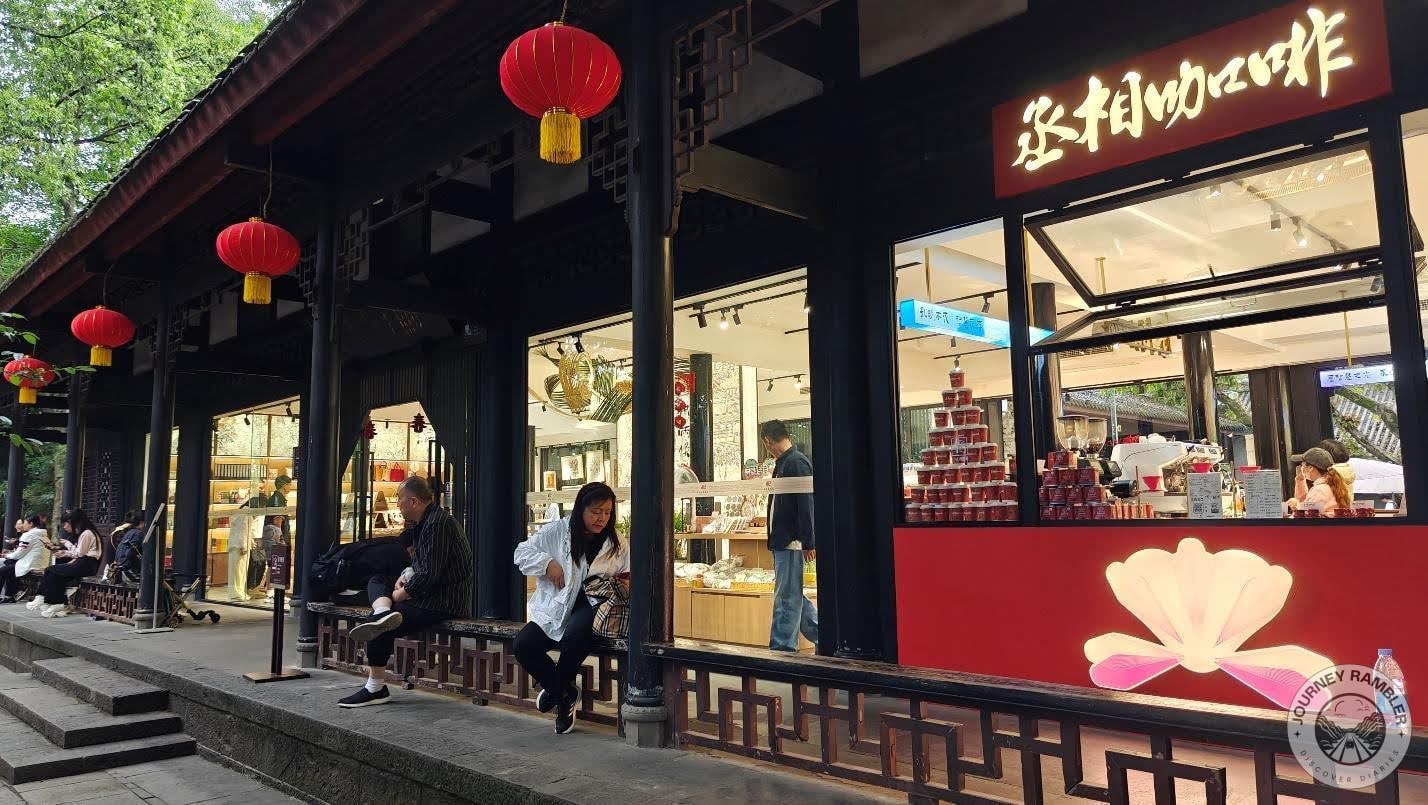
Off to the side of the Civil Officer’s Gallery is the shrine complex’s Culinary Street. As you would expect from its name, this area has plenty of food establishments with offerings that range from Sichuan cuisine to coffee. There are also benches here where you can rest while eating the food that you ordered.
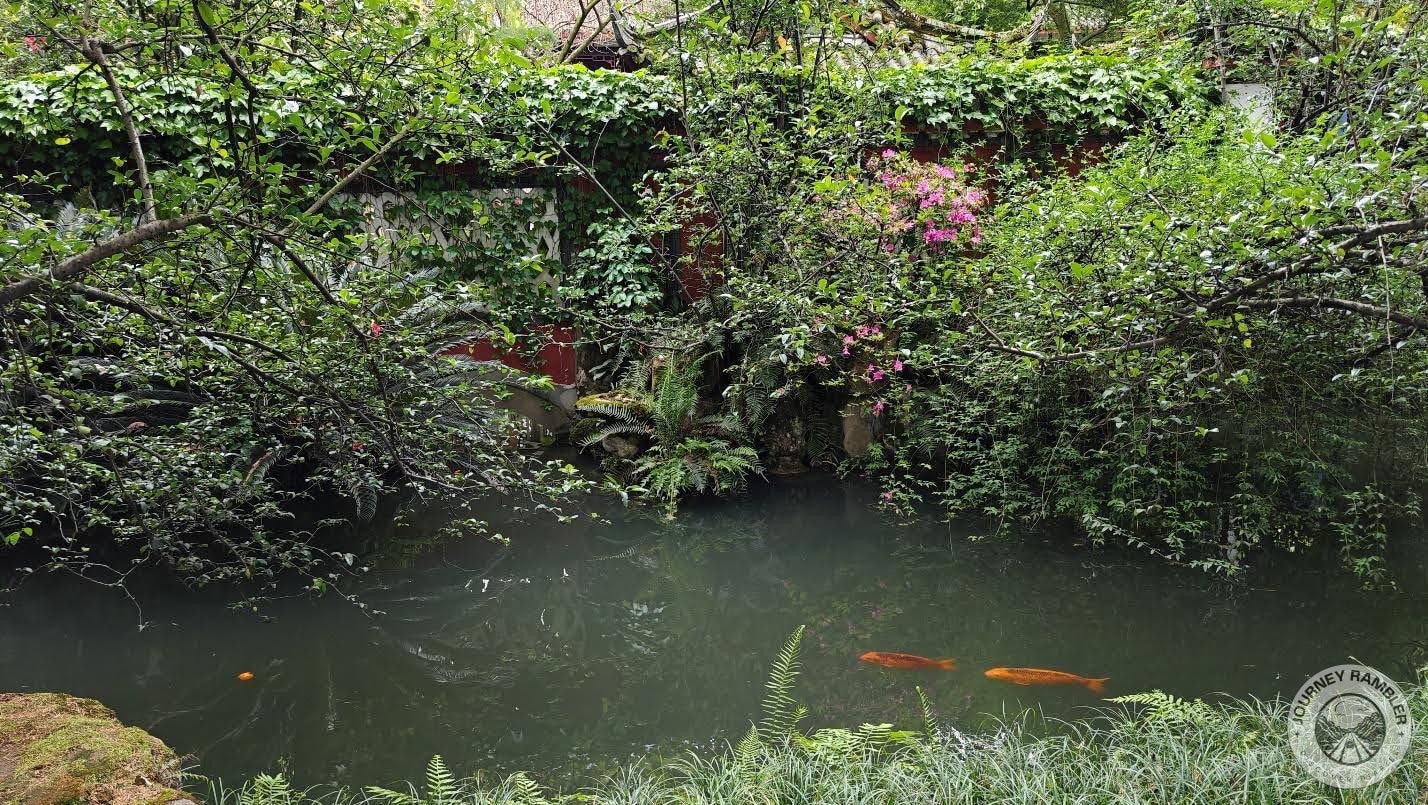
Another great feature of this area is that it has a garden and pond. If you’ve been following my travels, you’d know how much of a garden and pond enjoyer I am. I don’t know why but I just feel at ease whenever I see these in the places I visit.
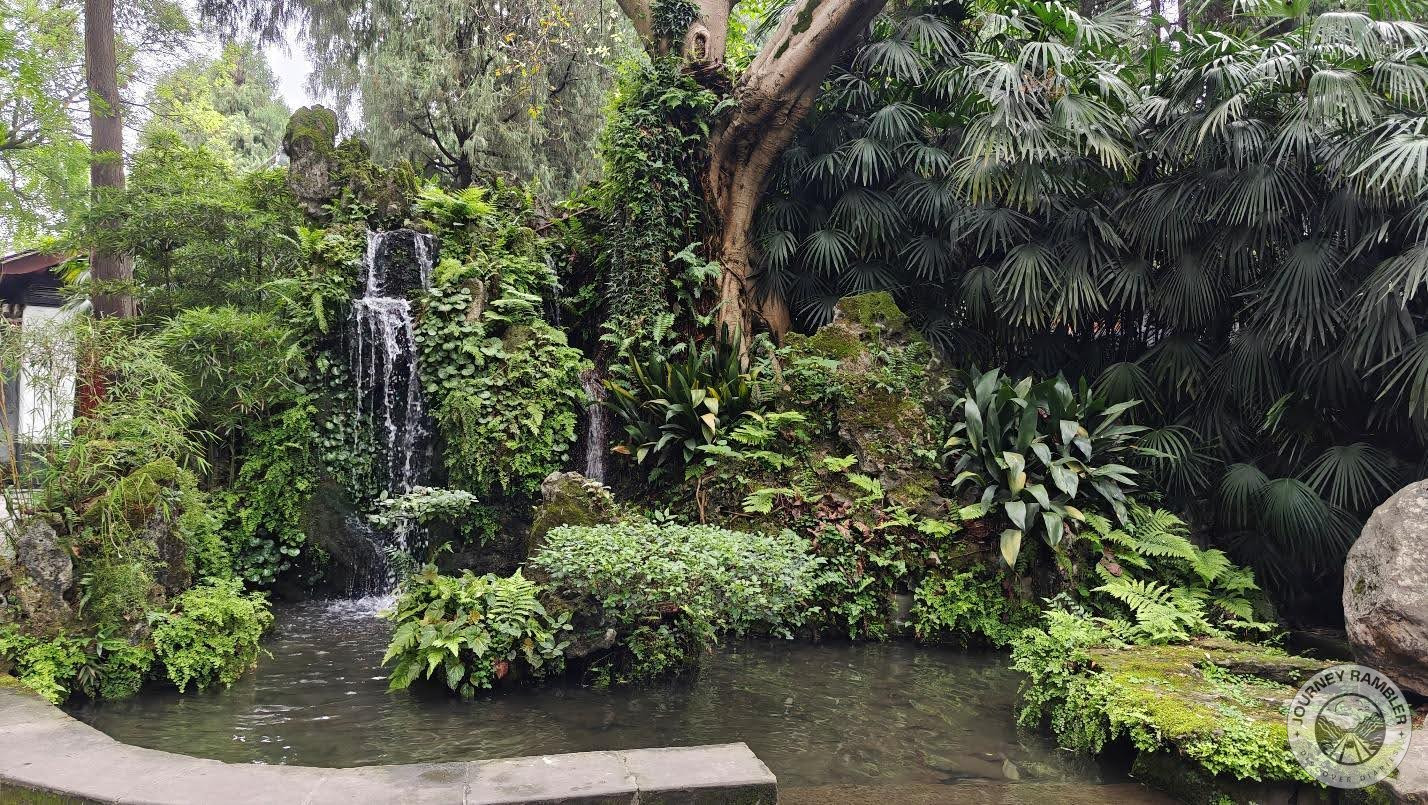
The pond and garden here in this area isn’t that large but I will say that it’s very relaxing. More importantly, there weren’t that many people here (at least during my visit) so I was able to recharge my social battery a bit. Take note that this isn’t the only garden and pond here.
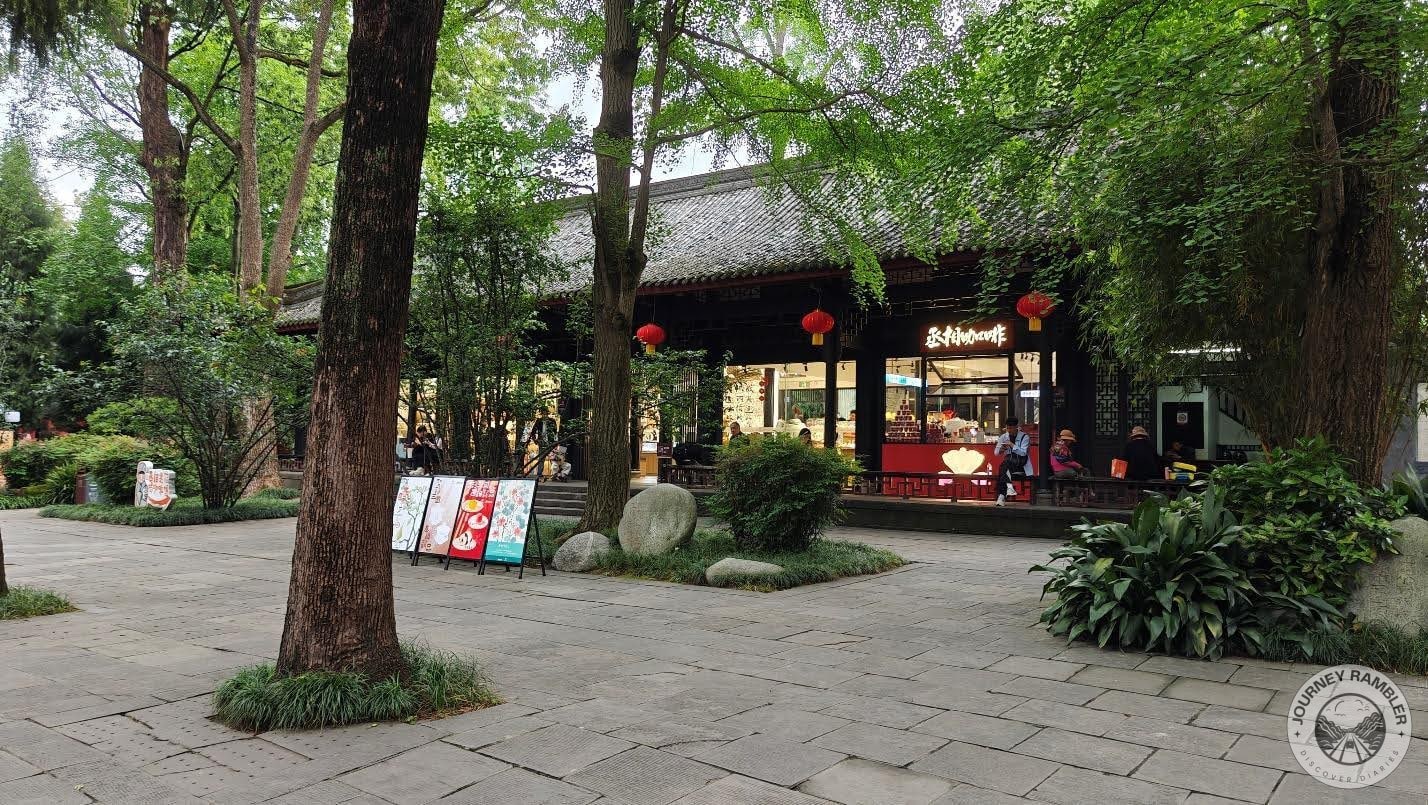
Here’s how this part of the shrine complex’s Culinary Street looks from near the pond area. The trees here were quite tall and provided adequate shade thanks to their sprawling branches and leaves. Thanks to these, it was also relatively cool here.
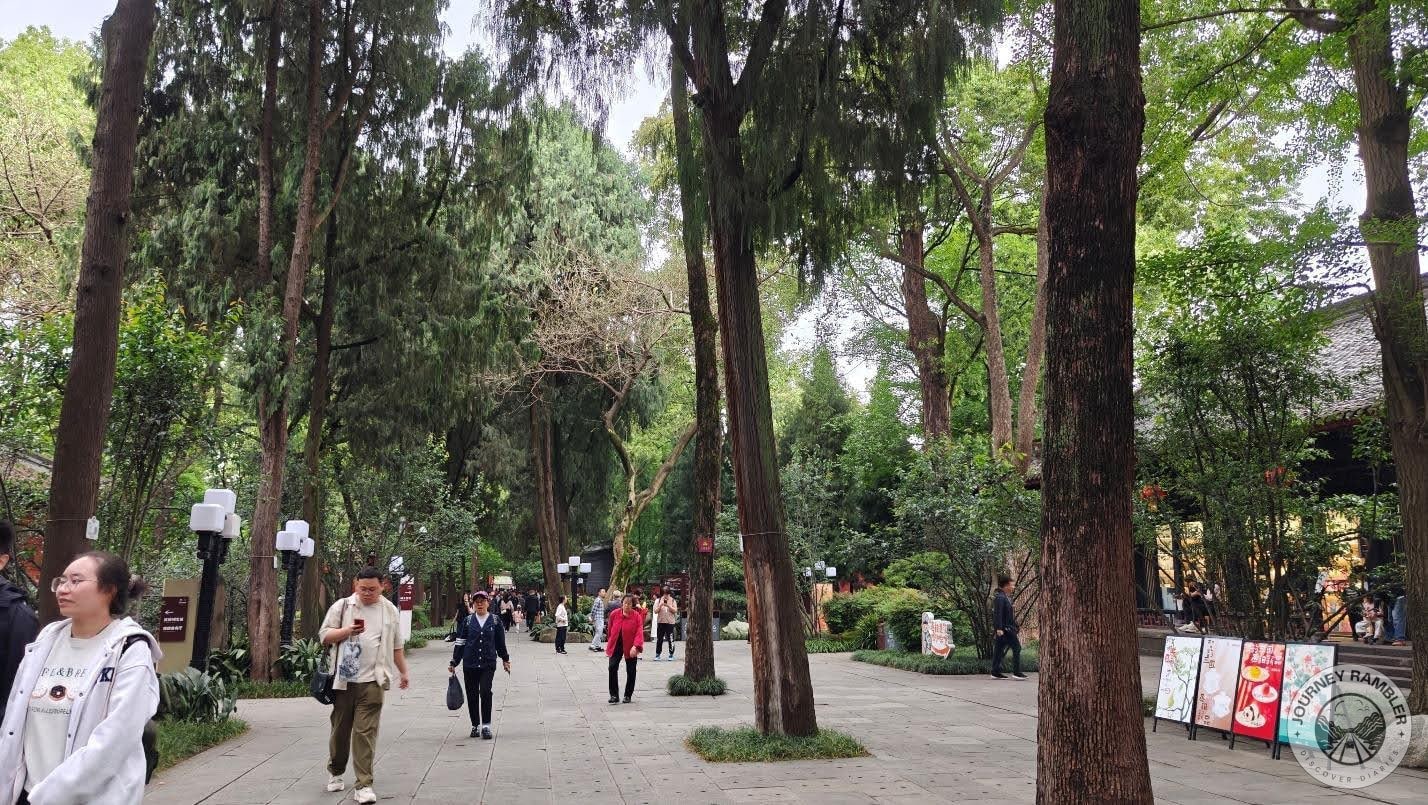
These people are probably done with their visit and are going back to the main gate to exit from the shrine complex. Again, I really liked how there was a healthy mix of young and old people here which speaks to the universal popularity of the shrine.
Now you’re probably wondering, what about Zhuge Liang’s statue? I was there but it was extremely crowded. Remember that this was in April and as a result, students were visiting to pay their respects and pray to Zhuge Liang for help in the Gaokao (which usually takes place in June).
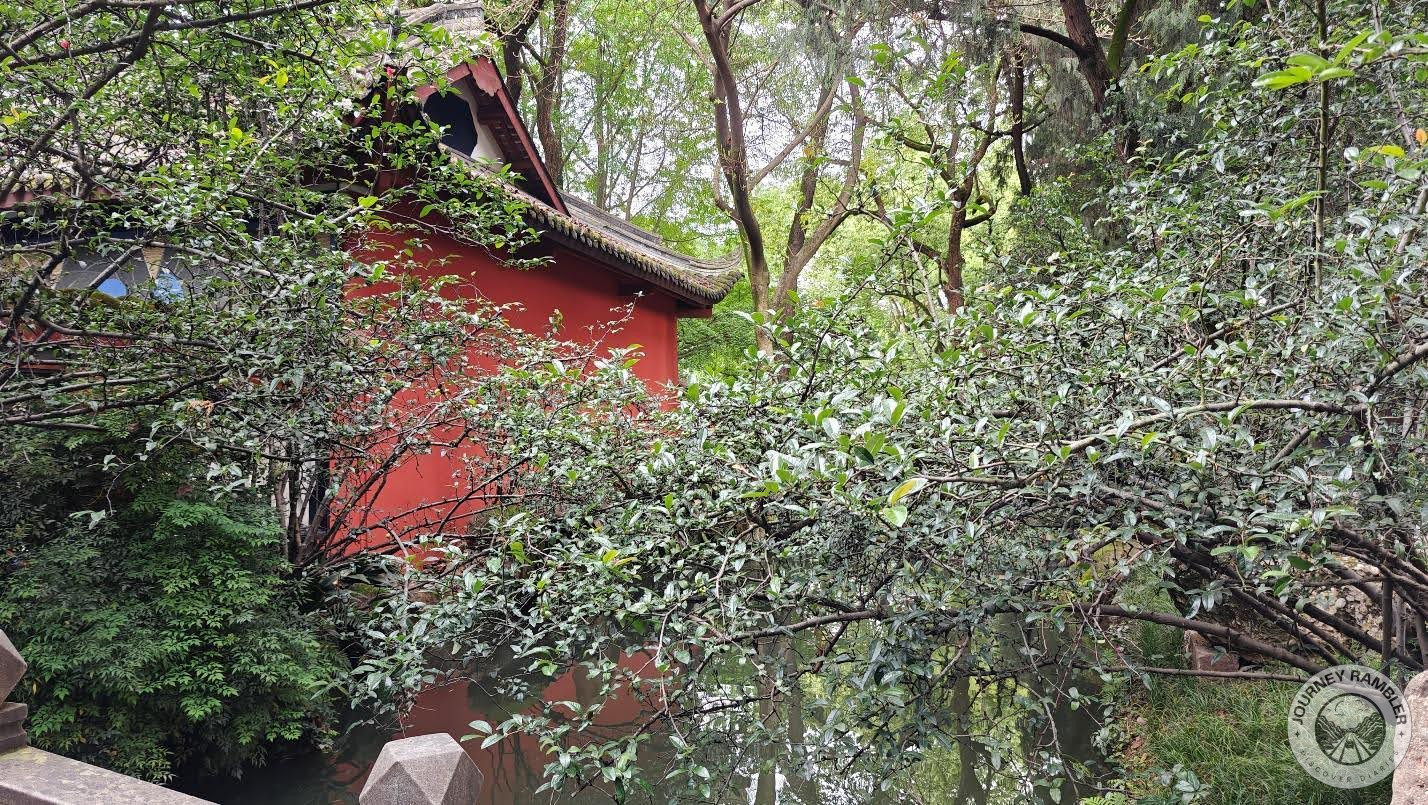
Don’t worry if the Zhuge Liang Hall is too busy though. In my case, I just decided to head to the middle and western parts of the Wuhou Shrine complex. The walk here was kind of relaxing thanks to the garden scenery.
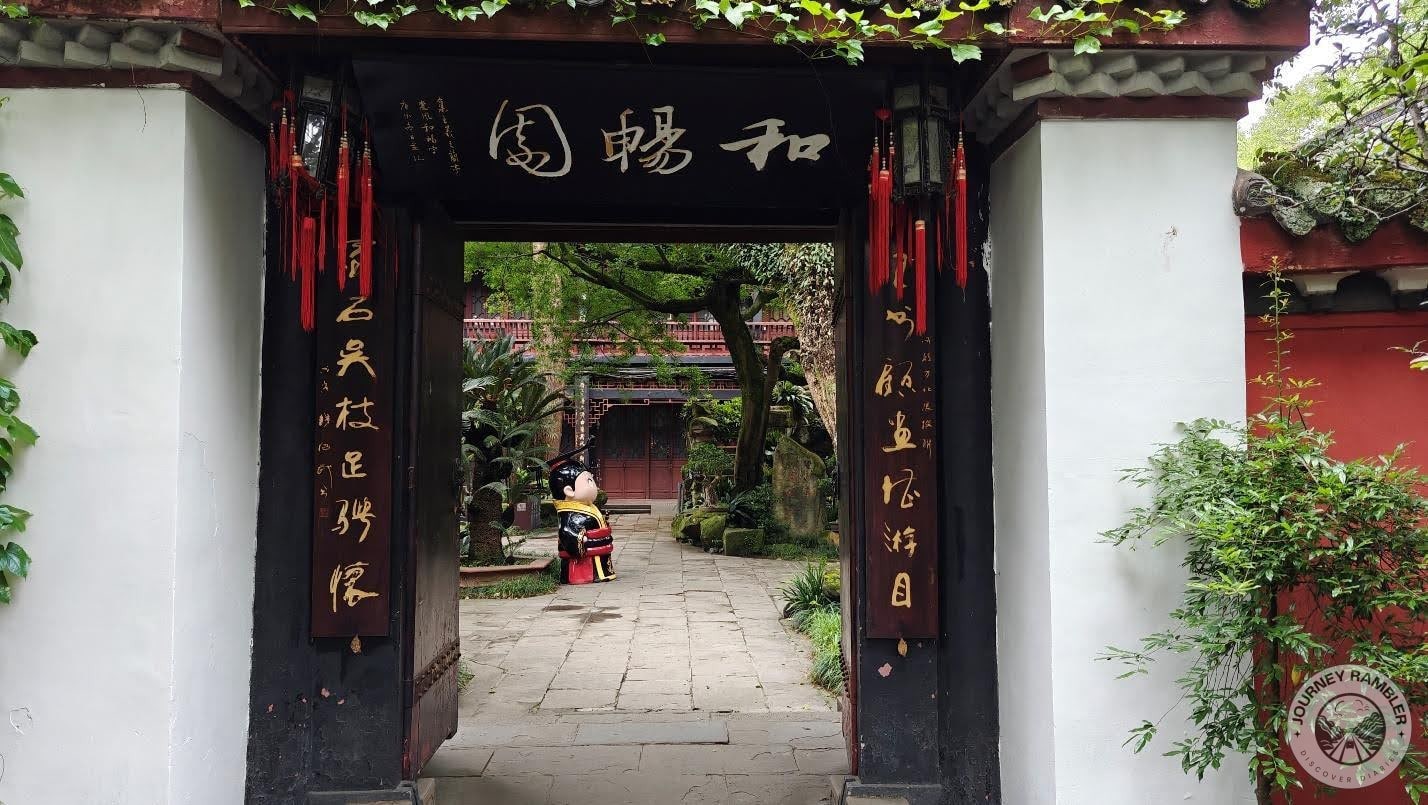
Perhaps the only issue I might have with the shrine is the presence of mascots like the one that you see in the courtyard in this image. In my opinion, it breaks the immersion of the place. That said, I kind of understand that these are sort of important when it comes to appealing to the younger generation.
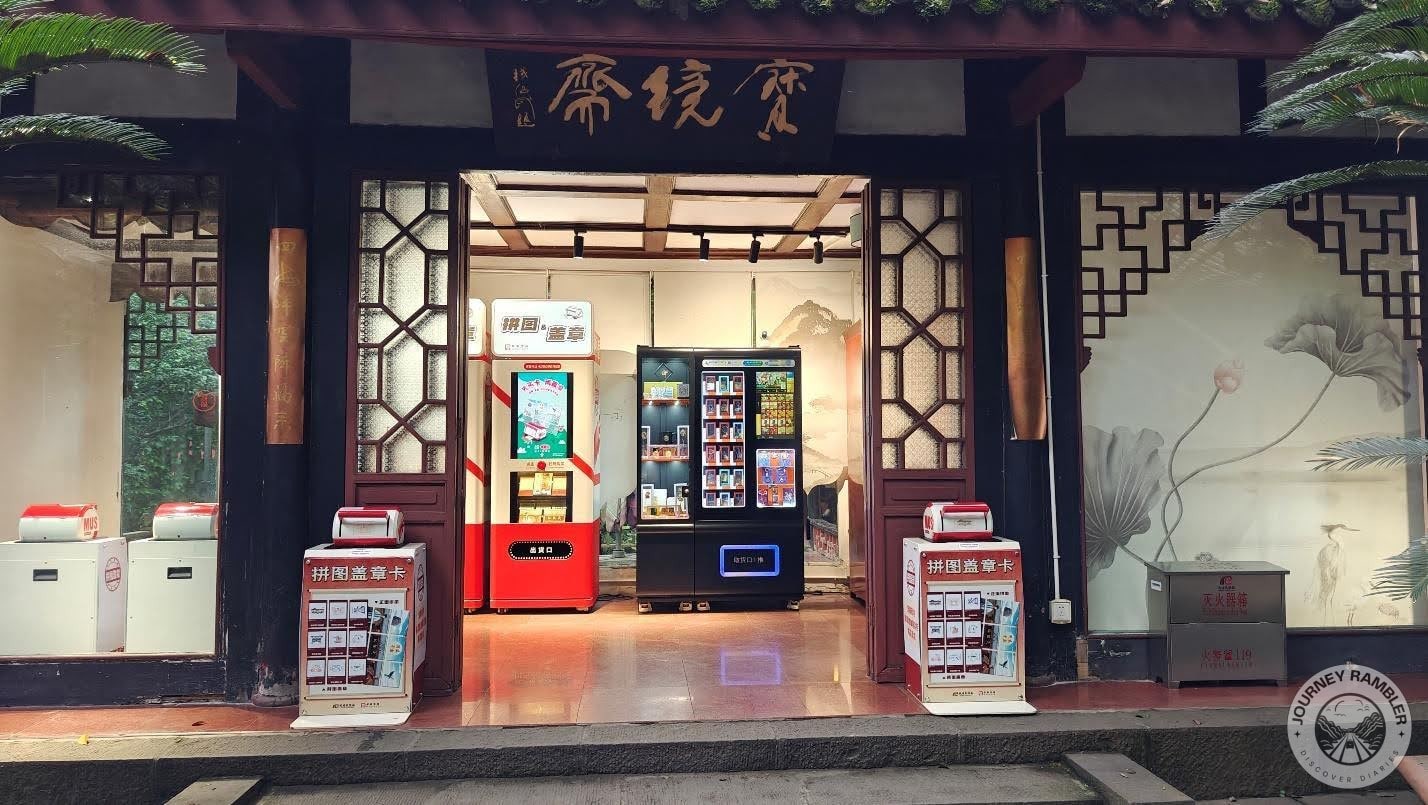
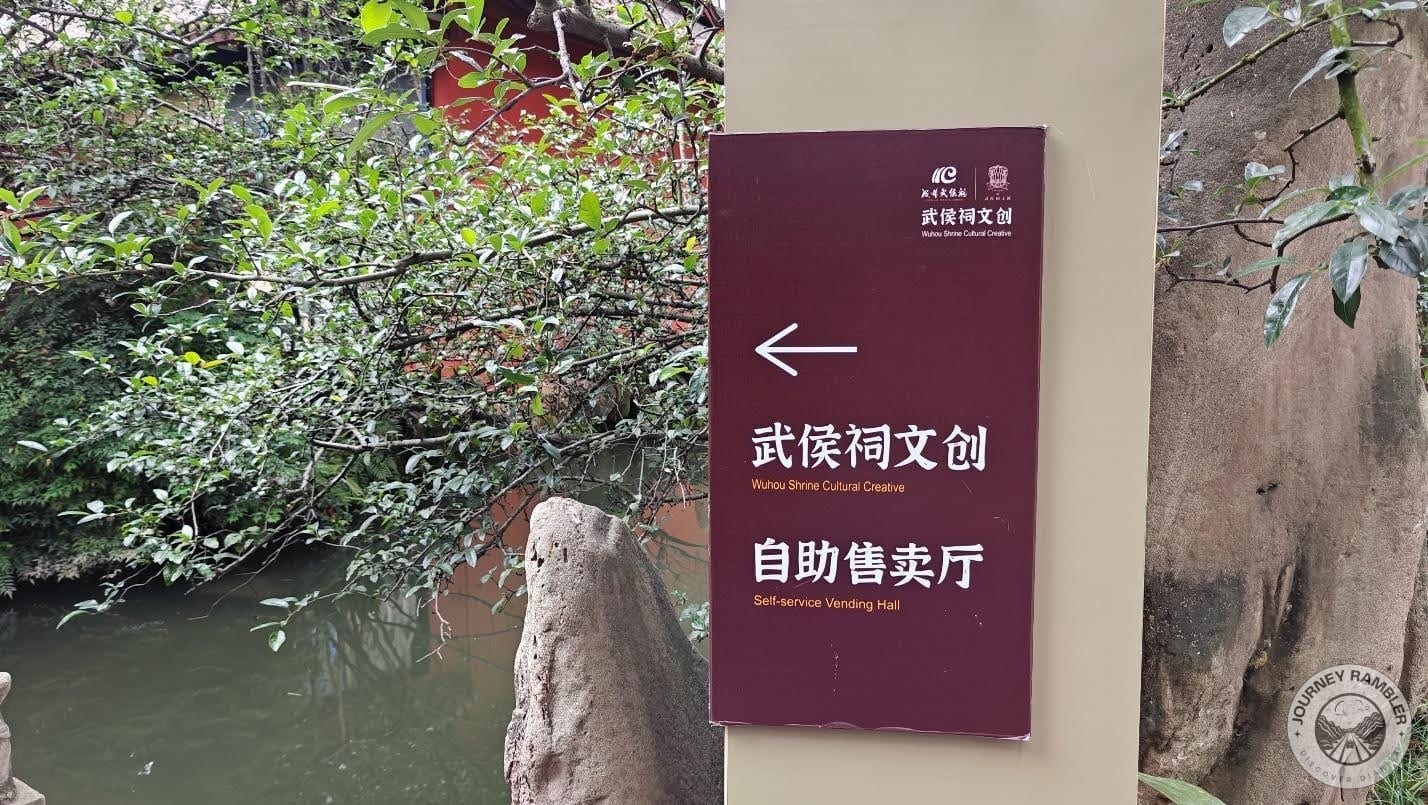
Here’s another section of the Wuhou Shrine Complex that’s meant to appeal to the newer generation. Initially, I thought these were vending machines for food and beverages. Surprisingly, they were actually for something else.
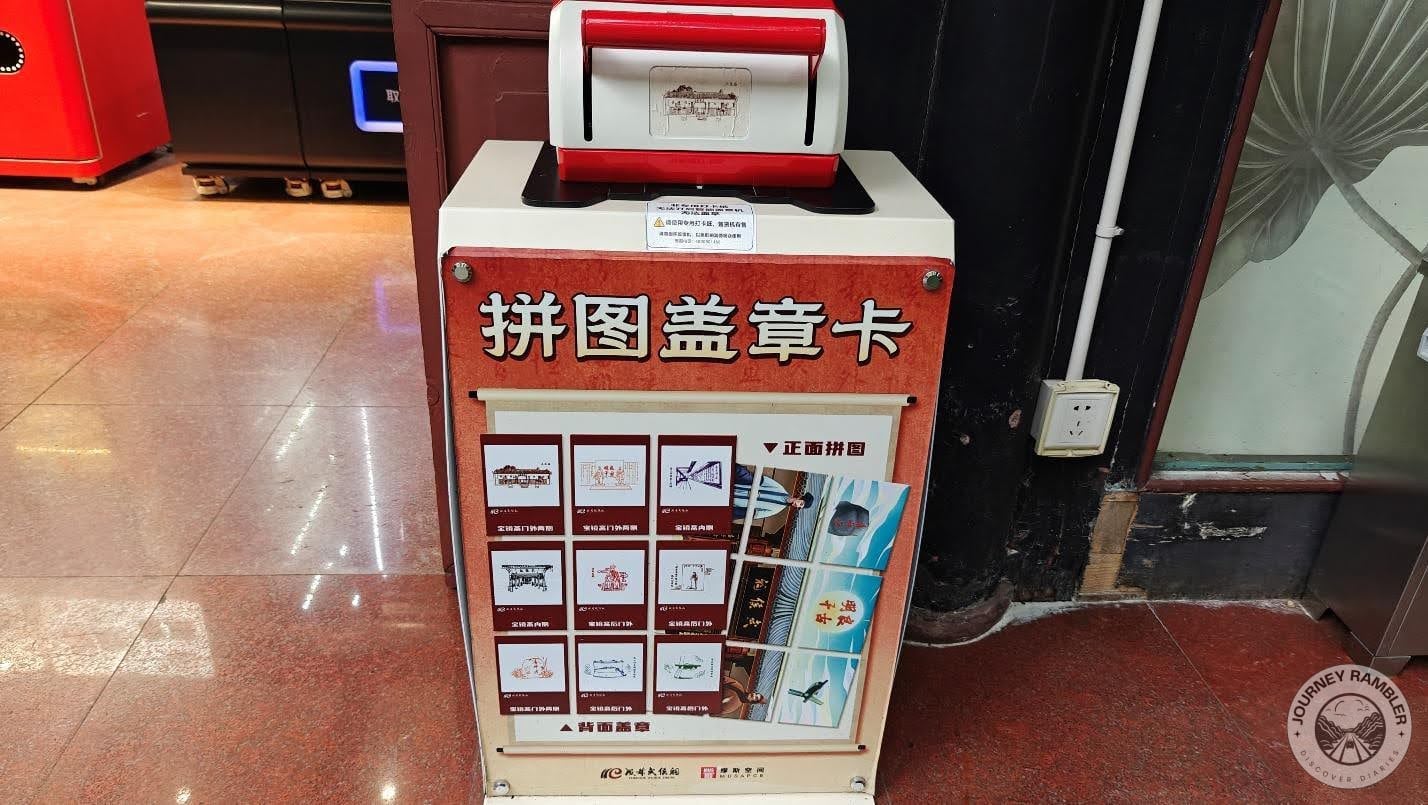
Rather than food, these contained Jigsaw Puzzle Stamp Cards which I didn’t know were a thing. If I’m not mistaken, the images on the cards are mostly from views here in Wuhou Shrine. I guess these would be nice as souvenirs though I think there might be better alternatives especially if you go to Jinli Ancient Street (which happens to be quite near the shrine complex).
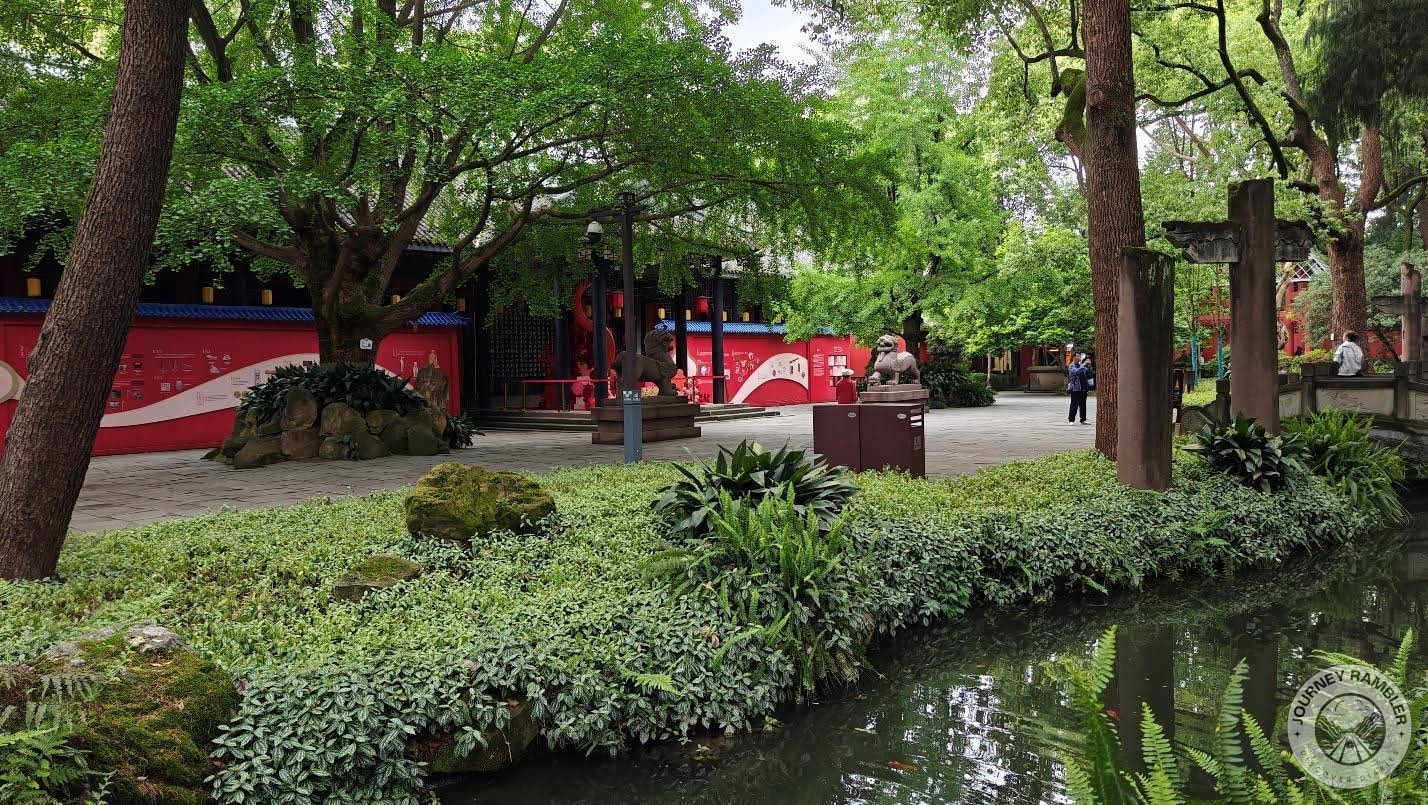
I must admit, I did get a little disoriented a couple of times here just because there was plenty of stuff to see. Thankfully I always snap a photo of the guide map in cases like this. Even if you don’t use it, it’s still kind of reassuring that you have the guide map with you.
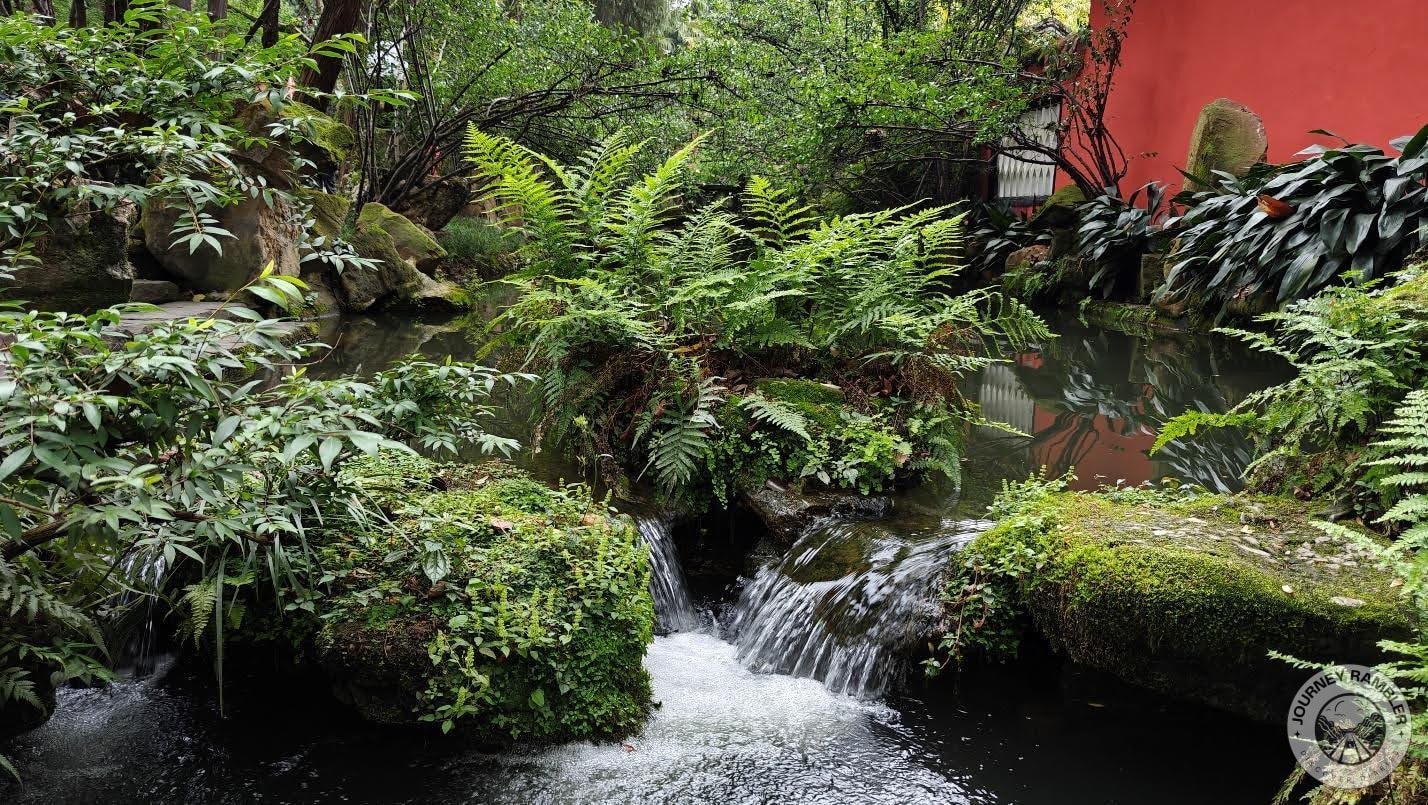
This pond is a lot larger than the one earlier and I’d say a lot more aesthetic. I particularly liked how the ferns here look as well as the moss growing on the rocks. There weren’t that many fishes here though which is a sharp contrast to the other pond you saw earlier.
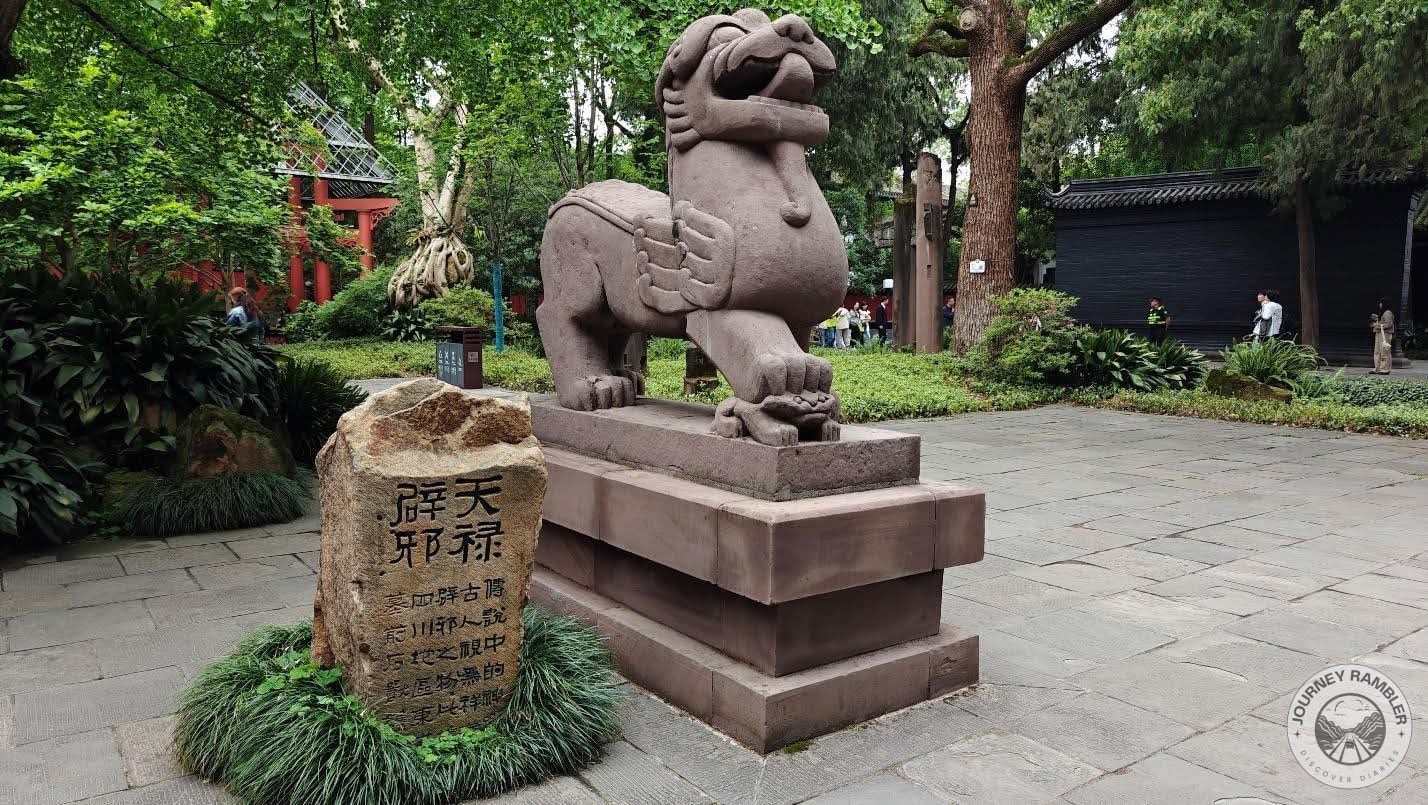
Now I’m not sure what kind of mythological creature this statue is supposed to be. I tried searching for it online and most point to it being a Pixiu or Pi Yao. Here it can be seen stepping on what I think is a money toad (though I might be wrong since I’m not that well versed in Chinese symbolism).
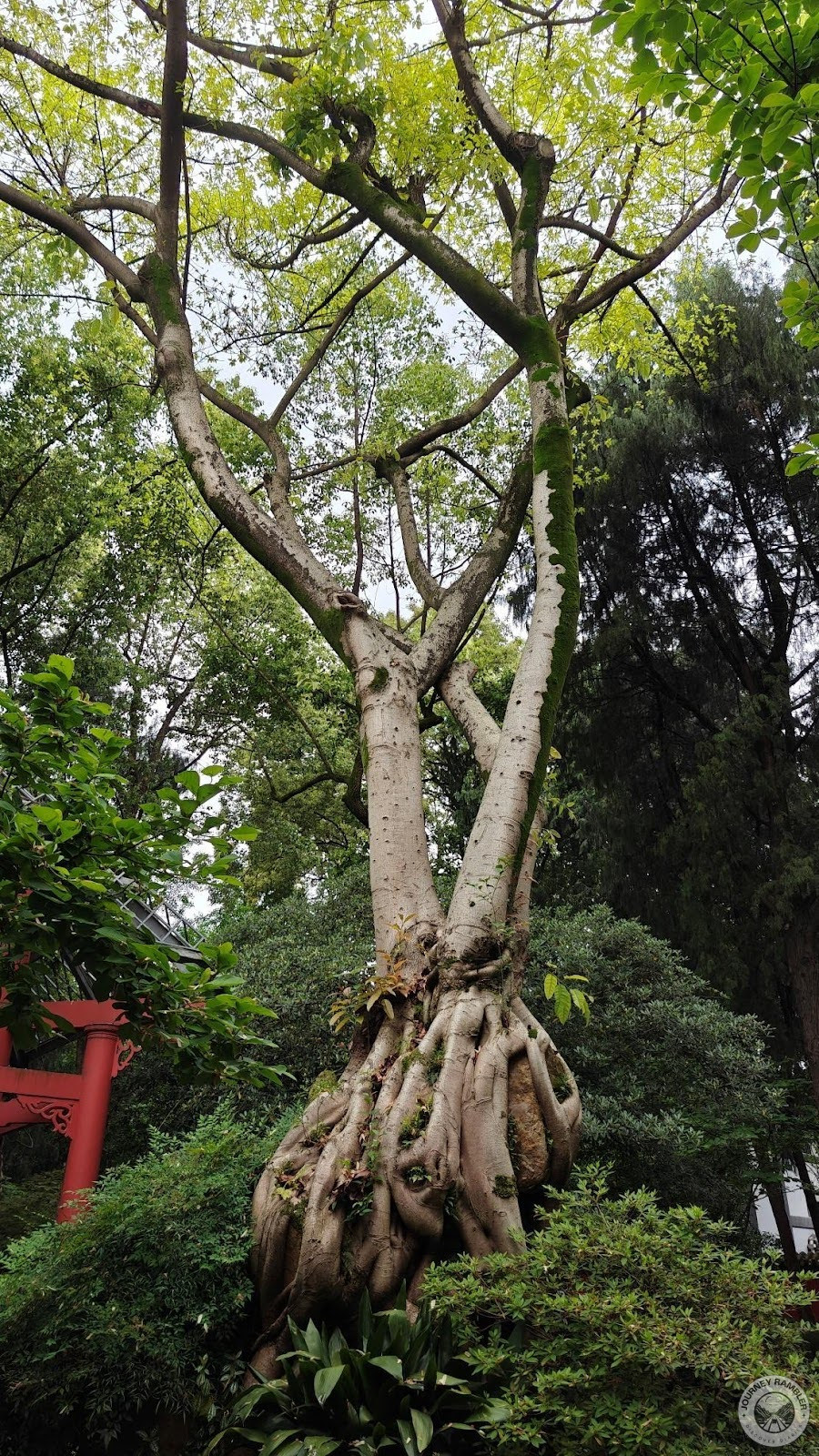
This tree was another one of the headturners here thanks to its weird looking trunk. Check that, I’m not even sure if this is a trunk or if it’s actually the tree’s roots. Regardless it looks really cool though I’m not really sure if the people visiting here think the same as me.
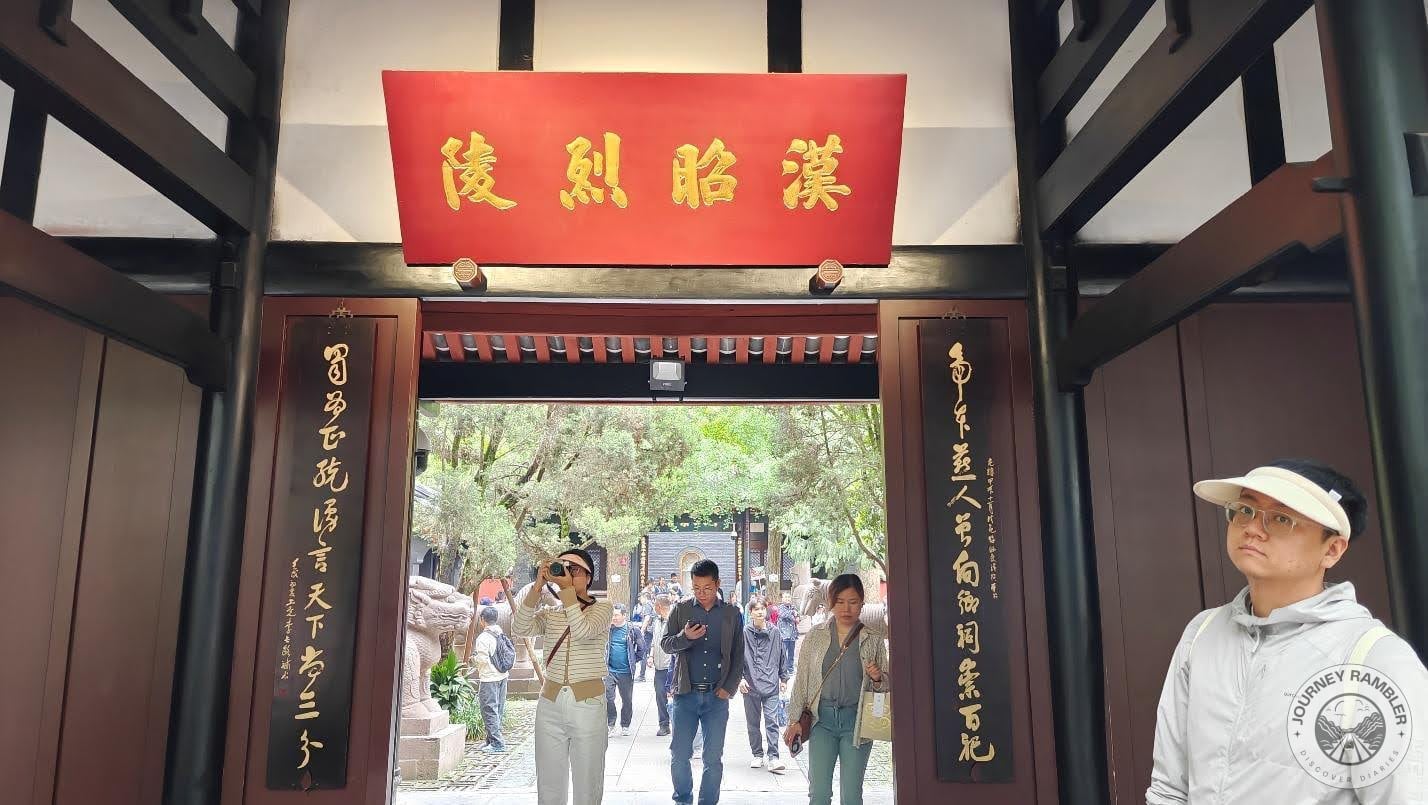
The next major area I visited was the Hui Mausoleum. It was also quite busy here but nowhere near as crowded as the Zhuge Liang Hall. This is the entrance near the Central Gate and Luyu Hall. You can also use the entrance near the Guihe Tower (more on this later) though I think this is much more scenic.
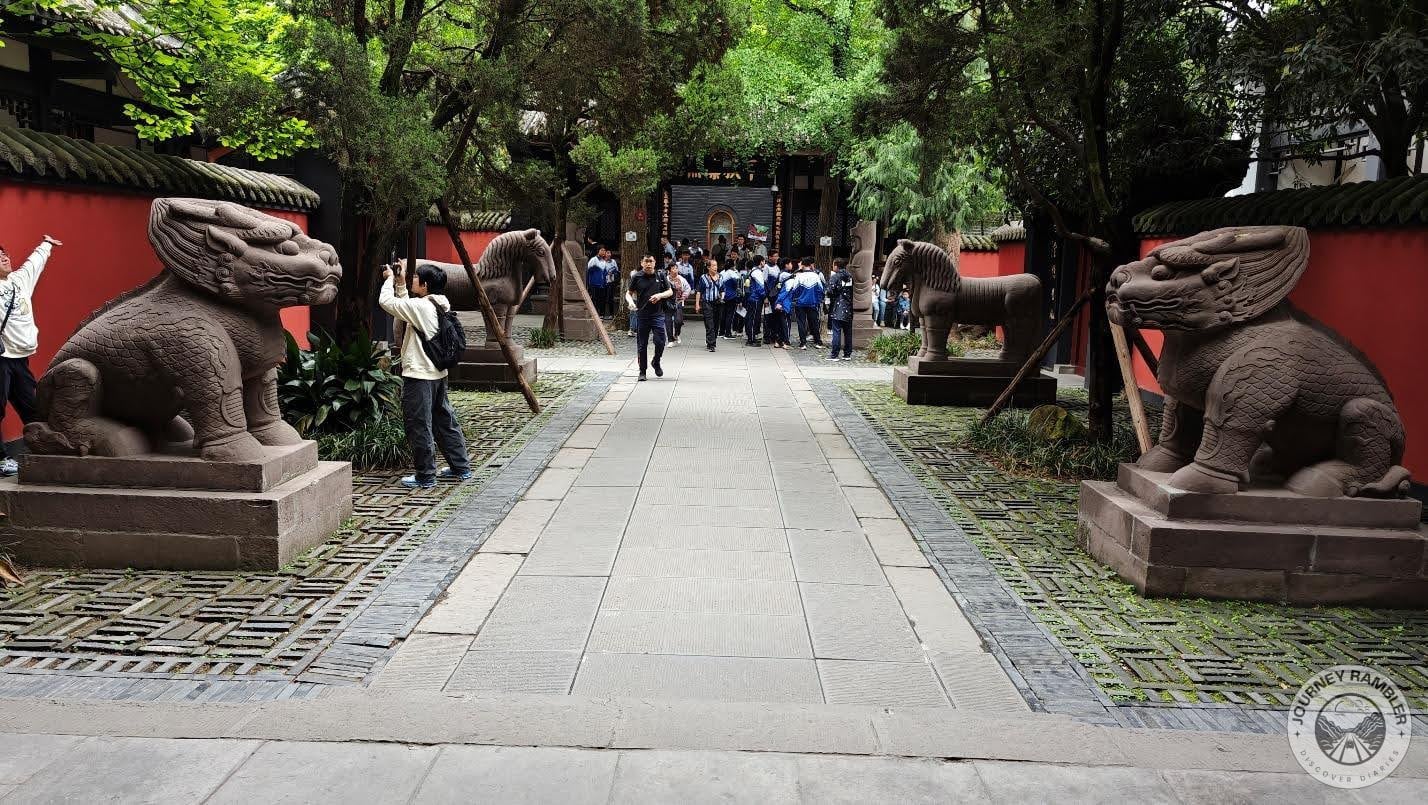
As you pass the entrance gate to this area, you’ll come across this walkway with statues lining its sides. I’m not particularly sure how old these statues are but they kind of look fairly new. Either that or they’ve been maintained really well.
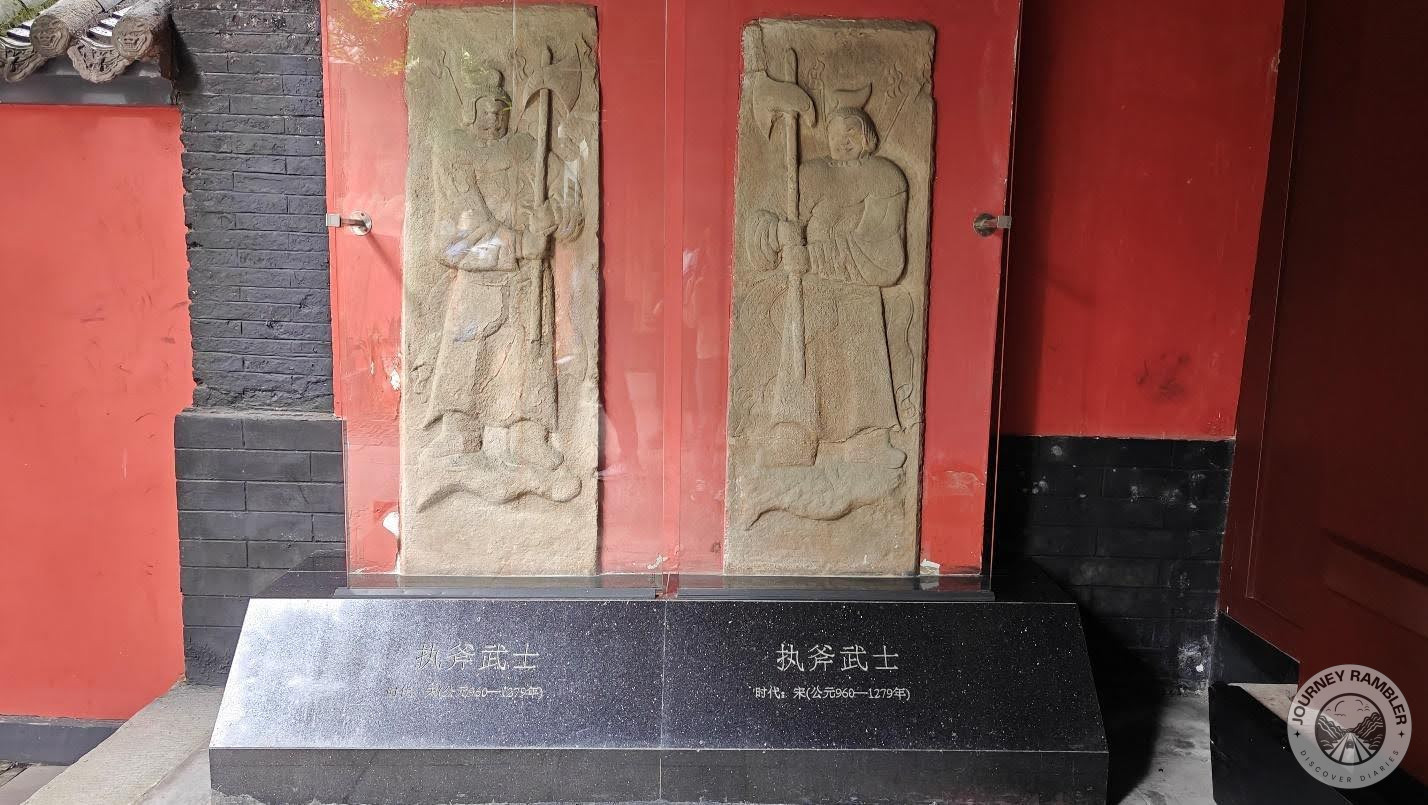
To the side of the entrance, you’ll see these stone reliefs of two warriors holding what looks like an axe. According to the inscription on the marble below them, these stone reliefs are called “Axe Warriors”. Also included in the inscription is the date when they were likely made (which is sometime during the Song Dynasty).
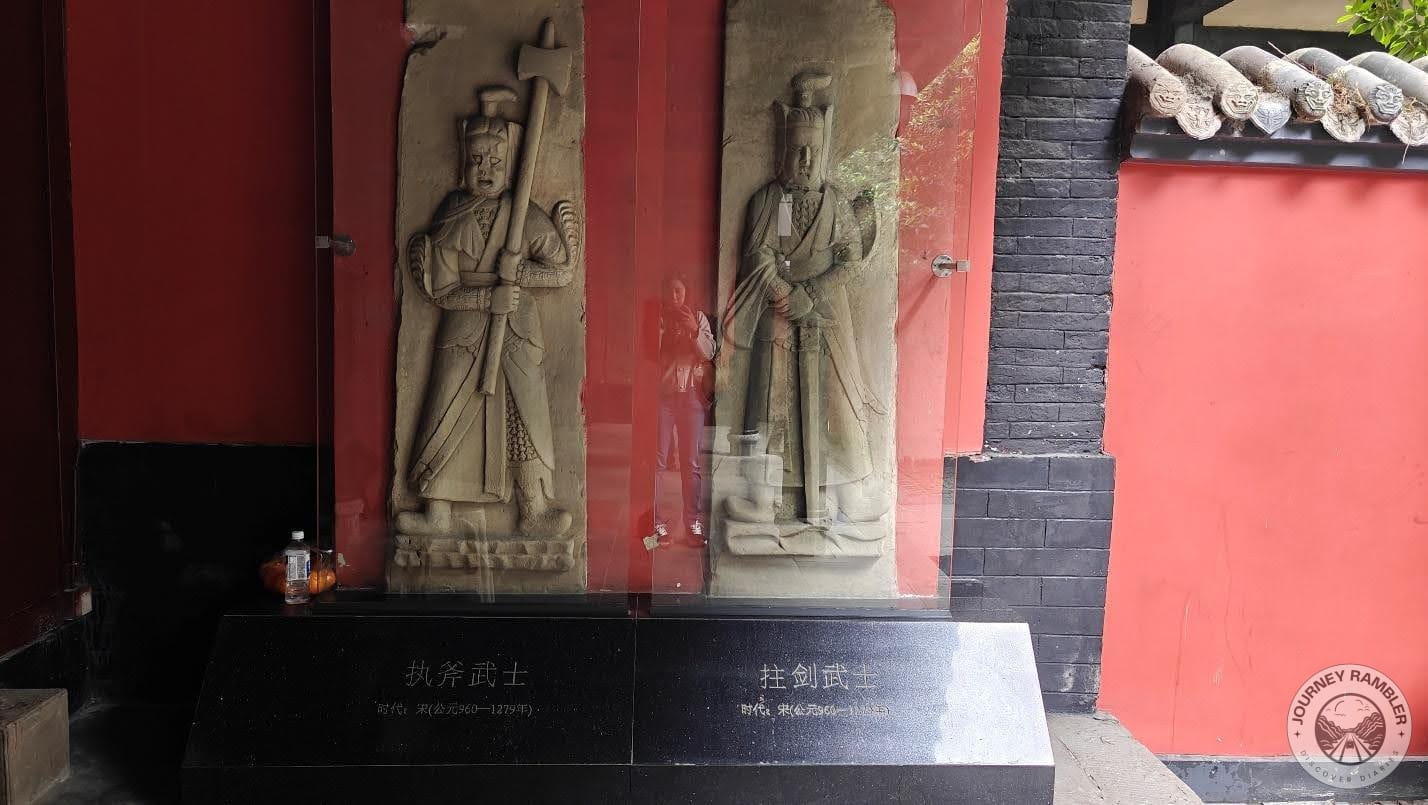
Opposite the pair of stone relief in the previous image is another pair. These are roughly from the same period but look so much more detailed and three dimensional. Also called Axe Warriors, I guess these are the equivalent to the Four Heavenly Kings in Buddhist temple entrance gates.
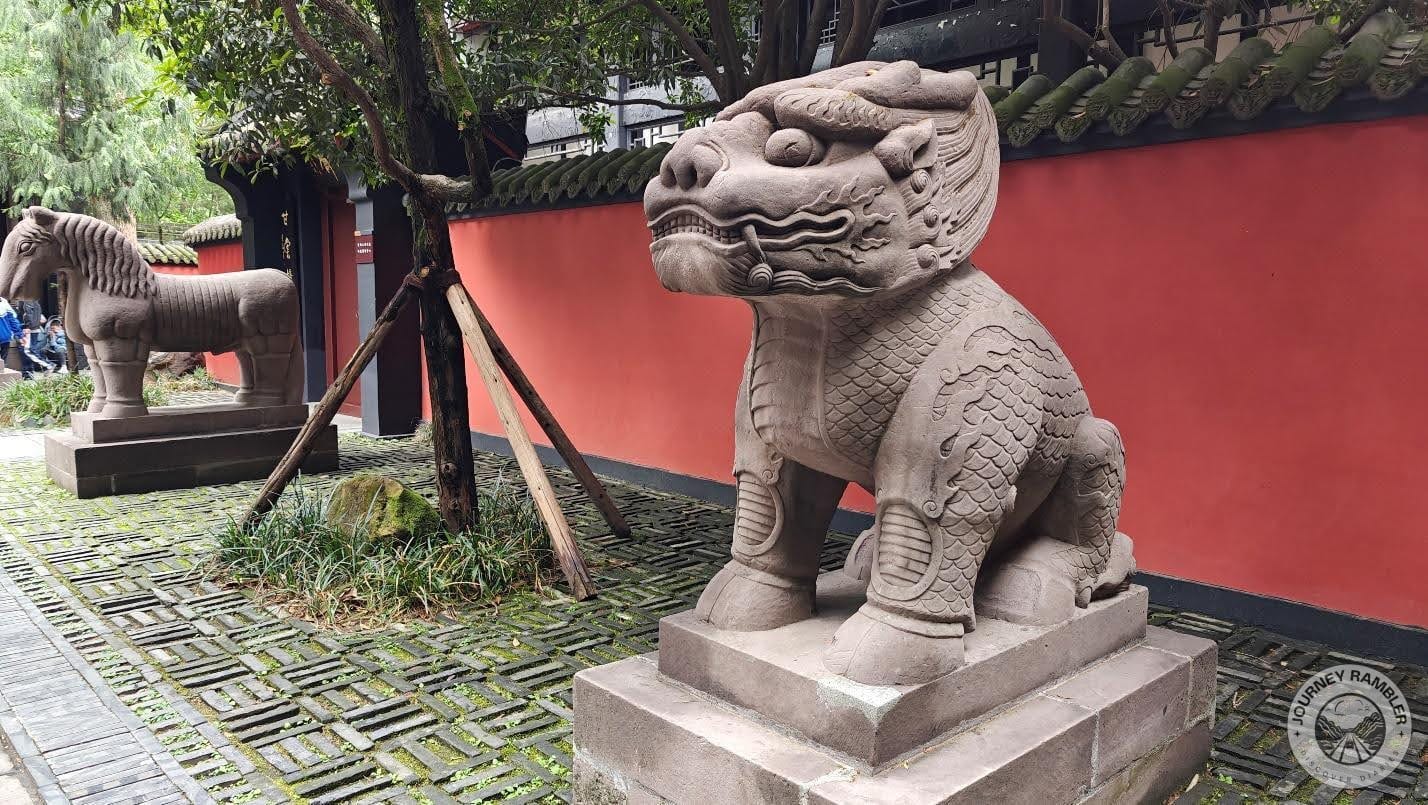
Here’s a closer look at one of the statues of mythical creatures that line the pathway leading to Hui Mausoleum. Like I said earlier, it looks relatively new though I could be wrong. From what I’ve been told, this mythical creature is a guardian lion and the one after it is a stone horse statue.
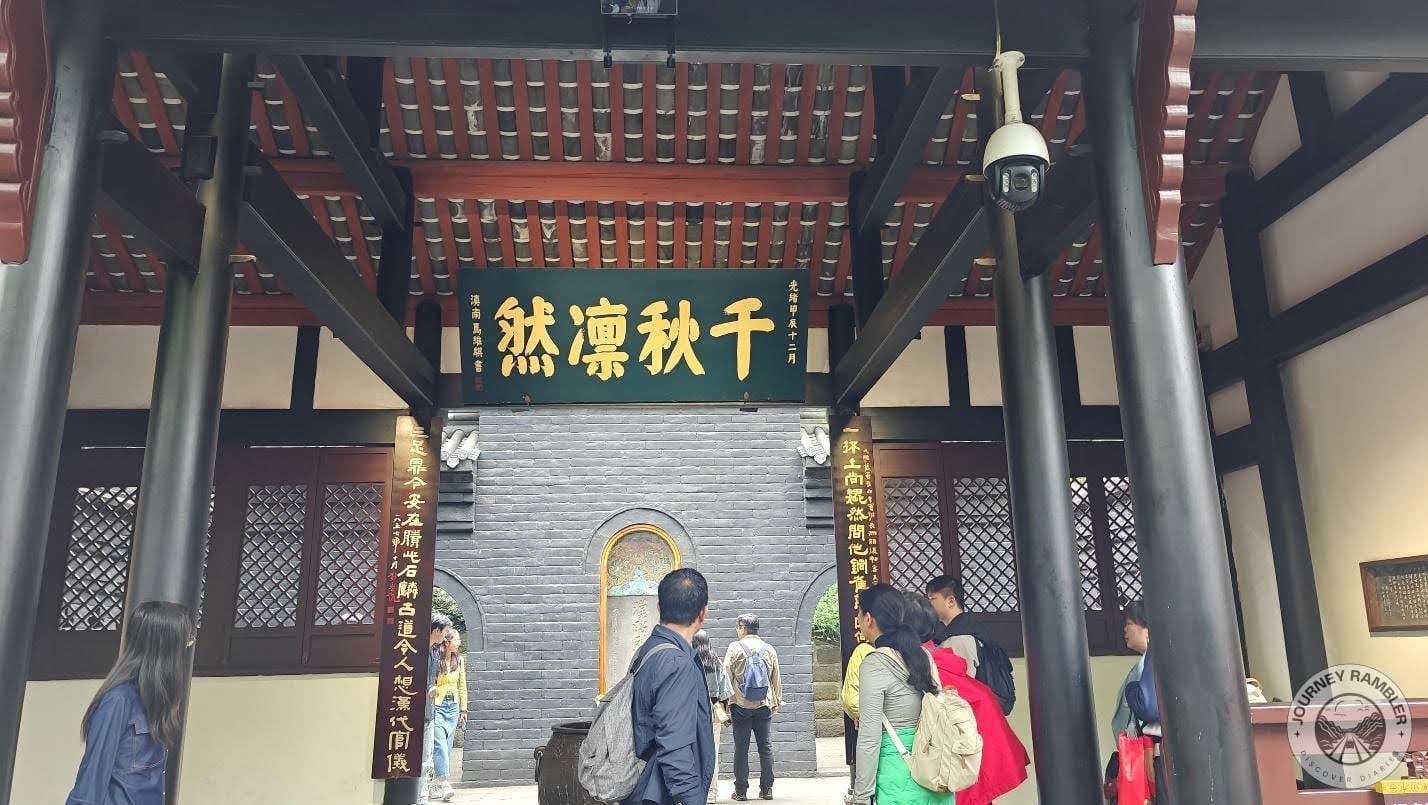
This is the gate just before the mausoleum. I’m not sure what happened but by the time I got here there weren’t that many people. This actually suited me though as crowds here can be quite draining at times.
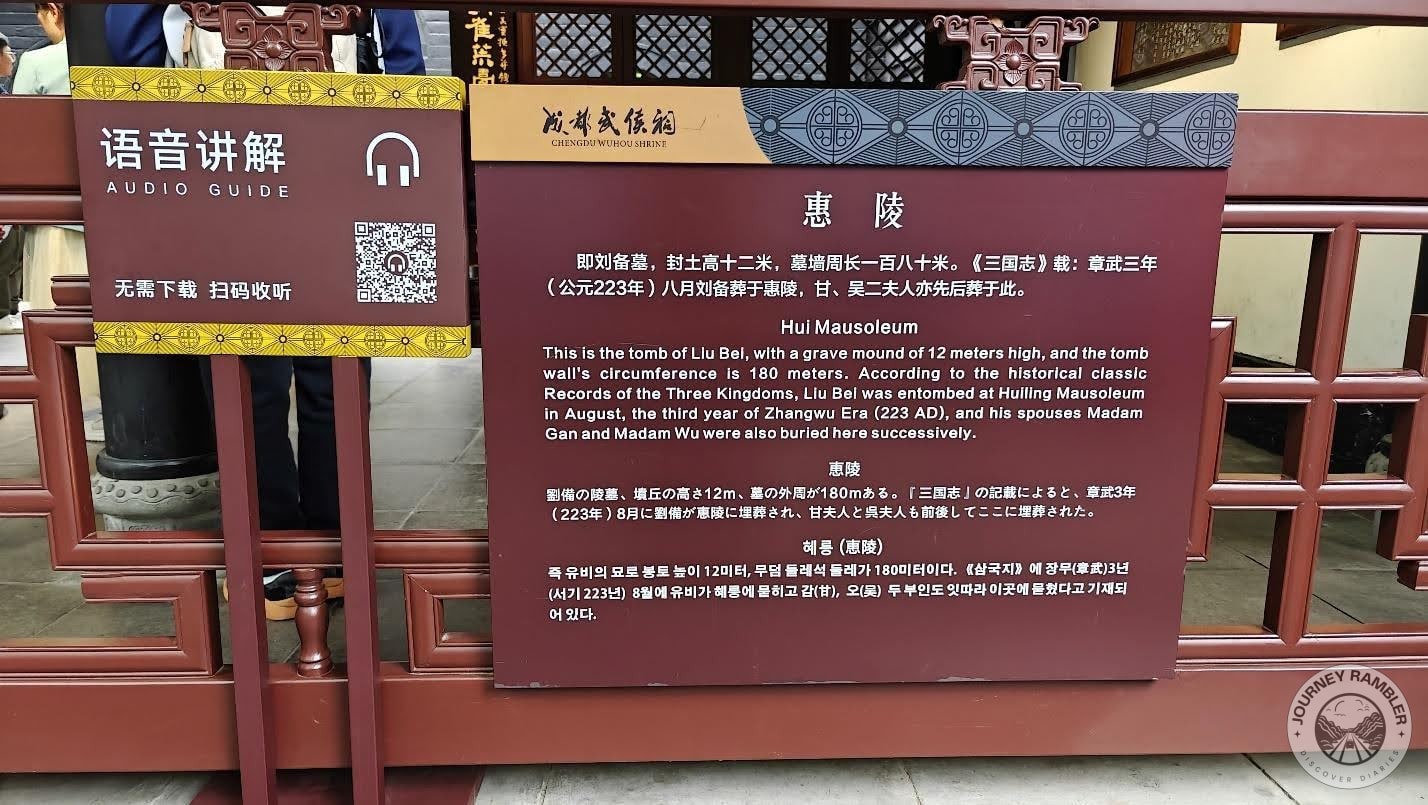
Here you’ll see a sign with a quick summary of Hui Mausoleum. It’s basically the resting place of Liu Bei along with his wives Madam Gan and Madam Wu. If you’re not keen to read then scan the QR on the smaller sign and you can hear an explainer of the site’s purpose and significance.
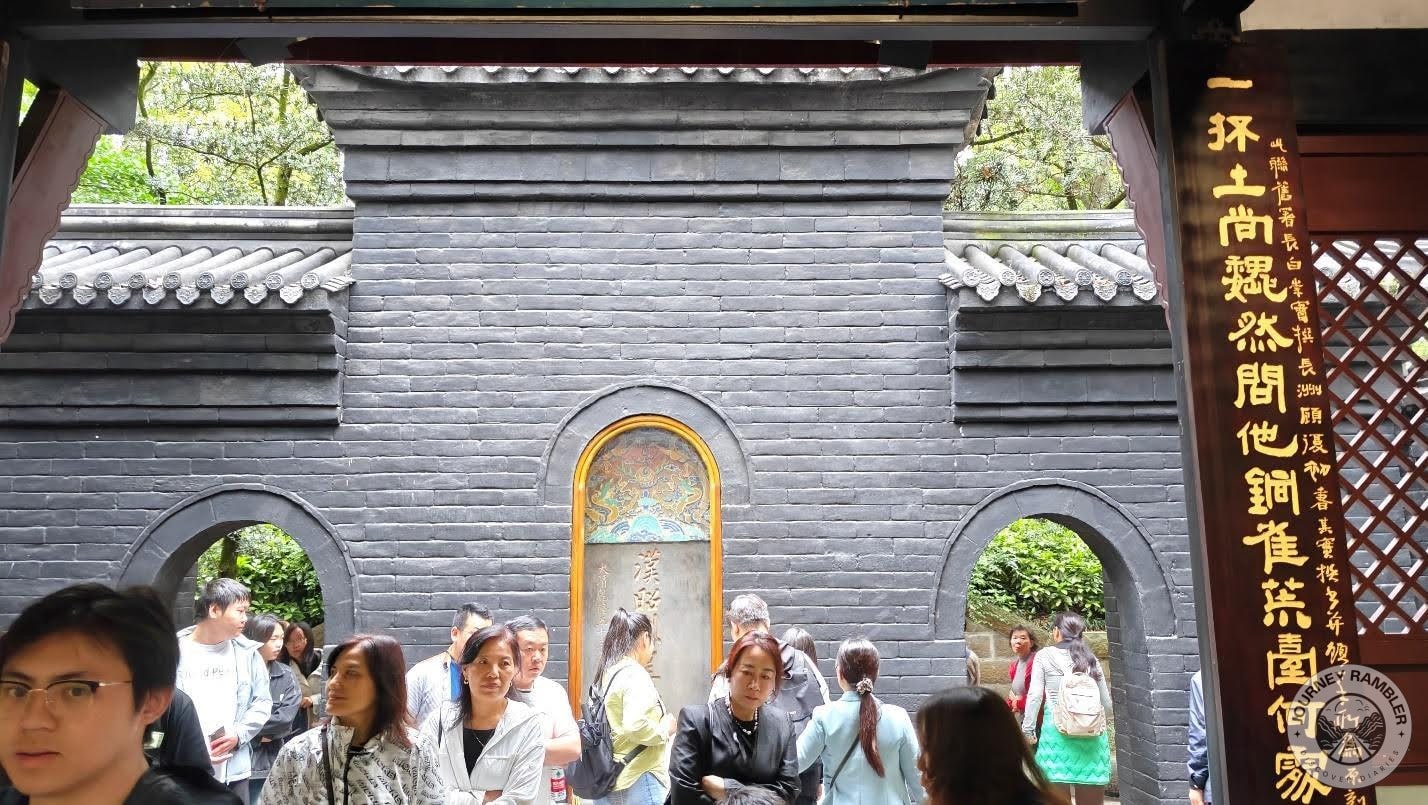
And there it is. I actually expected Liu Bei’s tomb to be much larger and grander considering his status. What I didn’t know is that this is basically just his tombstone.
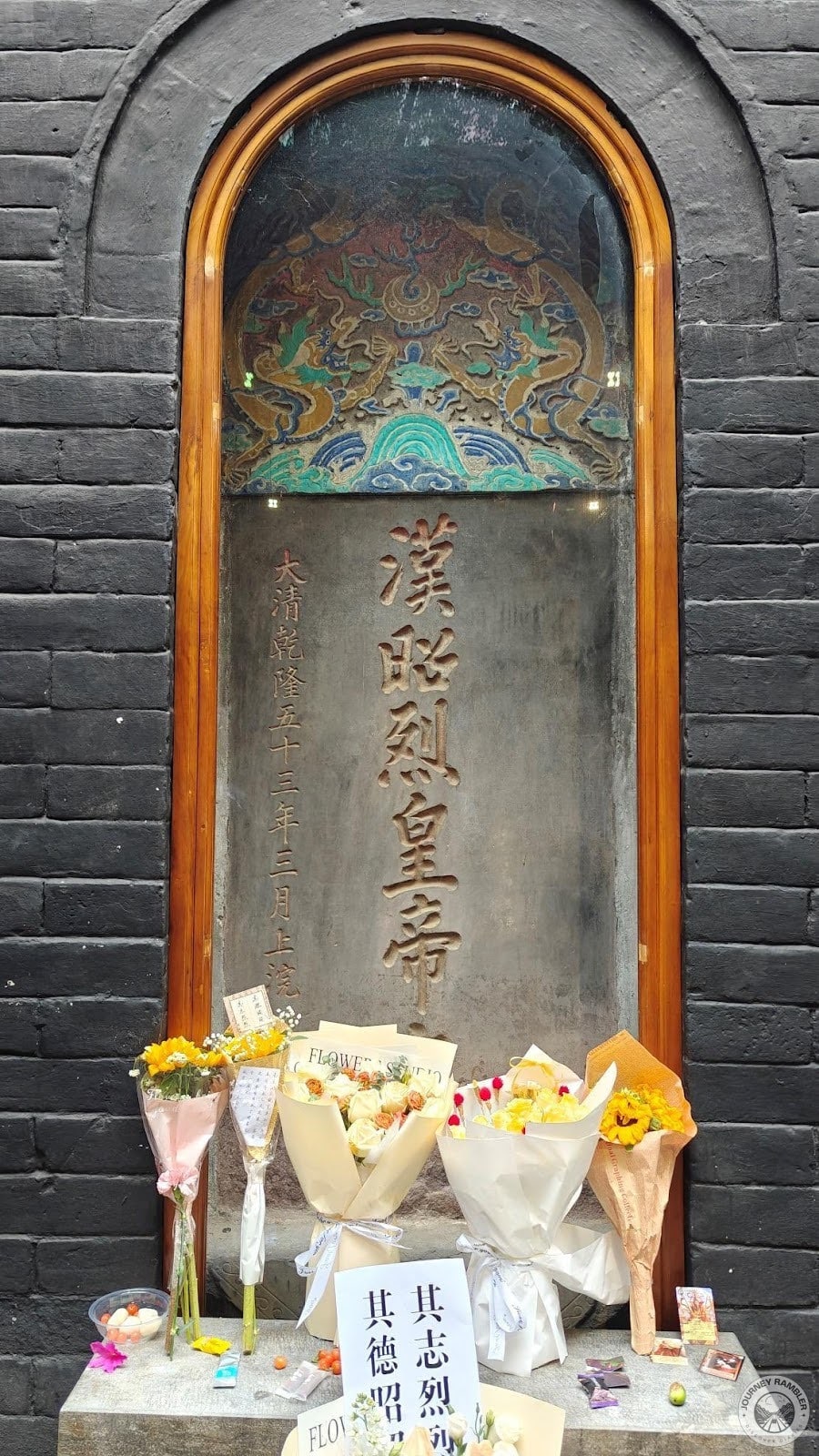
It’s kind of surprising how revered Liu Bei and Zhuge Liang are. I kind of knew that they were a big deal in China thanks to the Dynasty Warriors games but their popularity only really sunk in when I visited Wuhou Shrine. In Liue Bei’s case, I noticed how visitors often leave flowers as well as other merch like playing cards that feature him on his tombstone as well as his statues.
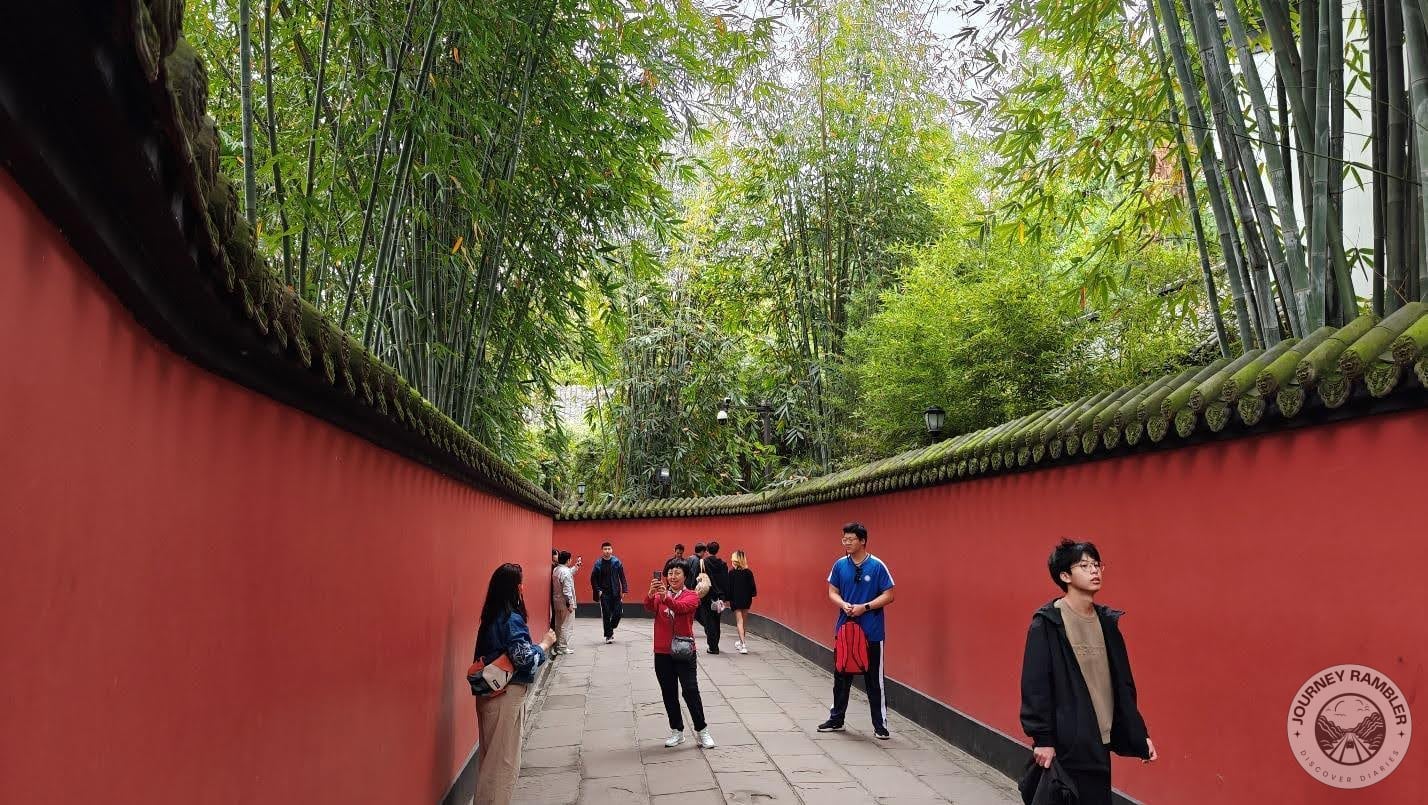
Here’s the famed Red Walled Alley that encircles Liu Bei’s tomb. Like I said earlier, the tablet with the epitaph earlier was just his tombstone. His tomb is actually much larger and it’s encircled by this red colored wall.
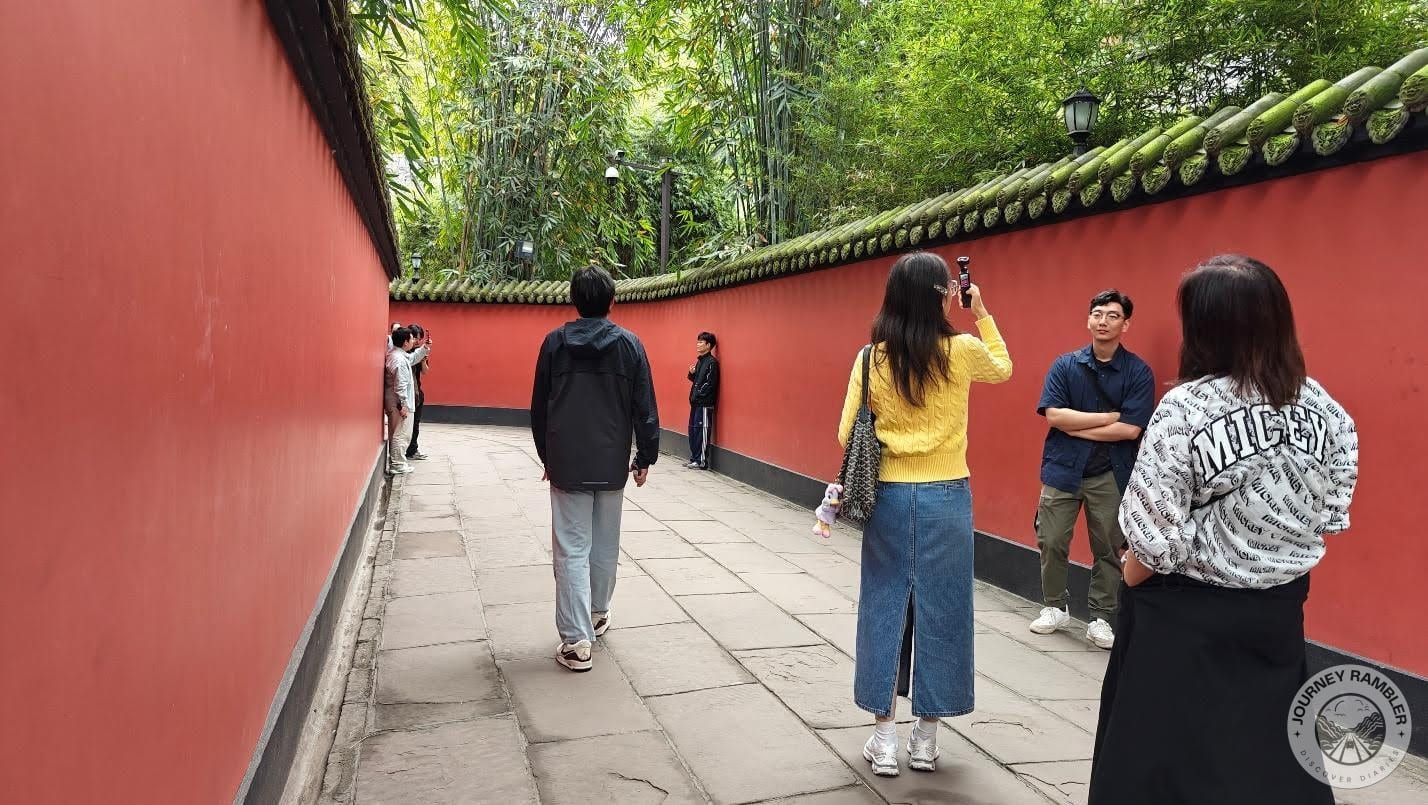
Much like a lot of Chinese emperors’ tombs, Liu Bei’s is an earth mound. It’s not as massive as Qin Shi Huang’s but it also hasn’t been excavated. If I’m not mistaken, the red walls also serve to protect the mound though I’m not quite sure how long it’s been here.
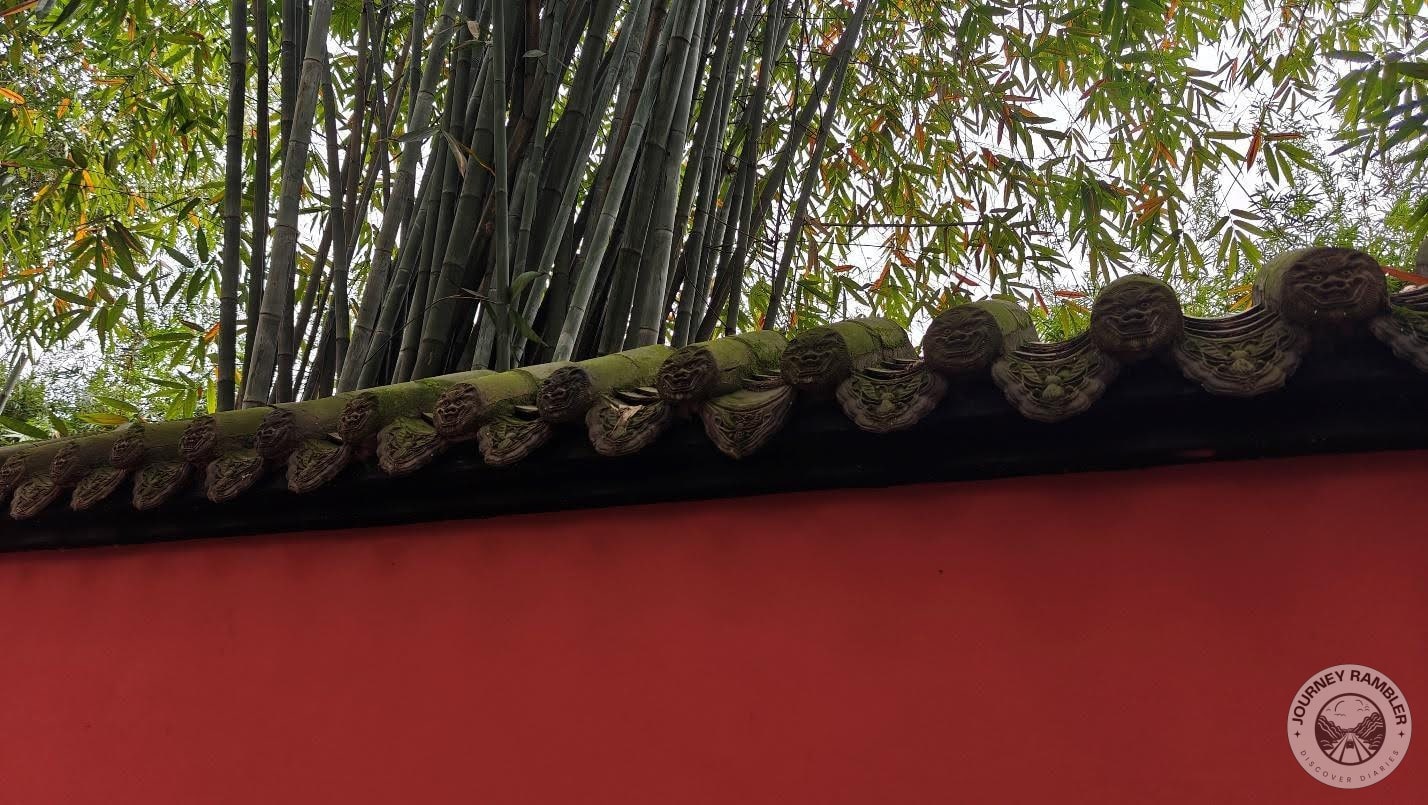
One thing that also impressed me about the alley was these tiles on the wall’s roof. I’m not quite sure what these are called but they look really intricate. I don’t think most people will notice these though as they’re likely going to focus on taking selfies with the alley as the background.
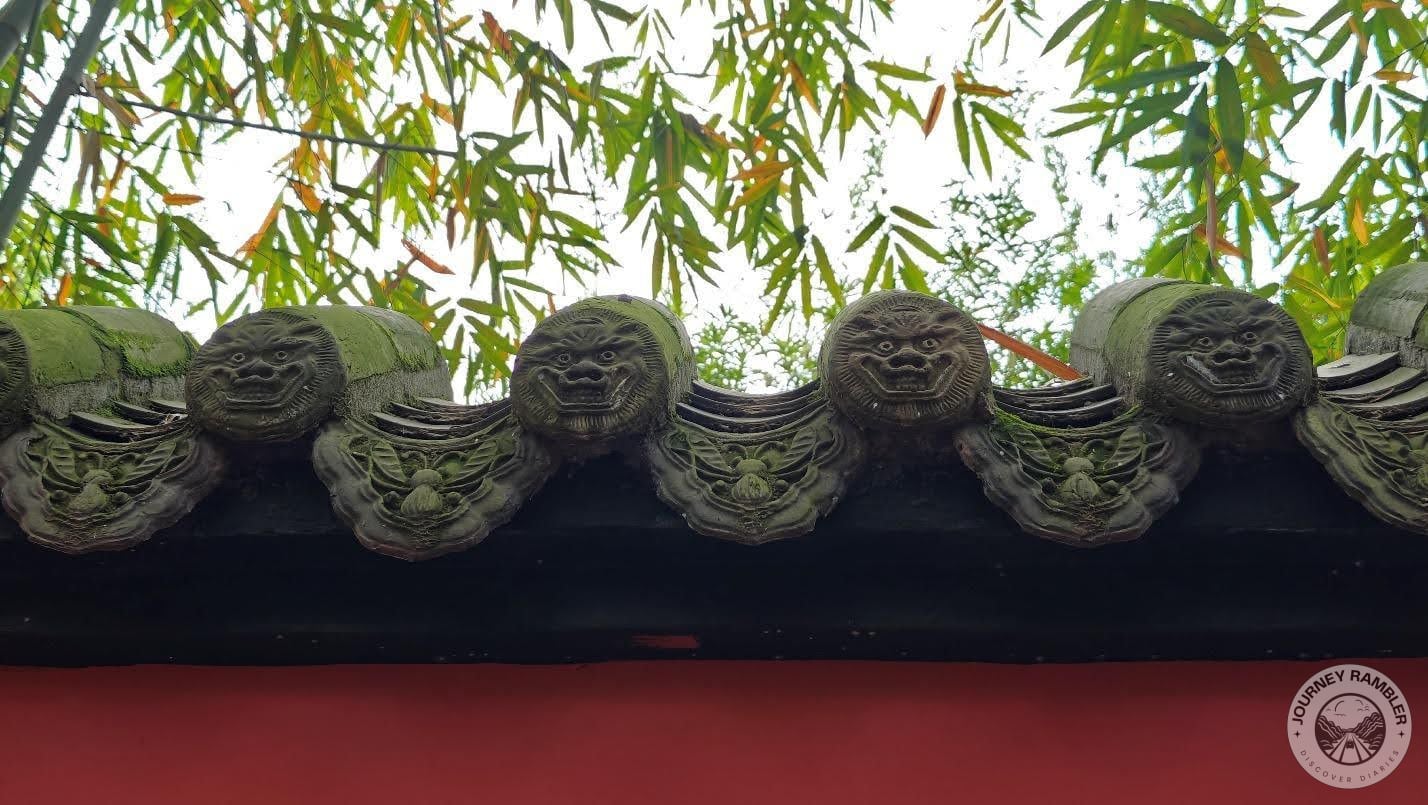
I’m not going to lie though, the faces do look kind of goofy. If I’m not mistaken, these are either dragons or lions since those are considered symbols of protection in Chinese mythology. I mean, who better to protect an emperor’s tomb than these mythological creatures?
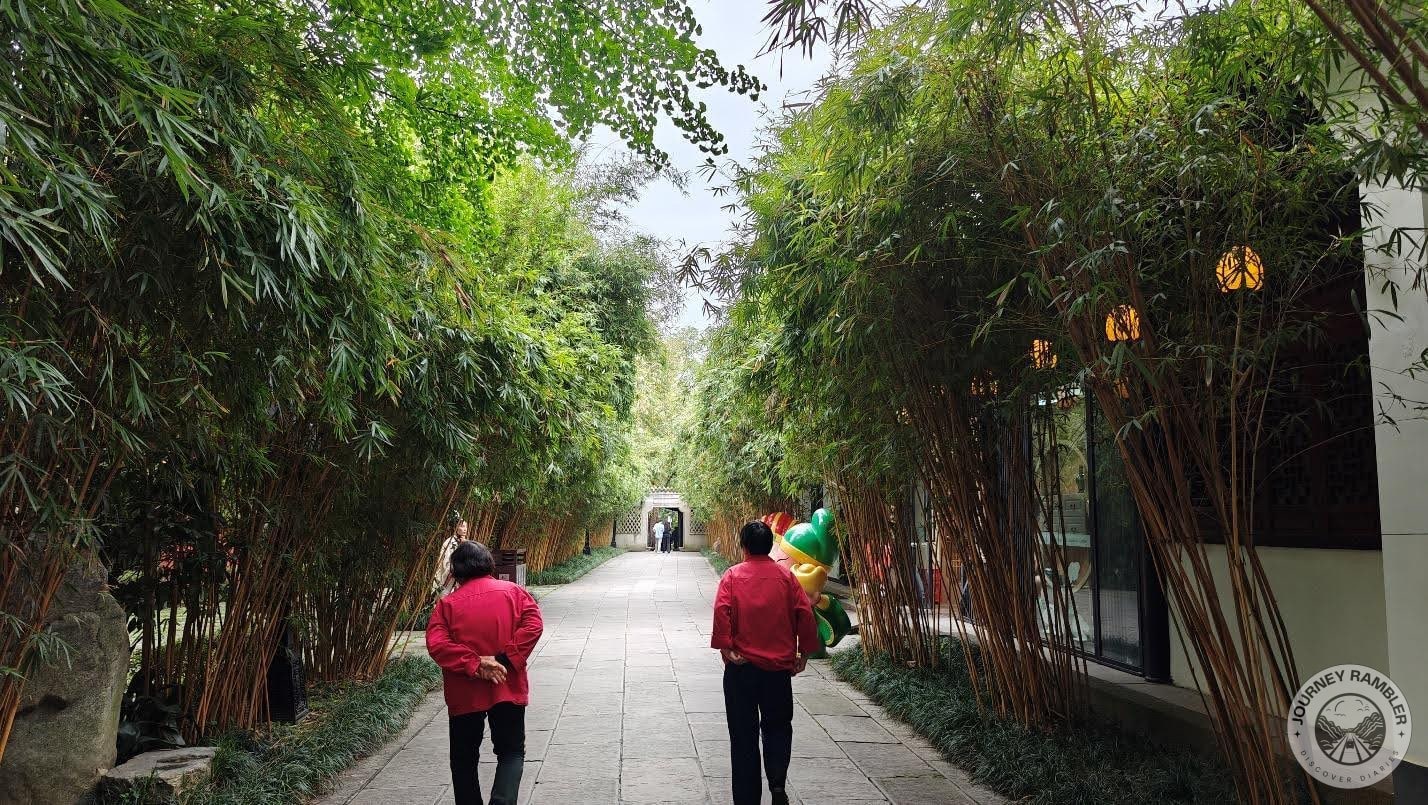
After seeing what the Red Walled Alley had to offer, I then went back to the main entrance of the Hui Mausoleum area. There was a pathway nestled between the mausoleum area and the Military Officer Gallery building that I then followed. This was a short but relaxing walk that would lead me to the Sanyi or Three Sworn Brothers Hall.
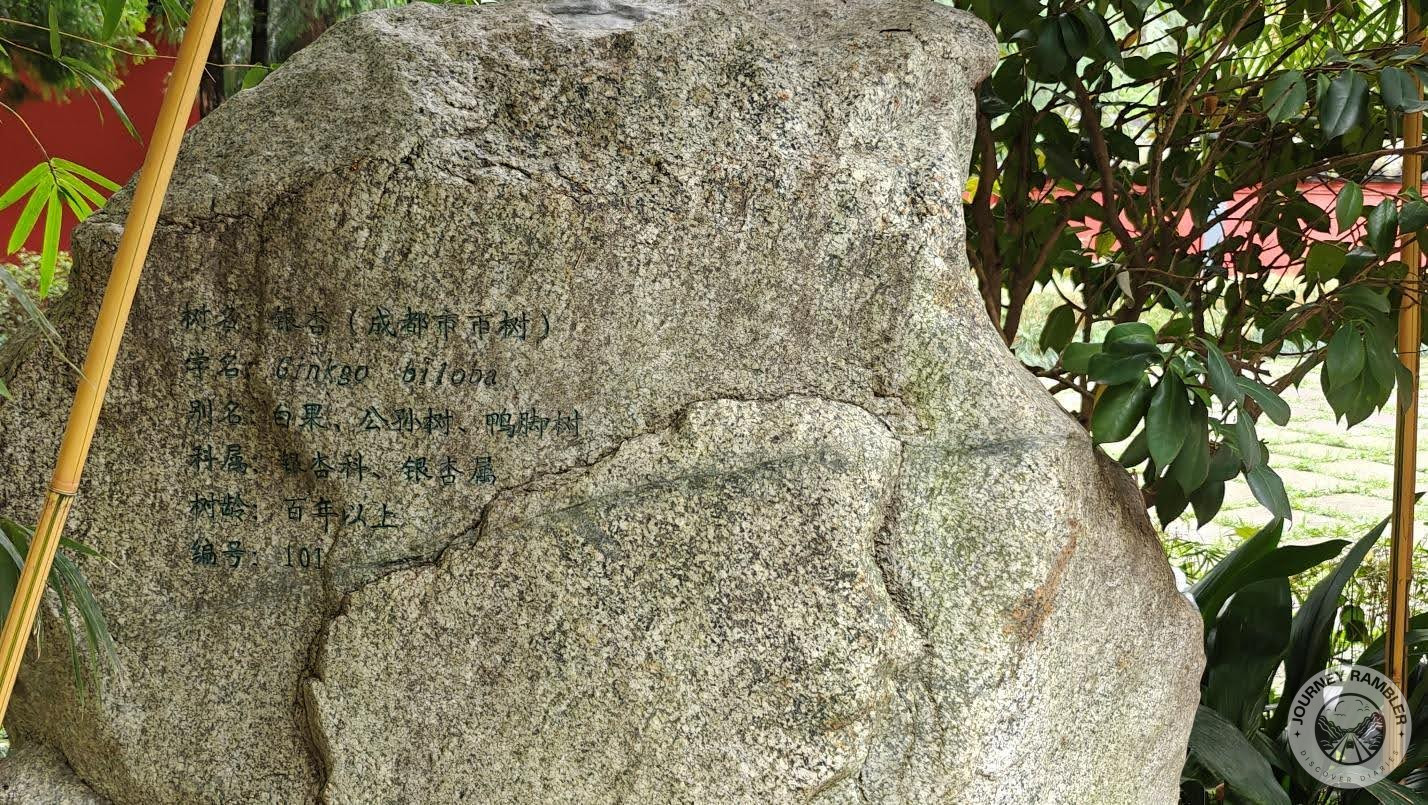
Before I got there though, I came across a number of attractions and sceneries that piqued my attention. This one is a sizable slab of stone with an inscription on it. Using my translation app, I found out that this describes a Ginkgo Biloba tree (Chengdu’s tree) that’s been around for a hundred years.
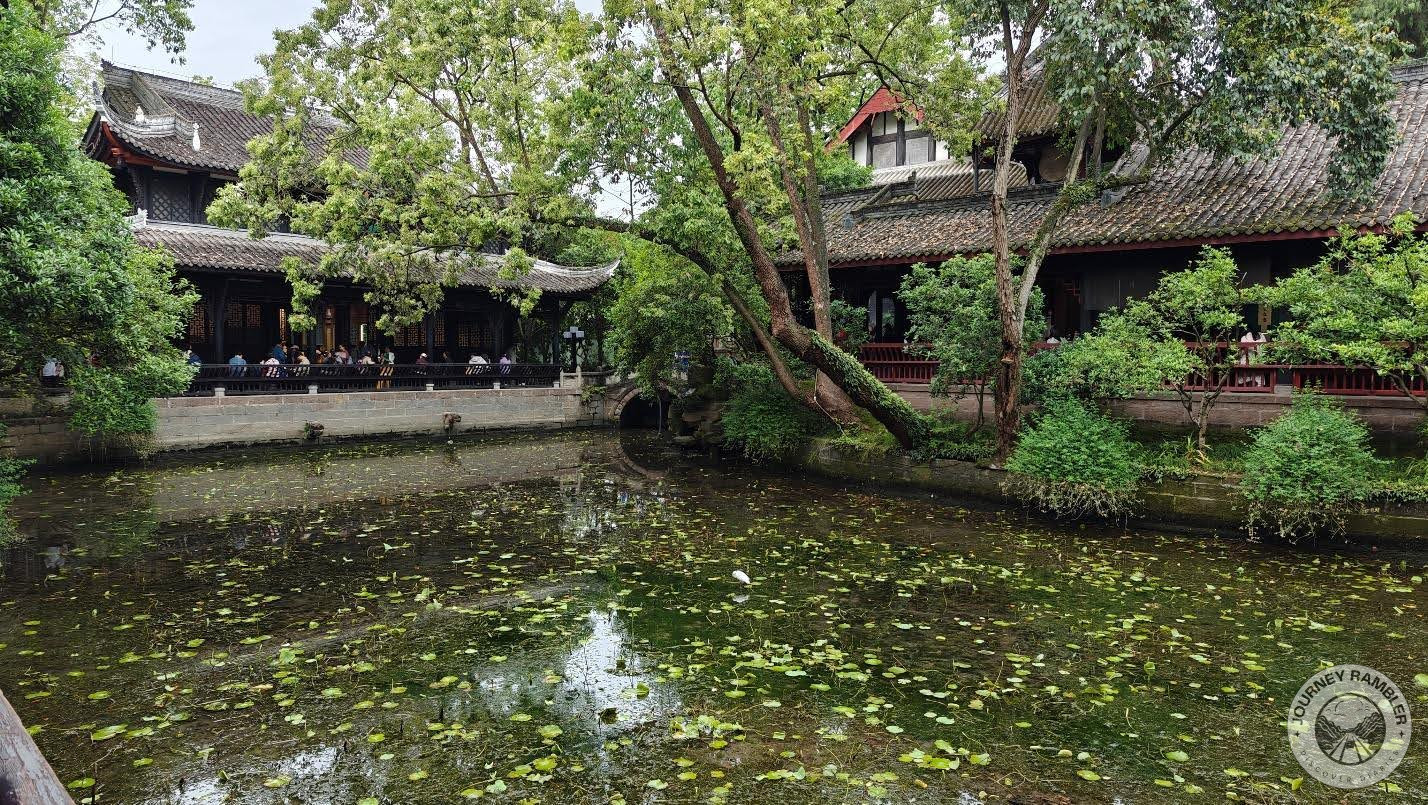
After a short walk, I came across this pond that looked like it could use some cleaning. Across this on the right is the building which has the Zhuge Liang Hall. It’s not shown but to my left, is the Red Walled Alley.
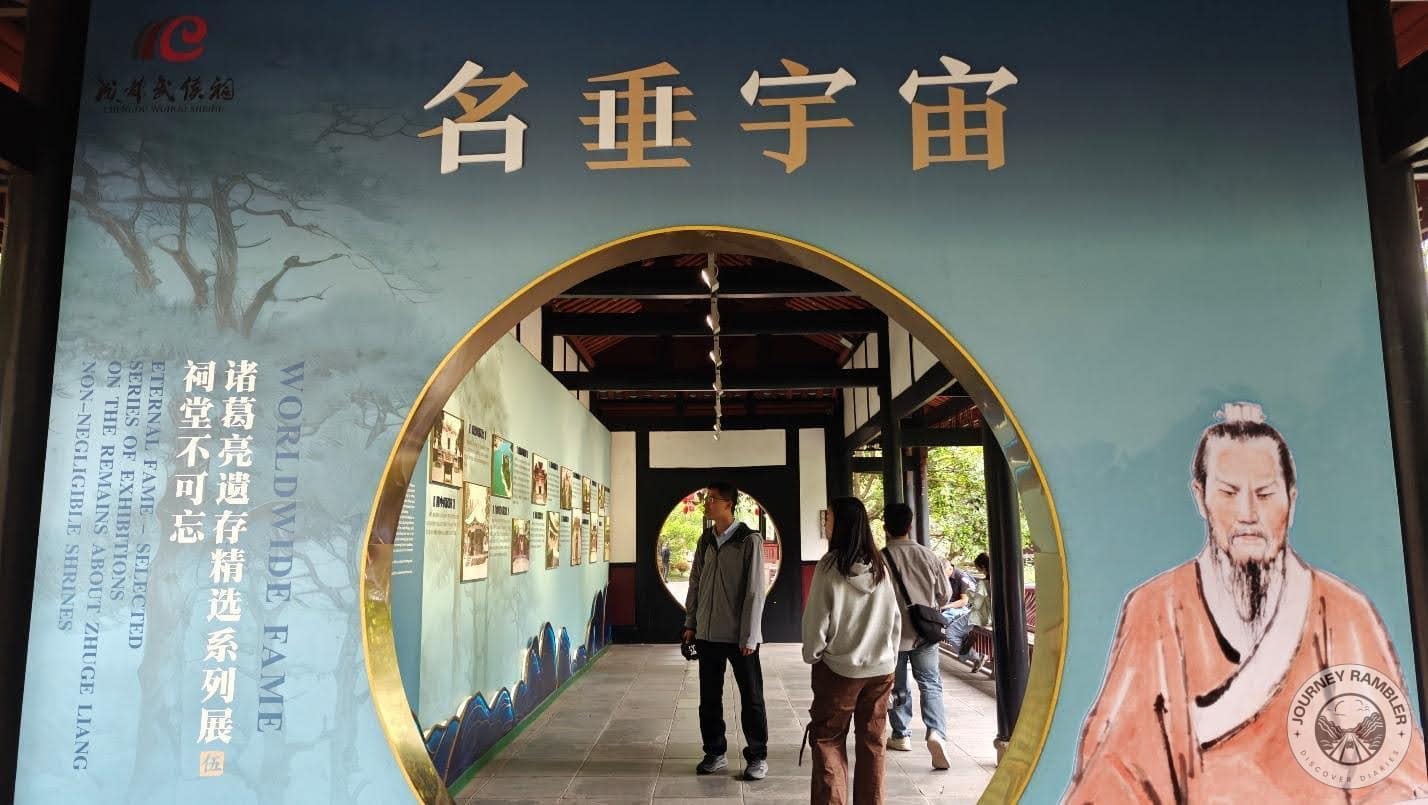
Another stop that I made before going to the Three Sworn Brothers Hall is here at this exhibit. It’s dedicated to Zhuge Liang and its theme is about Eternal Fame and how the master strategist was able to achieve it. The exhibition really just shows images of the various relics and locations that celebrate him.
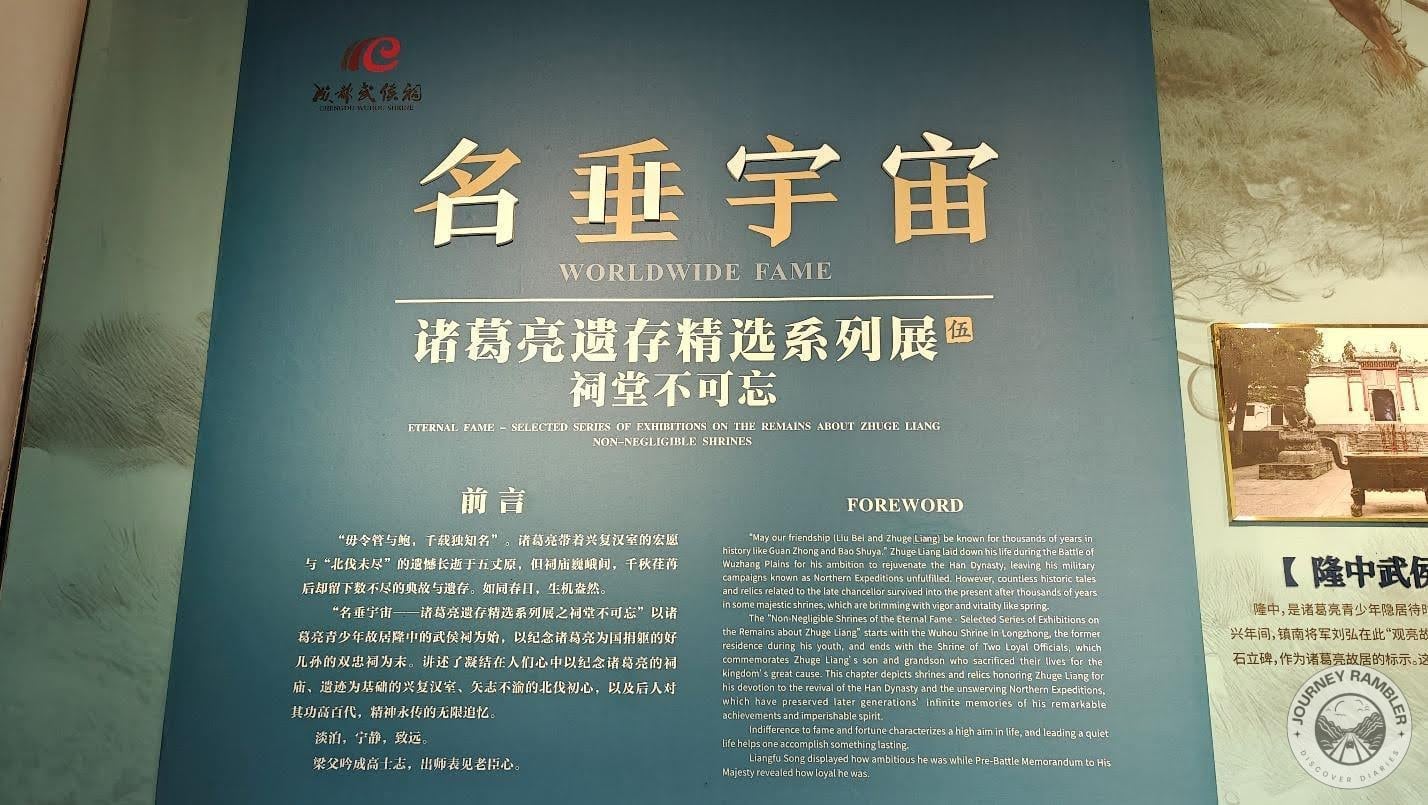
Here you can read about the exhibit and what it’s really about. Unfortunately, the English used in this translation is kind of archaic so it might be a little hard to understand. I’ve found that there are times that Google Lens actually puts up better translations so you might want to use that as well.
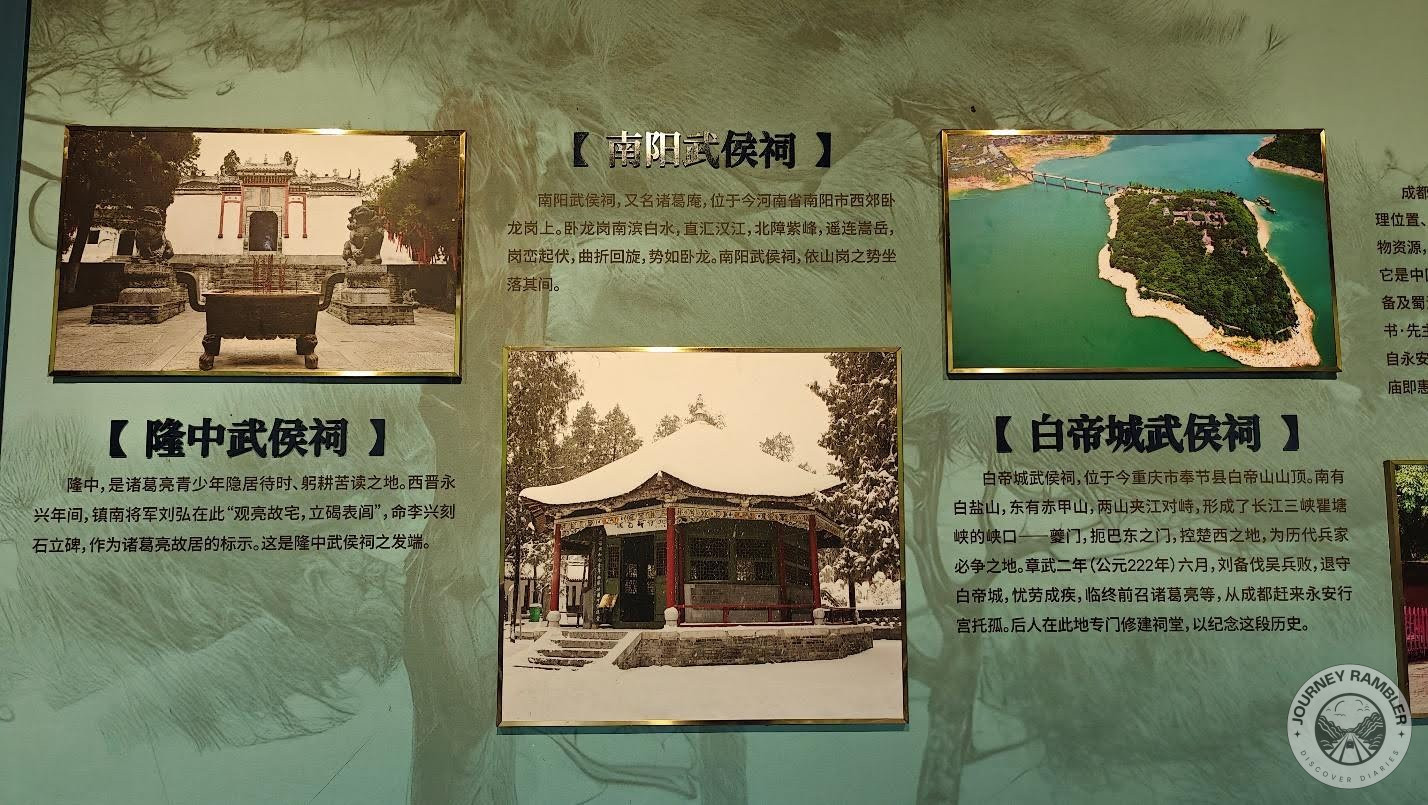
Here are pictures of some of the shrines dedicated to Zhuge Liang. The left-most is an image of the Longzhong Wuhou Shrine with the middle image being another Wuhou Shrine in Nanyang. The right-most is another shrine dedicated to the master strategist that’s located in Chongqing.
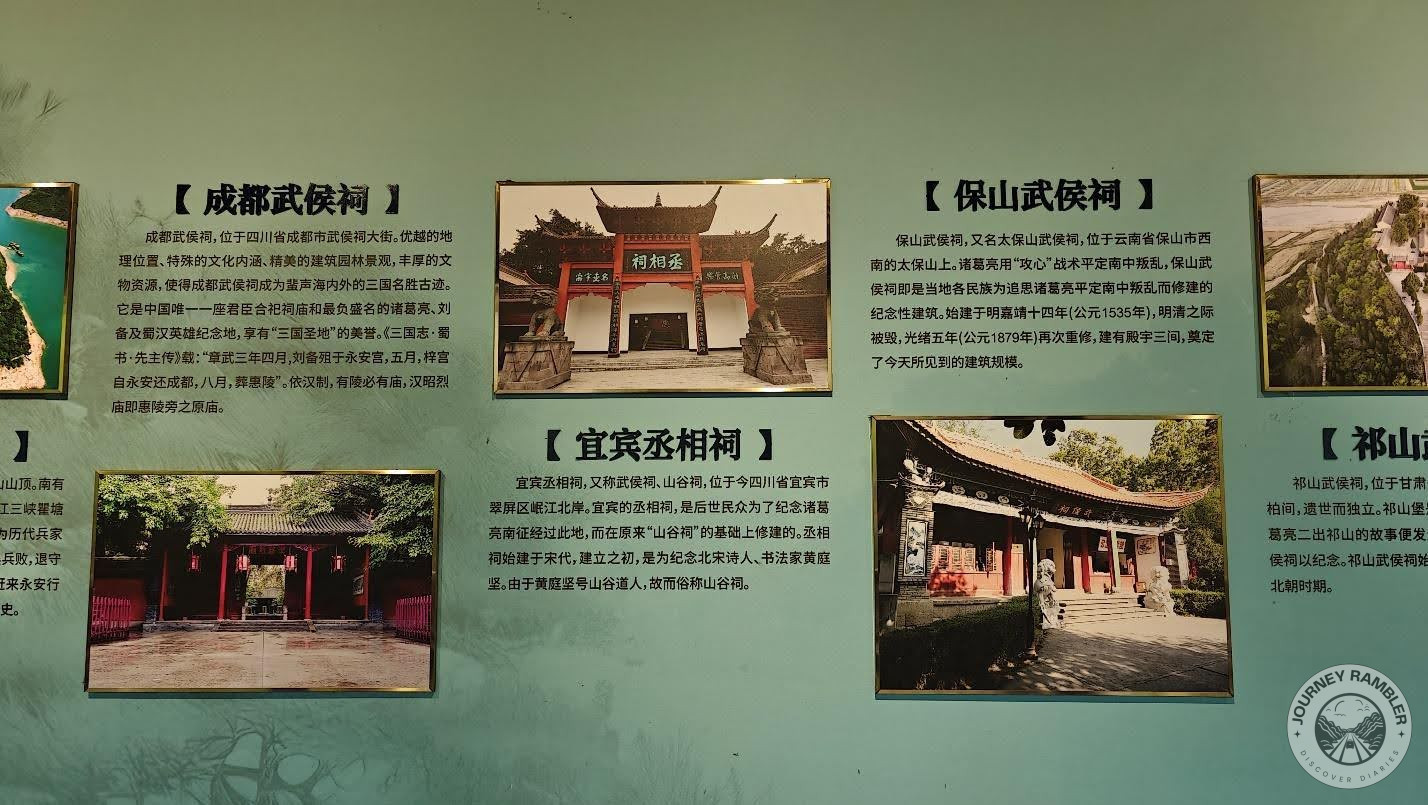
Of course, an image of the Chengdu Wuhou Shrine is also included here. Another shrine within Sichuan is the Yibin Ancestral Hall (middle image). Outside of Sichuan, there’s a shrine in the city of Baoshan in Yunnan Province.
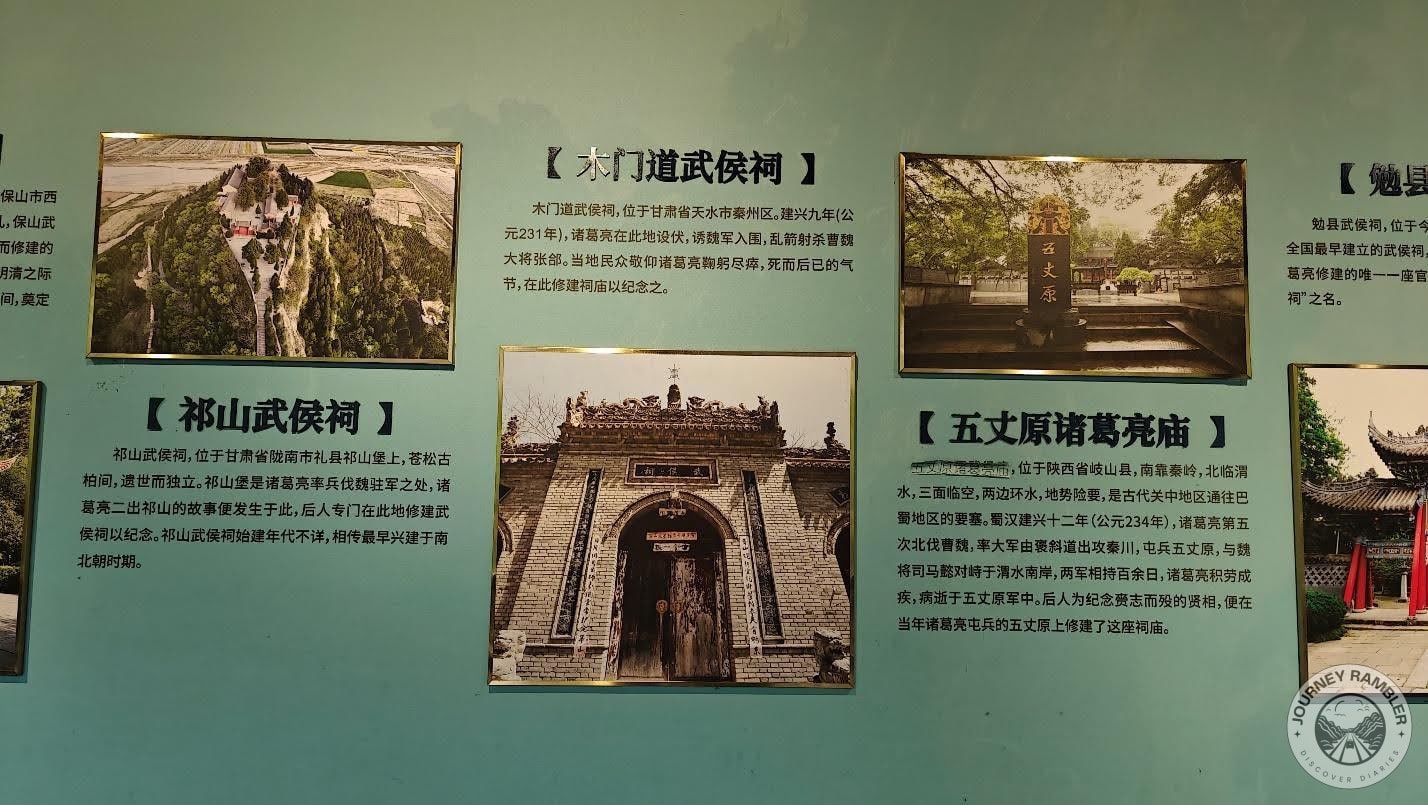
This next set of shrines are also found outside of Sichuan, specifically in Gansu Province. The left most is found at Qishan Fortress in Mount Qi, Longnan City. Also found in Gansu Province is the Mumen Dao Wuhou Shrine which is located in Tianshu. As for the image on the right, it’s of the Wuzhang Plains Zhuge Liang Temple in Shaanxi Province.
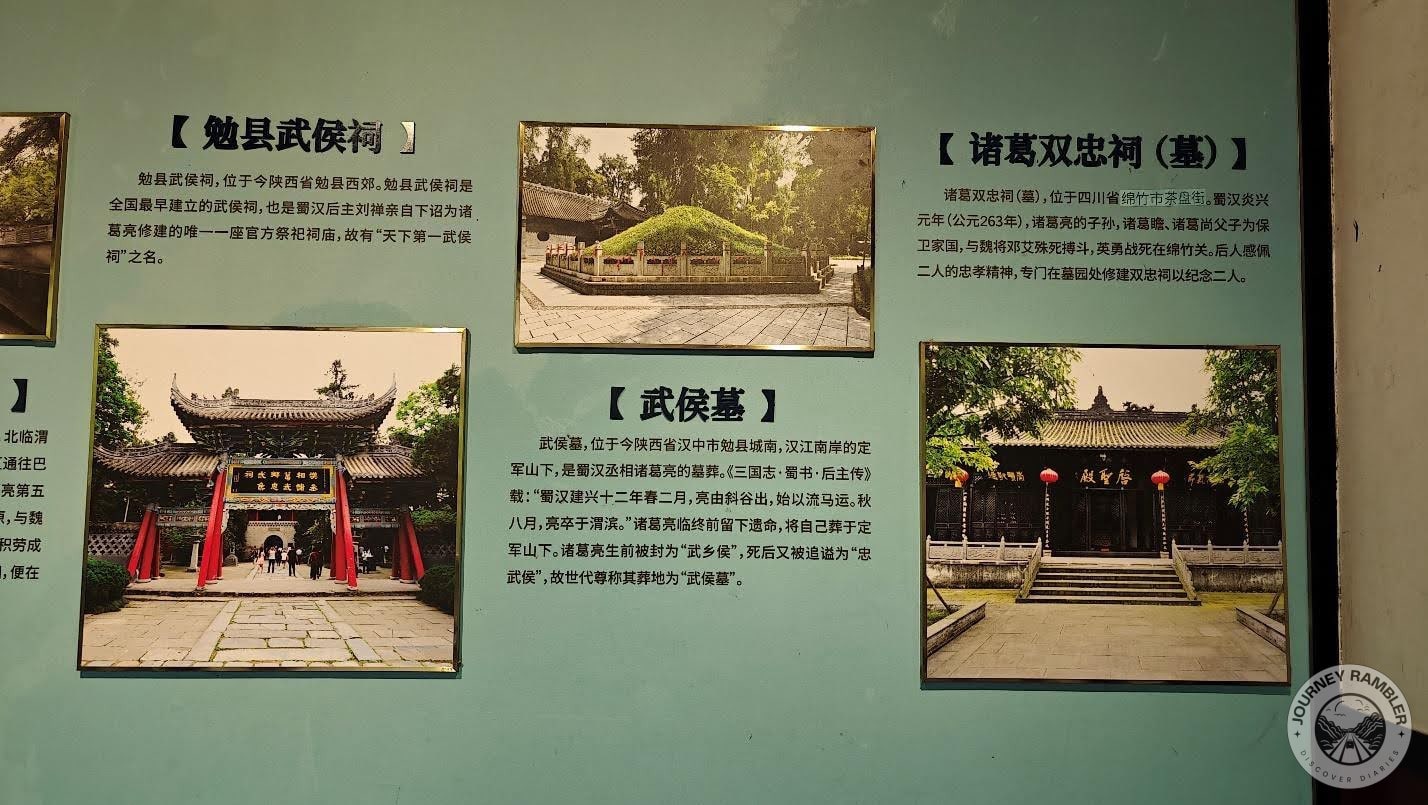
The final images of this section of the exhibit are of the Mianxian Wuhou Shrine, Zhuge Liang’s Tomb in Mian County, and the Shrine of the Two Loyal Zhuges here in Sichuan. Of these, only the last is not specifically for Zhuge Liang. Instead, it’s for his son Zhuge Zhan and grandson Zhuge Shang.
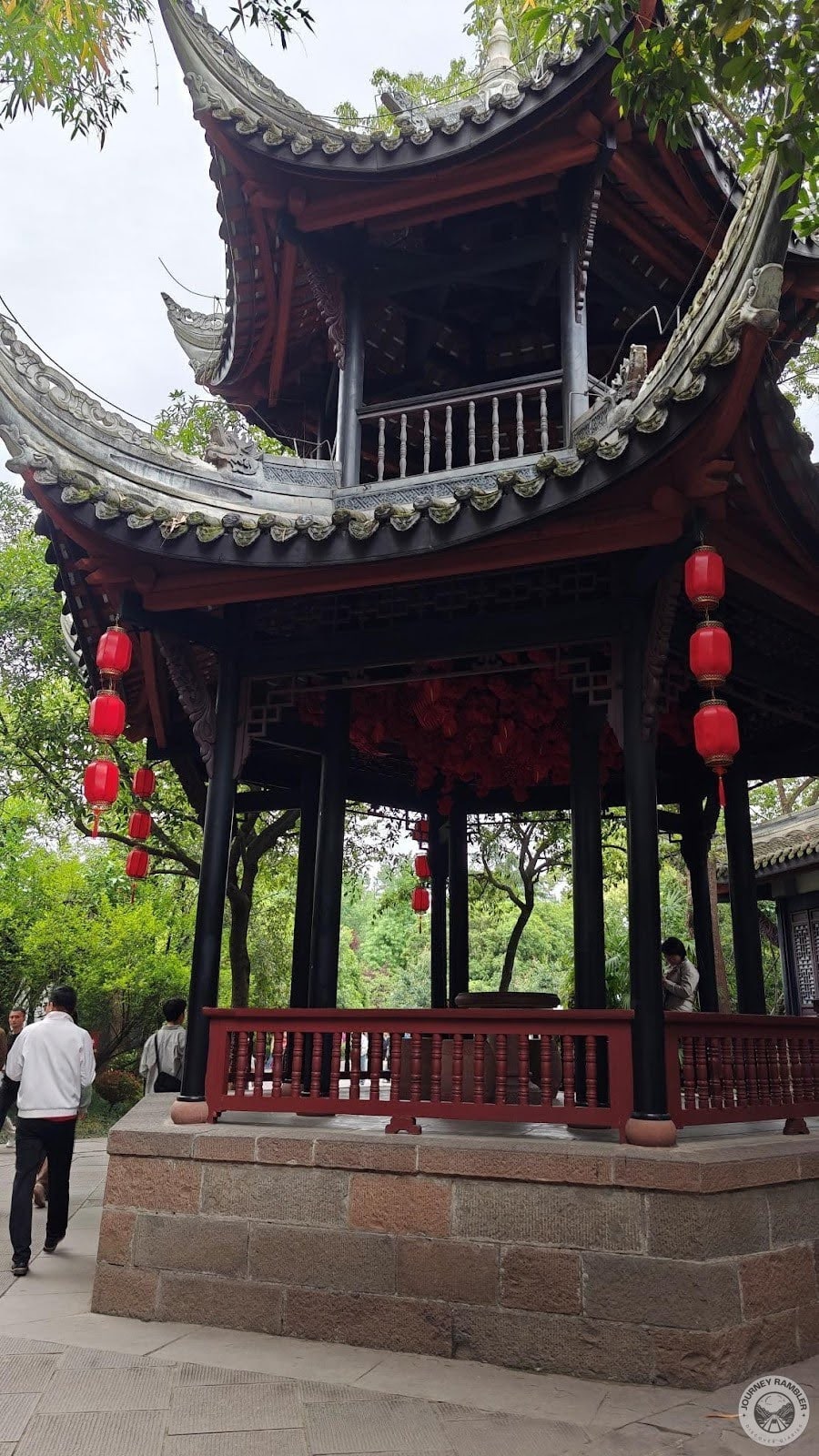
If I’m not mistaken, this is called the Guihe Lou or Guihe Tower. I have no idea how old the building is but it does feature one of my favorite aspects of traditional Chinese architecture. If you look at the columns, those are actually sitting on top of a stone base called zhuchu that provide a “sliding isolation” effect that helps reduce the effects of earthquakes on the building.
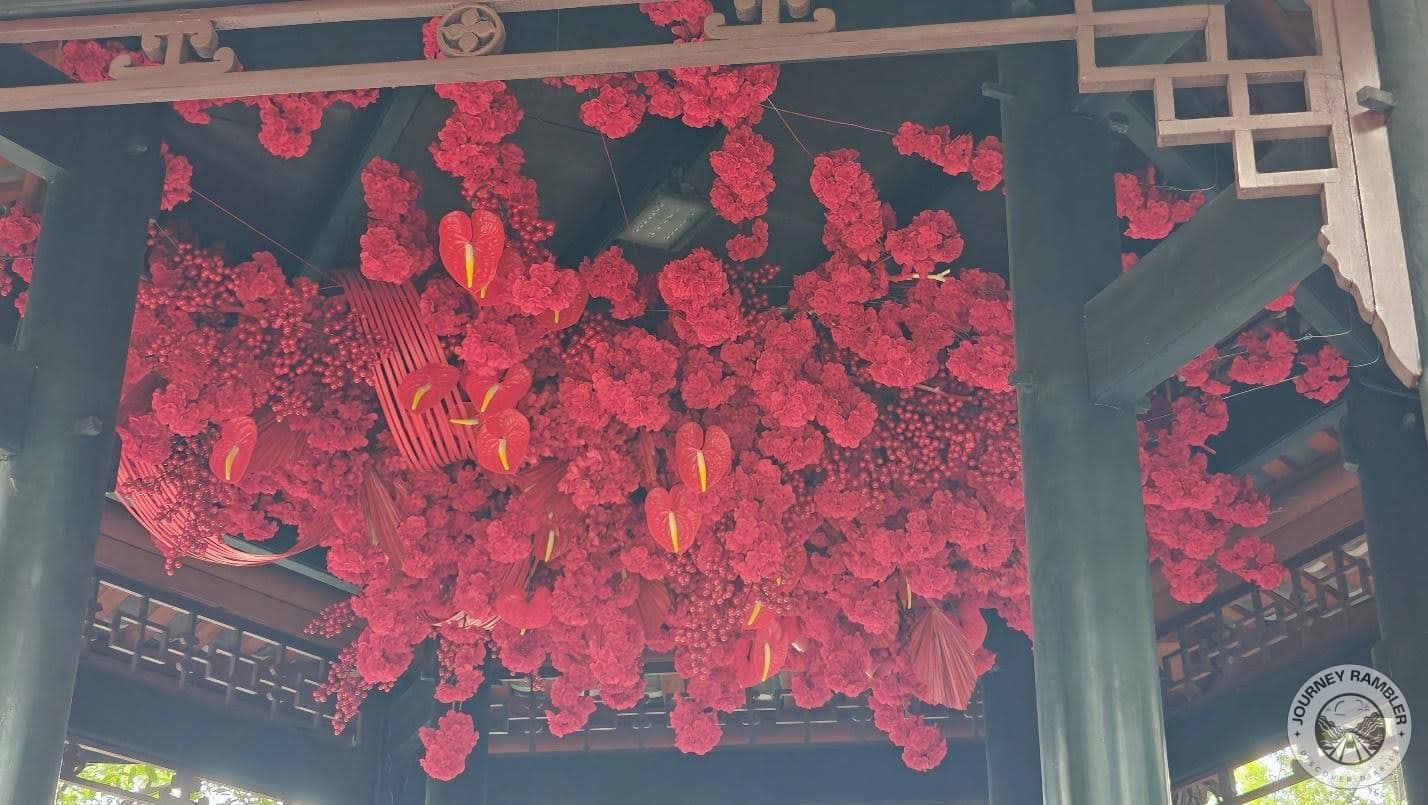
Another notable feature of the tower is its ceiling. Here’s a closer look of it with its red flower decorations. I’m not quite sure about the anthuriums here though as I’m pretty sure these weren’t around during the Romance of the Three Kingdoms period.
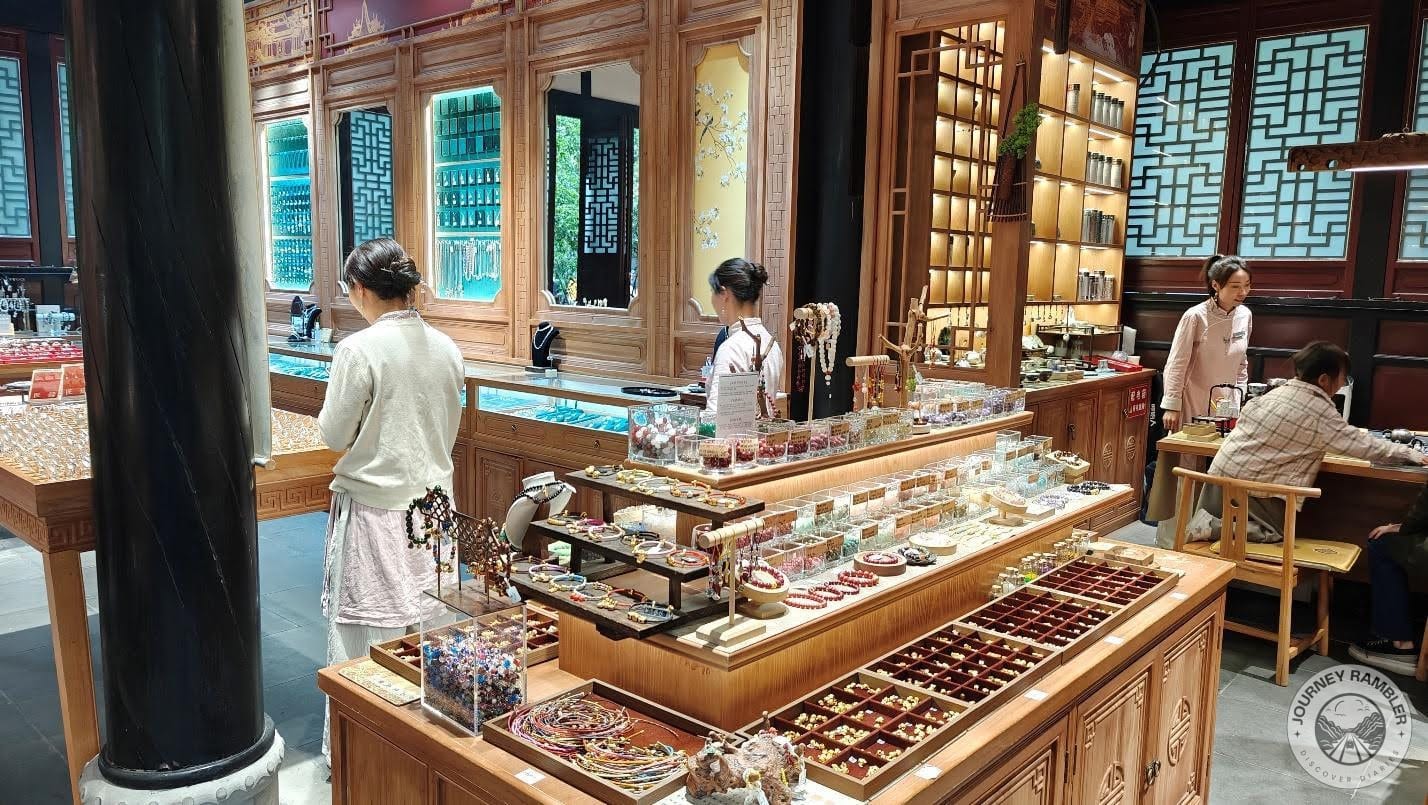
Of course, there’s also a shop here that sells trinkets and other souvenir items. A lot of the trinkets here were really colorful and I was actually tempted to buy some for people I know back home. That said, these are a dime a dozen and you might be able to find some that look better or cheaper at Jinli Ancient Street.
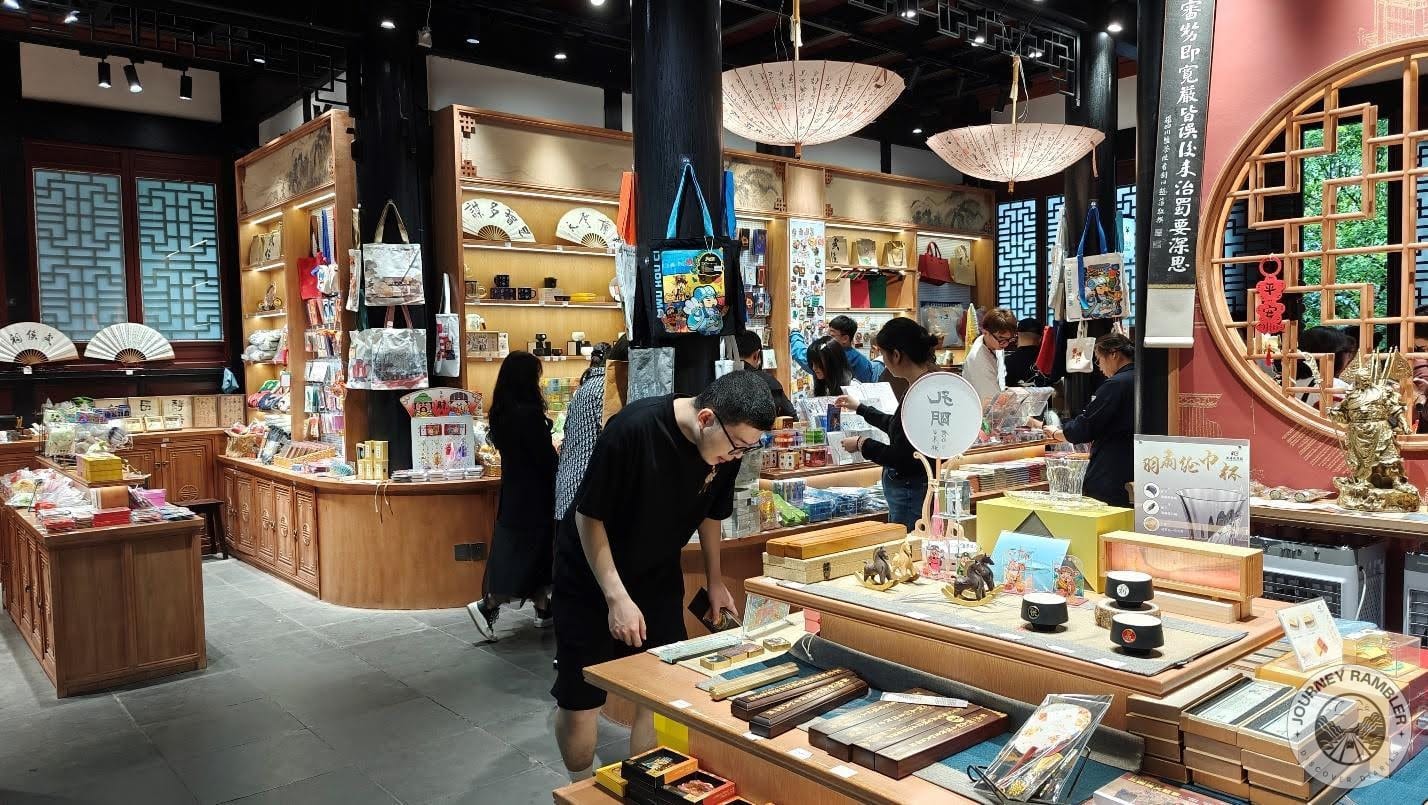
The great thing about buying here though is that it’s not as busy and I think it’s much more convenient. I personally didn’t end up buying anything but I was able to appreciate how cozy this place was. If I do return here though, I’d be sure to get maybe an ecobag or two as the ones that I saw here looked really cool.
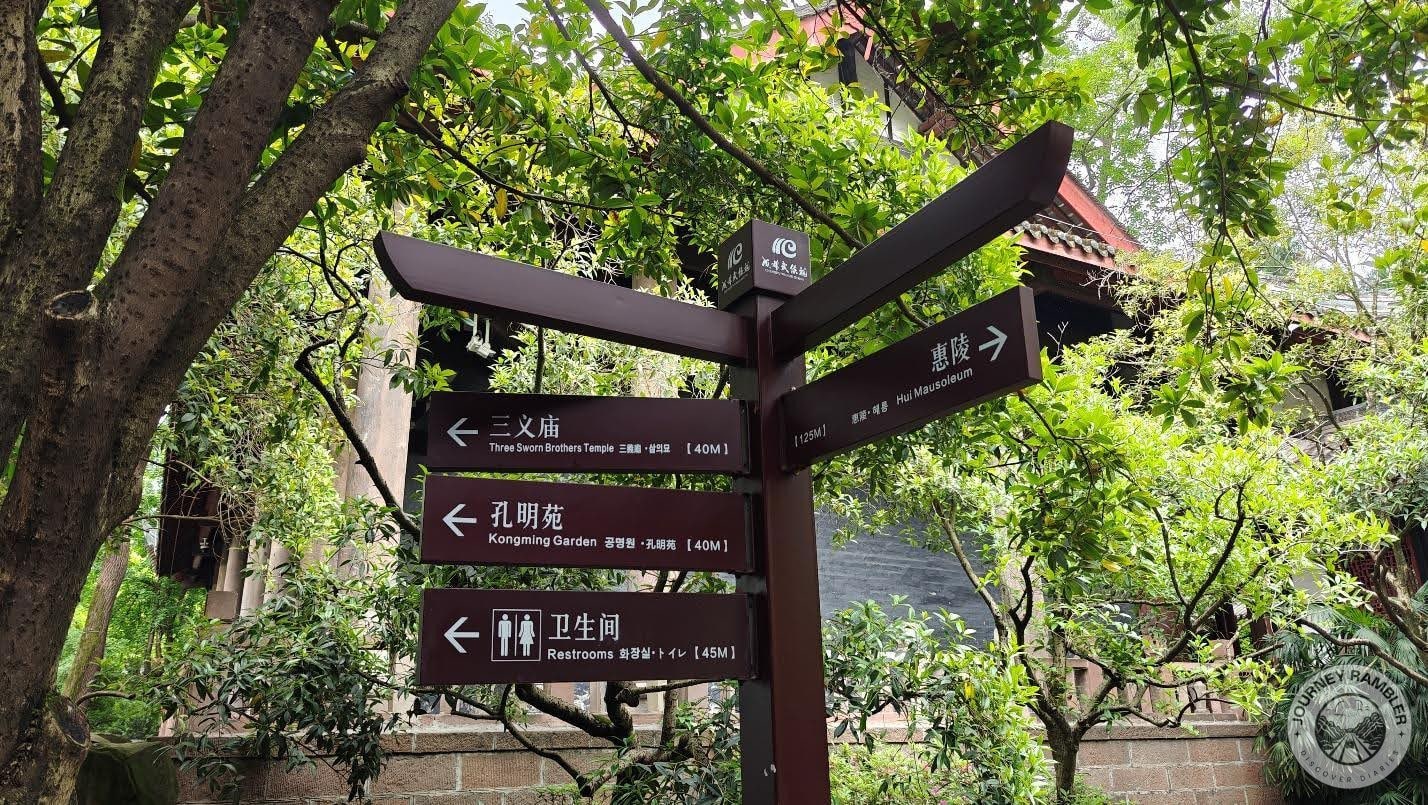
Now it’s finally time to walk over to the Three Sworn Brothers Temple. Here’s a sign pointing to the temple’s direction. There’s also a beautiful garden nearby with a pond that’s called Kongming Garden that you might want to check out as well.
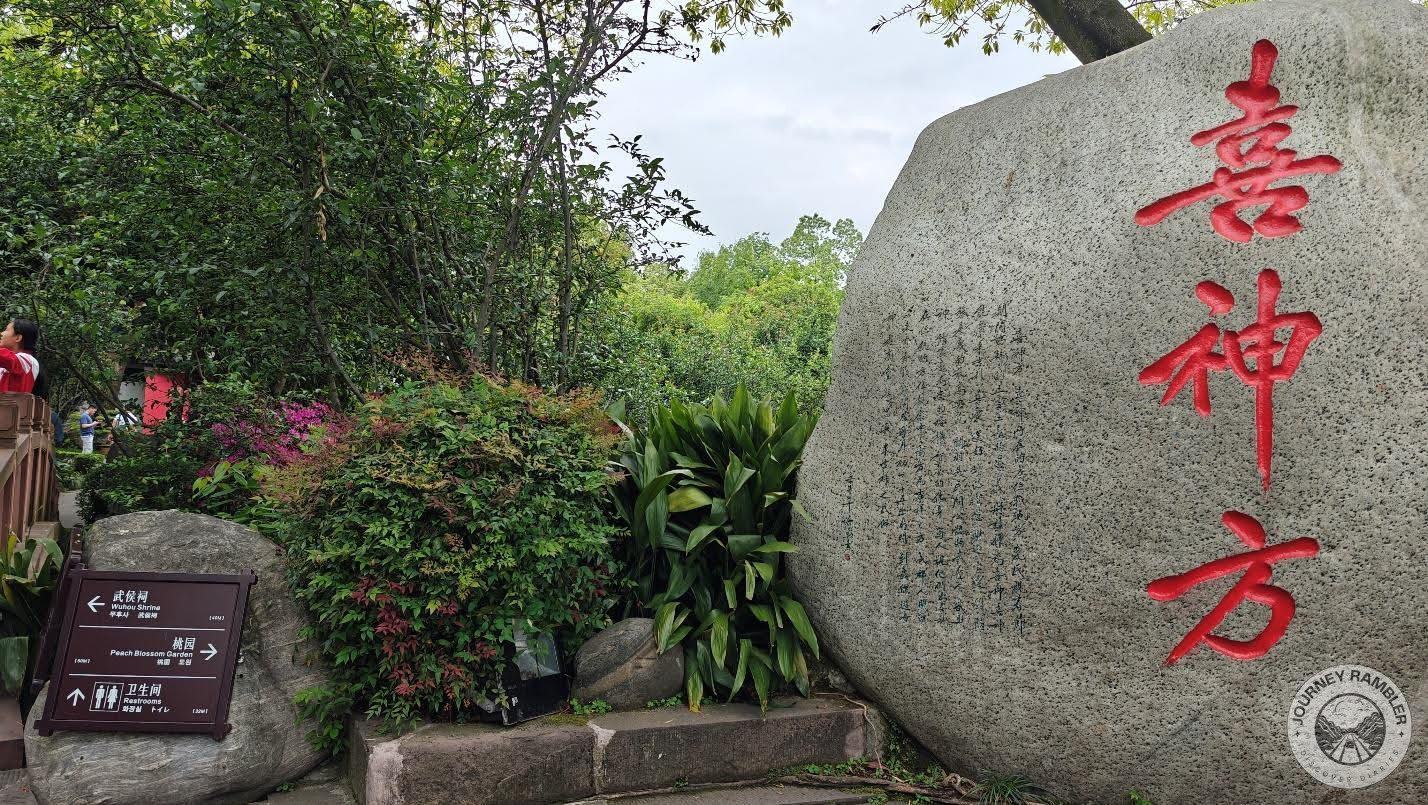
After a short walk, I found myself in a courtyard in front of the temple. On the side, there was this huge stone with large inscriptions in red (and smaller ones in black). According to Google Lens, the large inscription roughly translates to “The Direction of Happiness”.
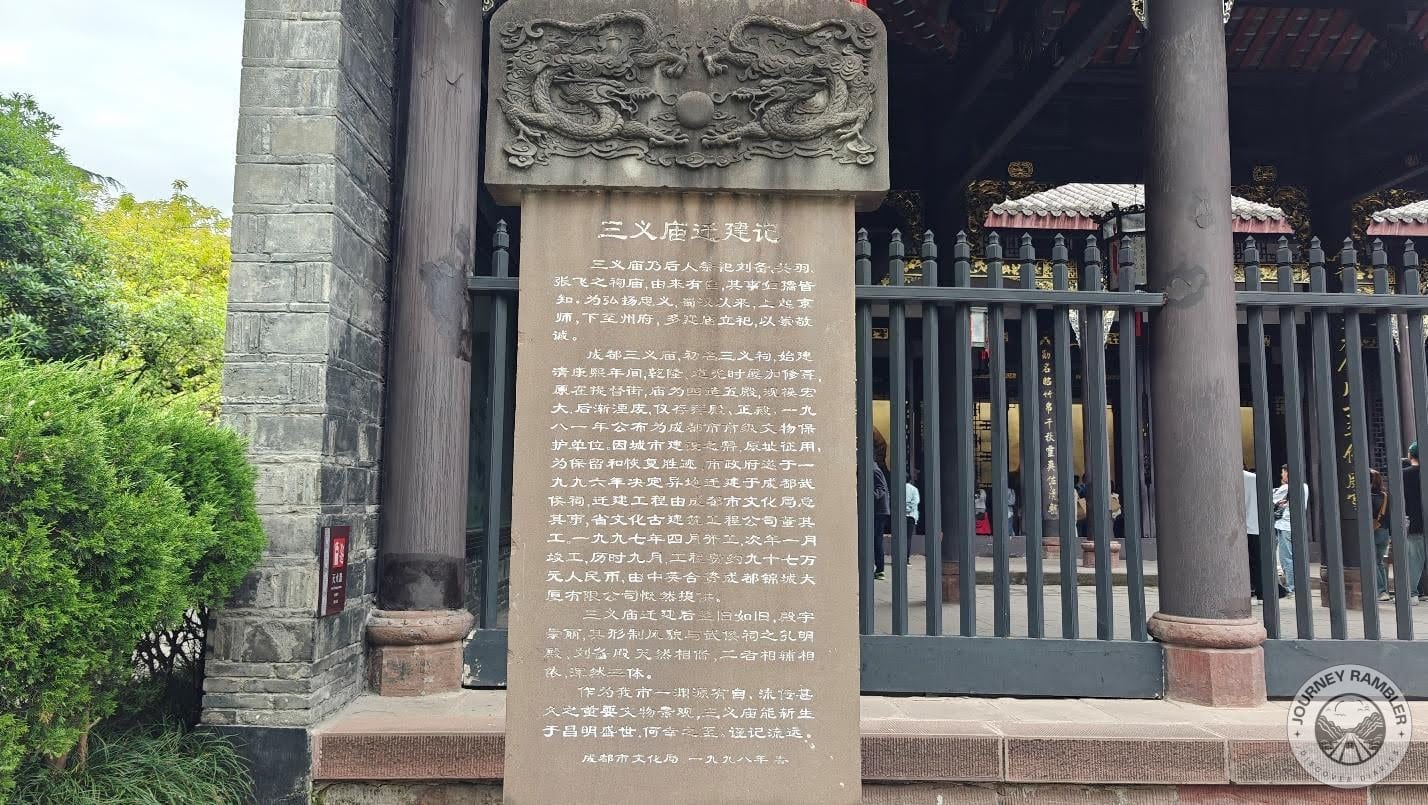
And now I’m finally at the Three Sworn Brothers Temple. Here’s a stele commemorating the temple’s relocation to the Wuhou Shrine complex. According to this, it was originally in Tidu Street and was first completed during the Qing Dynasty’s Kangxi period.
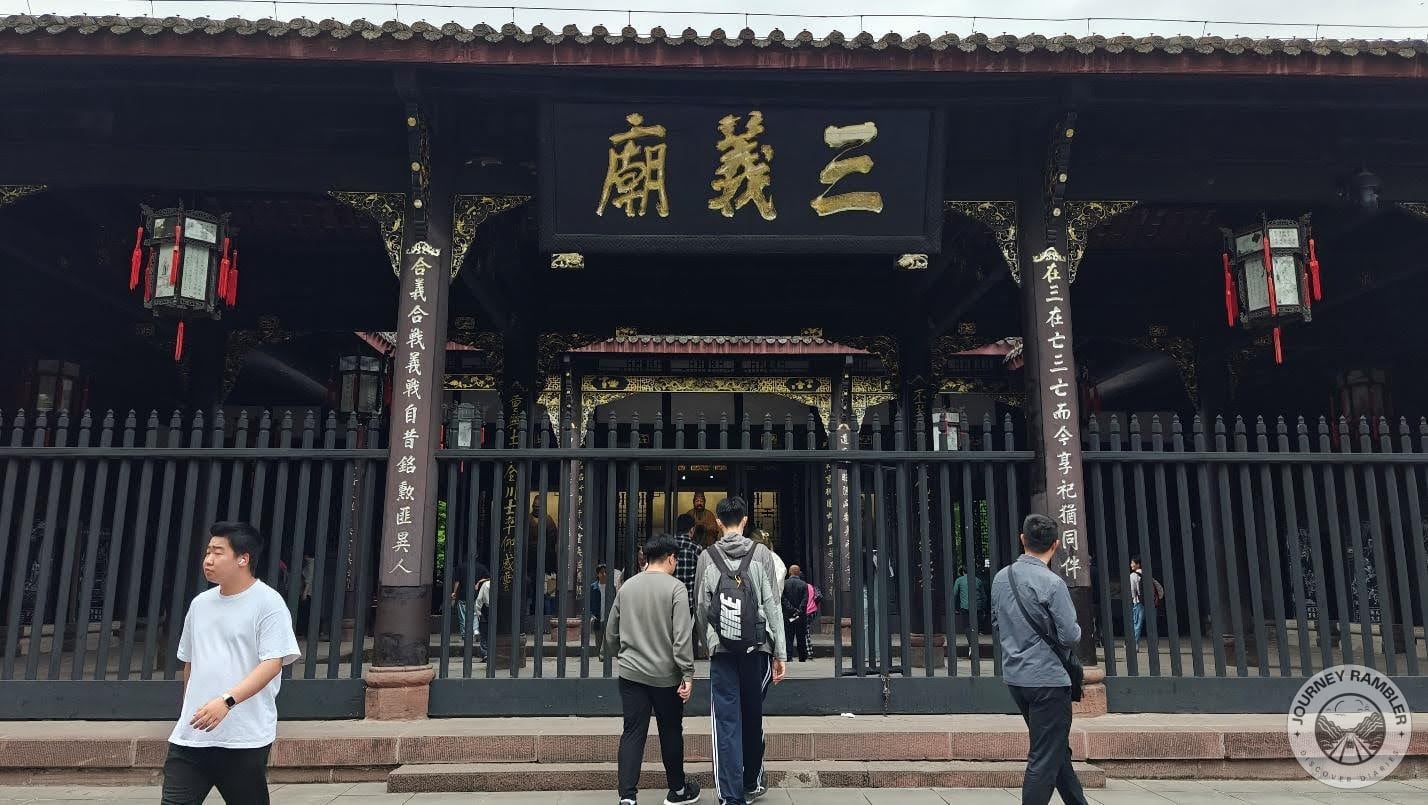
This is the entrance to the temple and I must say, it was probably the most impressive building in the whole shrine complex. The inside looked spacious and there was decent lighting thanks to its open courtyard (which I think is called a siheyuan). Interestingly, there were even fewer people here than in Hui Mausoleum or in the Liu Bei and Zhuge Liang Halls.
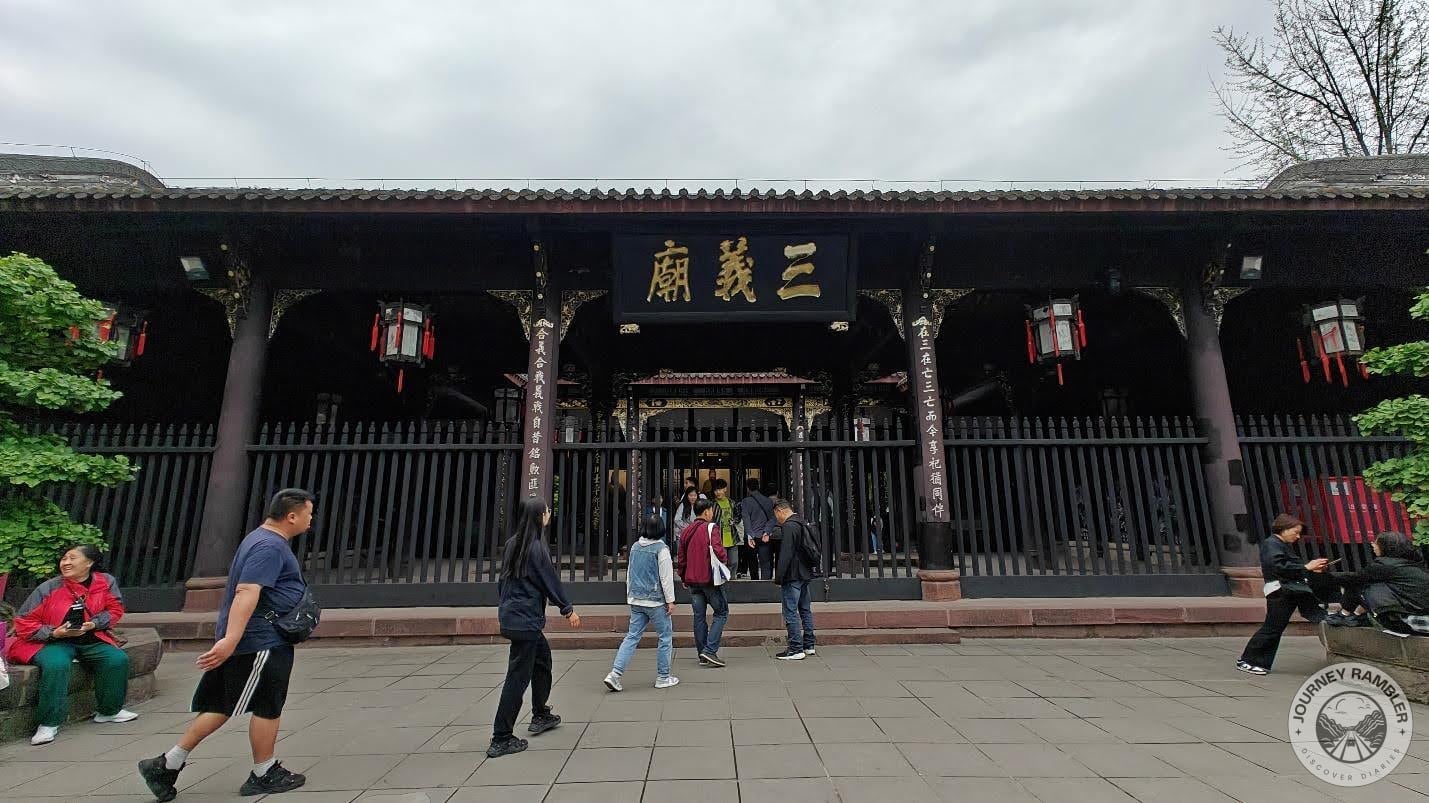
I guess the possible reason for the lack of people might be that they’re really just tired. Again, the shrine complex isn’t small by any means. I’ve seen guides online saying that there are walking routes that take an hour or two to finish.
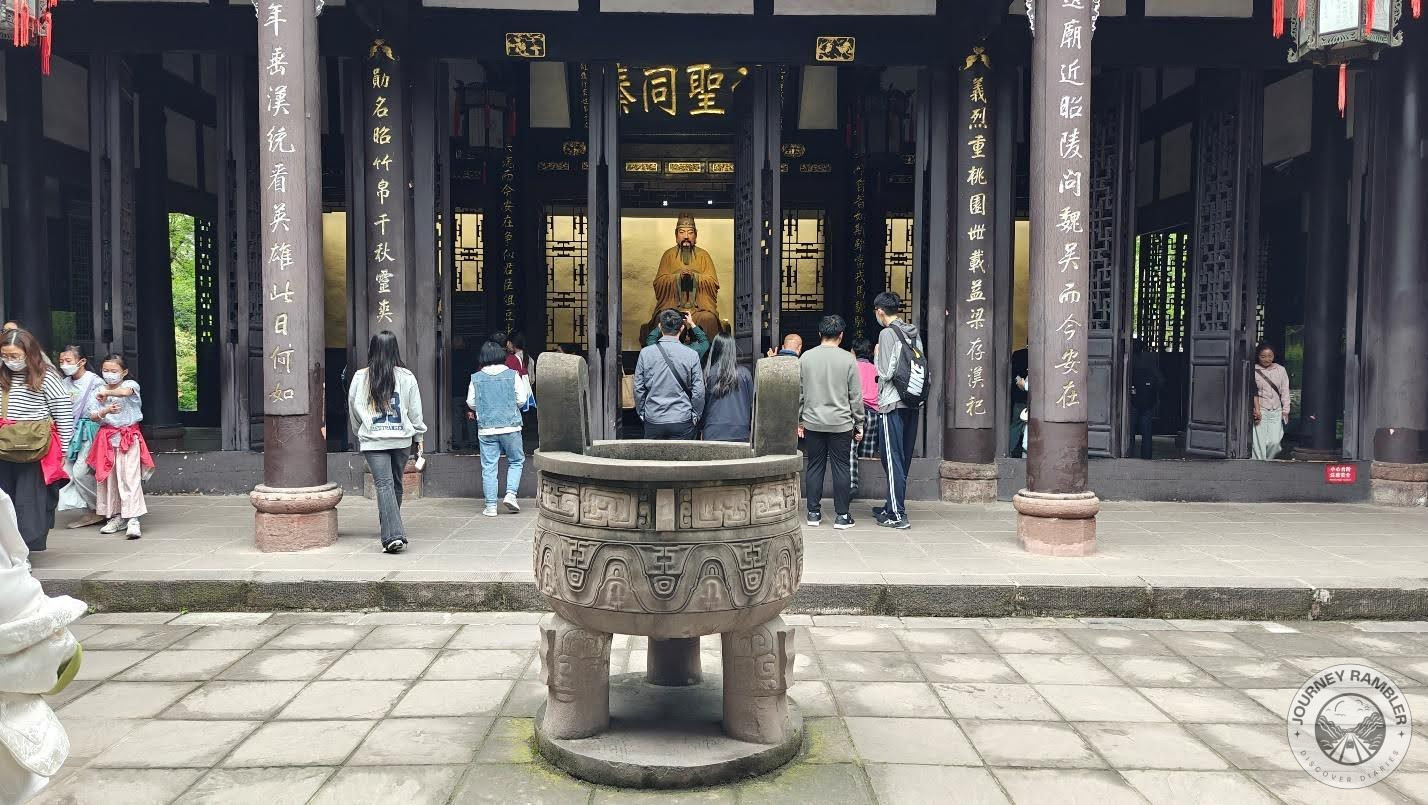
Here’s what the courtyard of the temple looks like. I’m not really sure if the large censer here was part of the original temple because it looked fairly new. Of course I might be wrong and it’s just actually really well maintained.
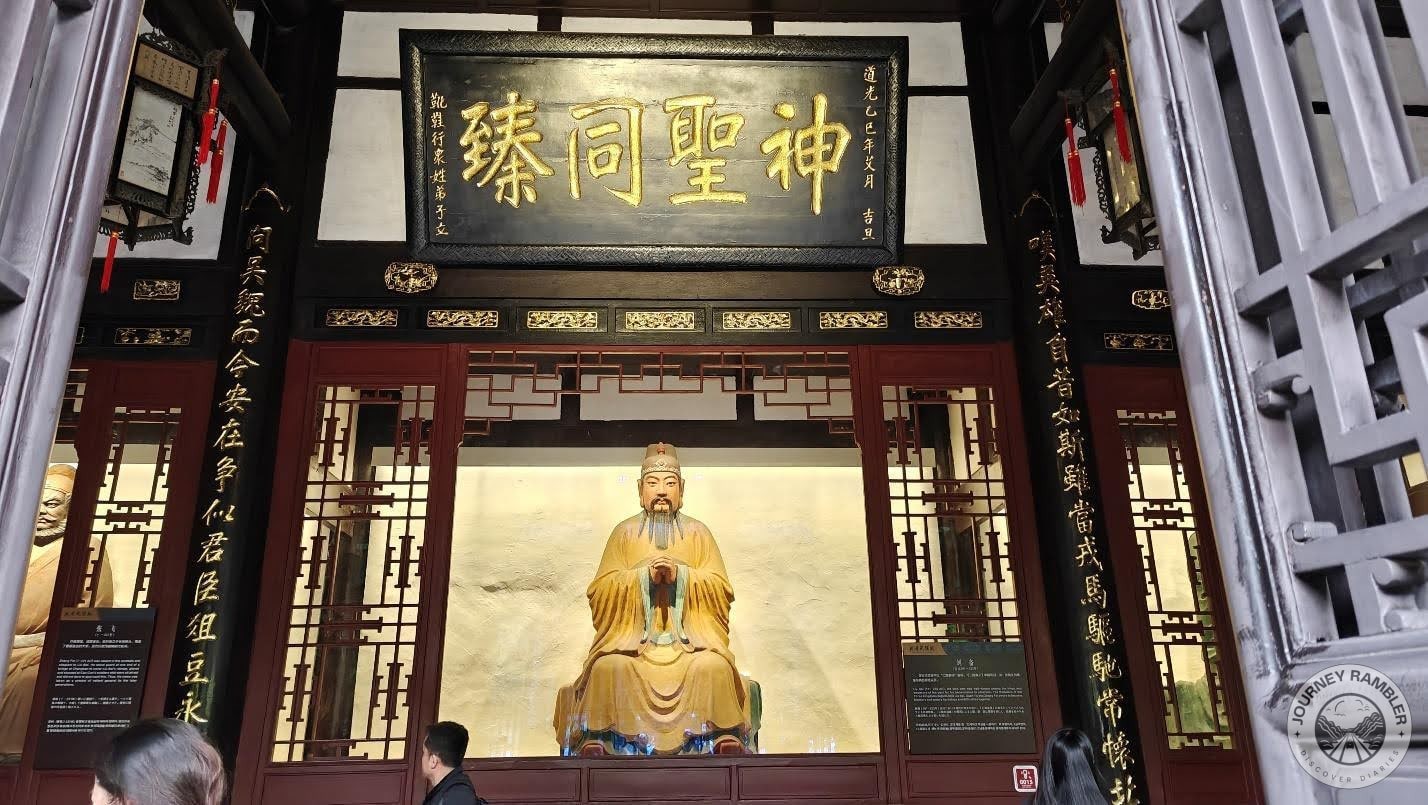
Since this is a temple dedicated to the Three Sworn Brothers it naturally has a statue of Liu Bei at its center. I don’t know if it’s just me but the statue looks much more realistic than the one at the Liu Bei Hall. More likely than not, it’s probably just because this is relatively newer.
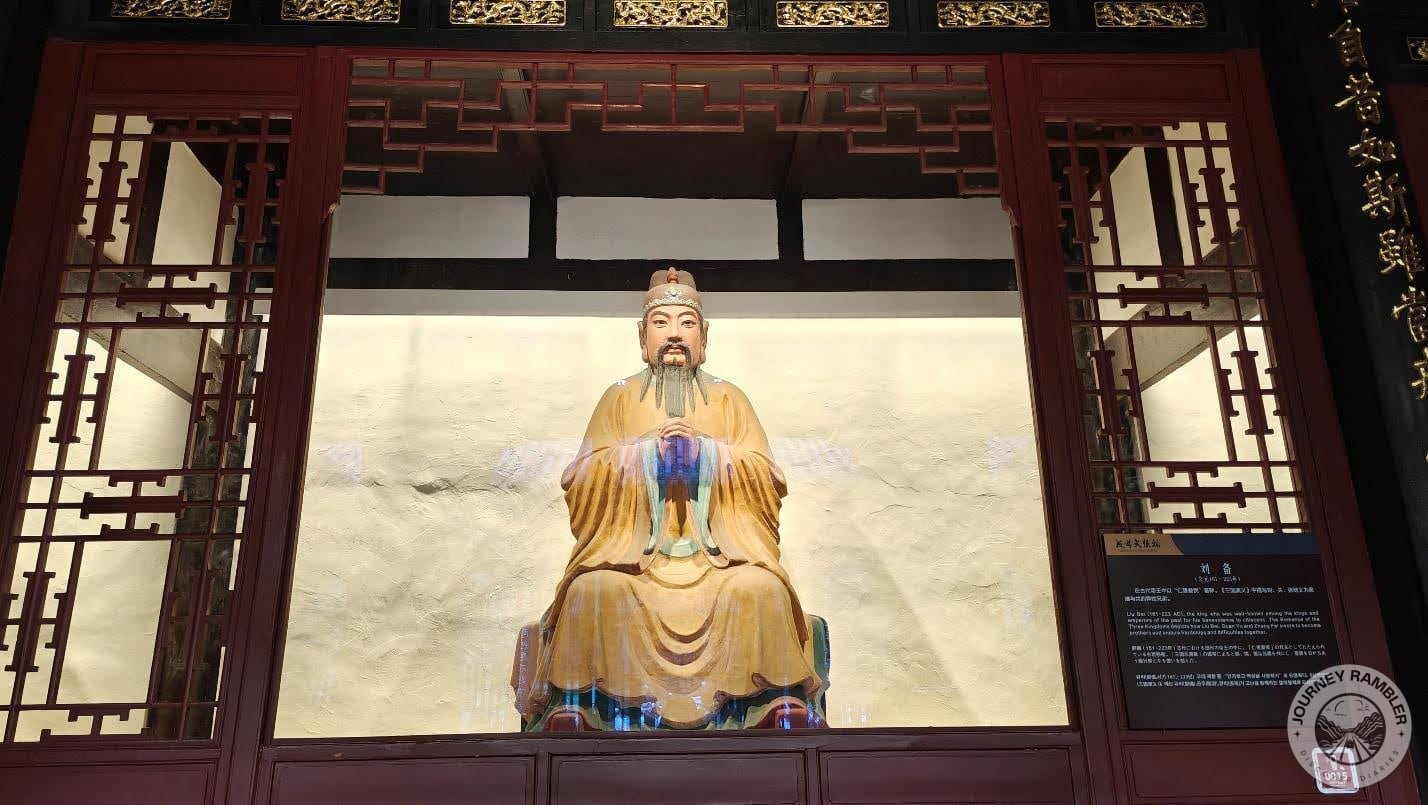
Aside from the realism, another way this statue of Liu Bei differs from the other one is with its portrayal of the ruler’s age. Here, Liu Bei looks much younger with a clearer look in his eyes. If there’s one area where this statue is inferior though, it has to be with its much simpler clothing.
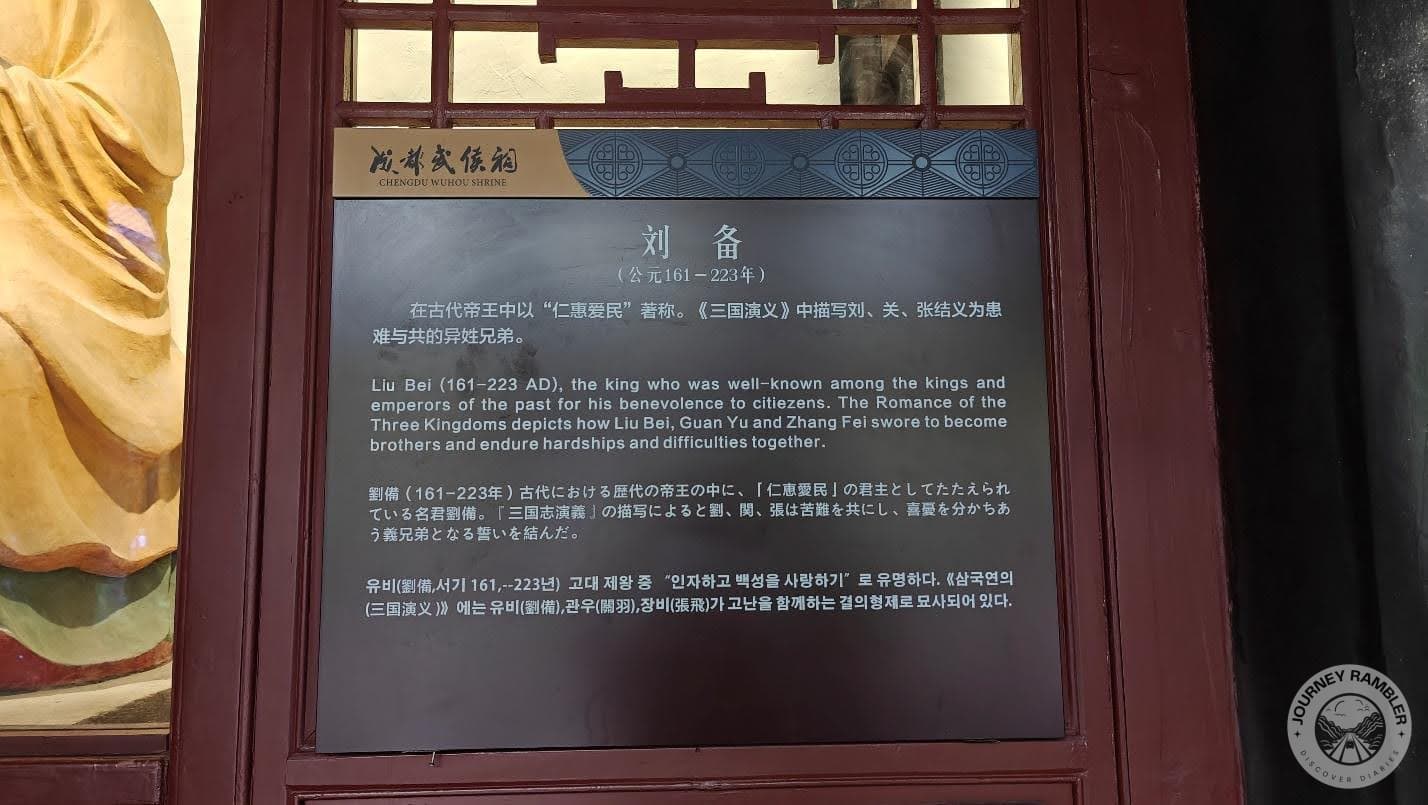
This is the description for Liu Bei’s display and statue. It talks of how he is popular thanks to his benevolence to his subjects. I will say that the description here isn’t as detailed compared to the one you’ll find at the Liu Bei Hall.
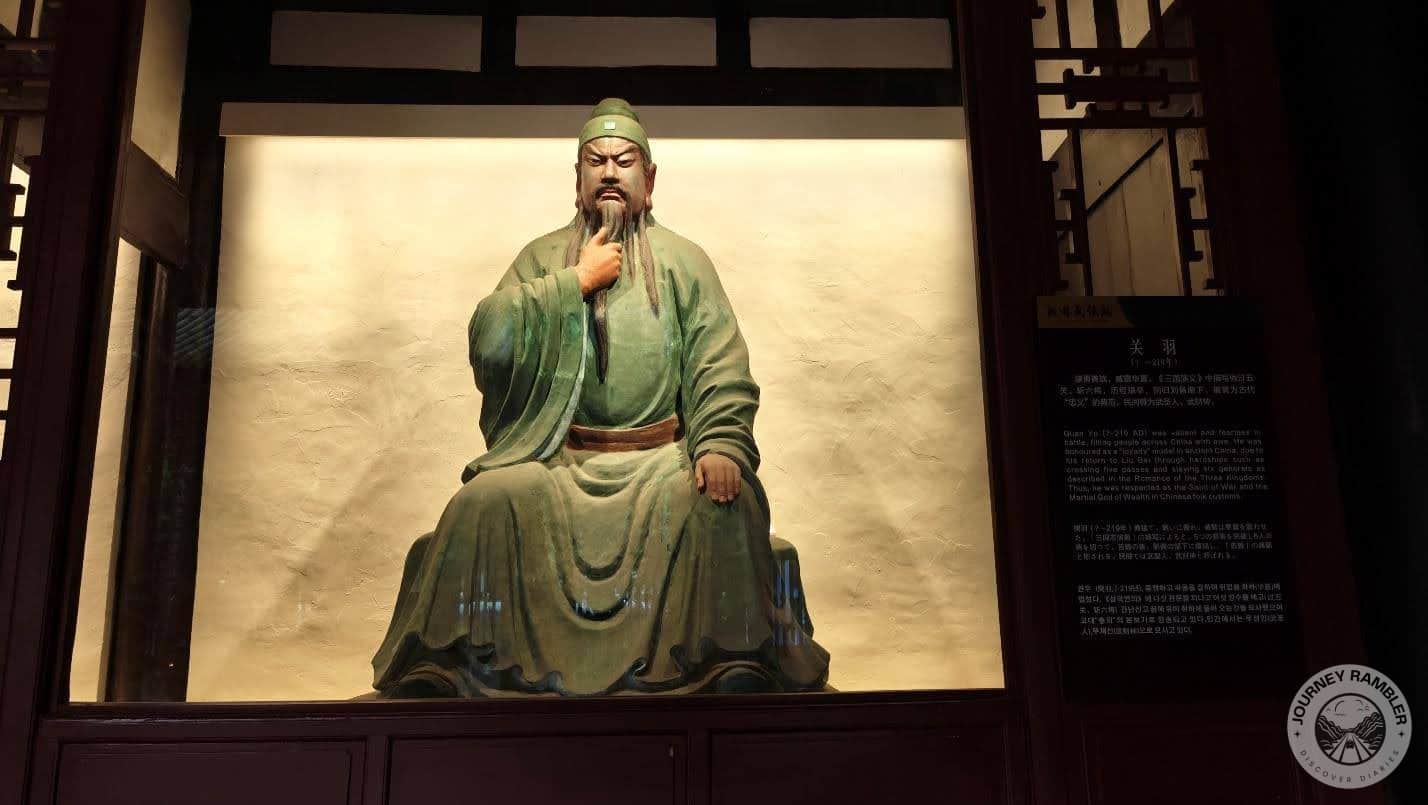
To Liu Bei’s right is the statue of Guan Yu. Again, this looks realistic compared to his other statue in Liu Bei Hall. Much like the statue of his liege, his clothes here look very simple and that’s because they’re sculpted as opposed to the others where the clothes were worn.
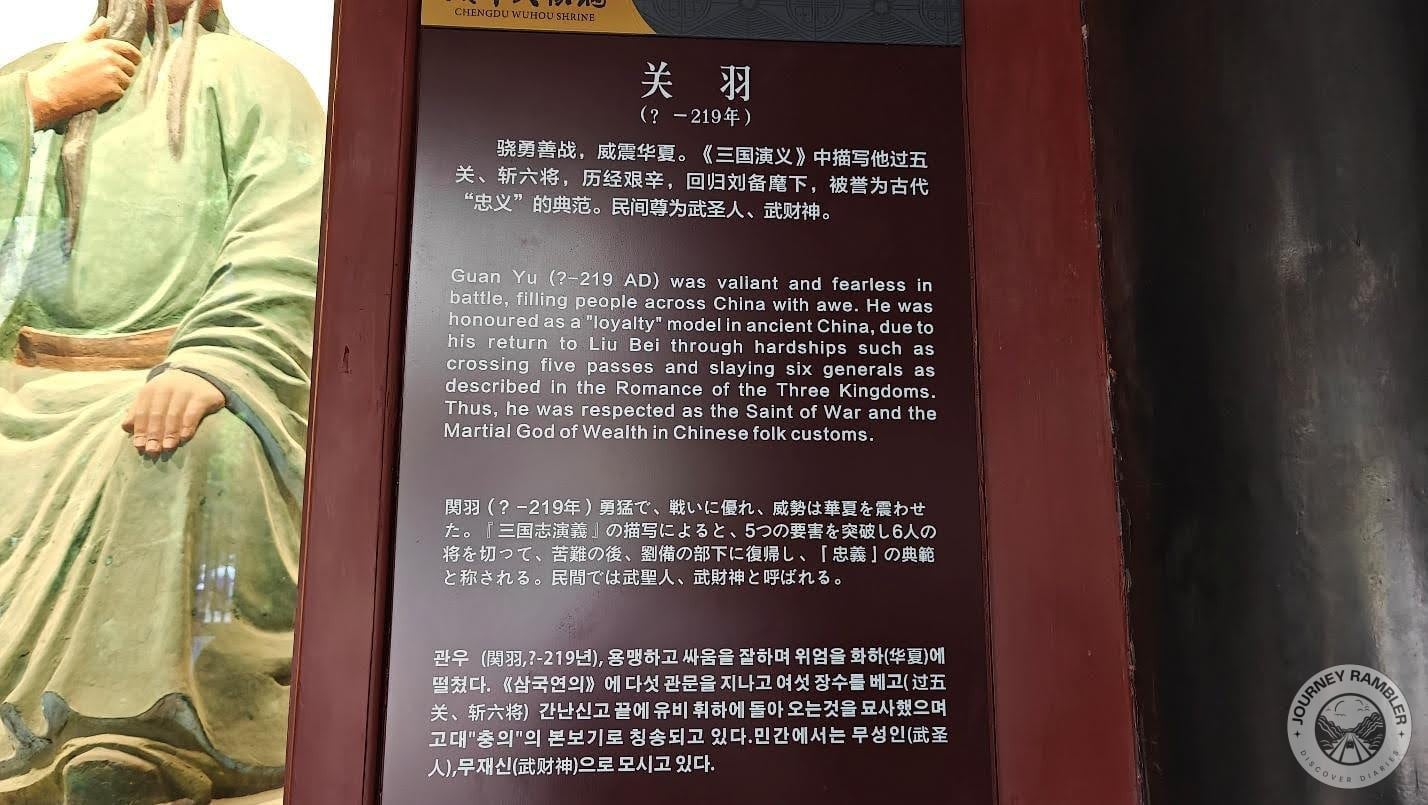
Surprisingly, Guan Yu’s description goes into much more detail about his deeds and accomplishments. It’s also interesting how his deeds have pretty much turned him into a God of War in Chinese mythology and folklore.
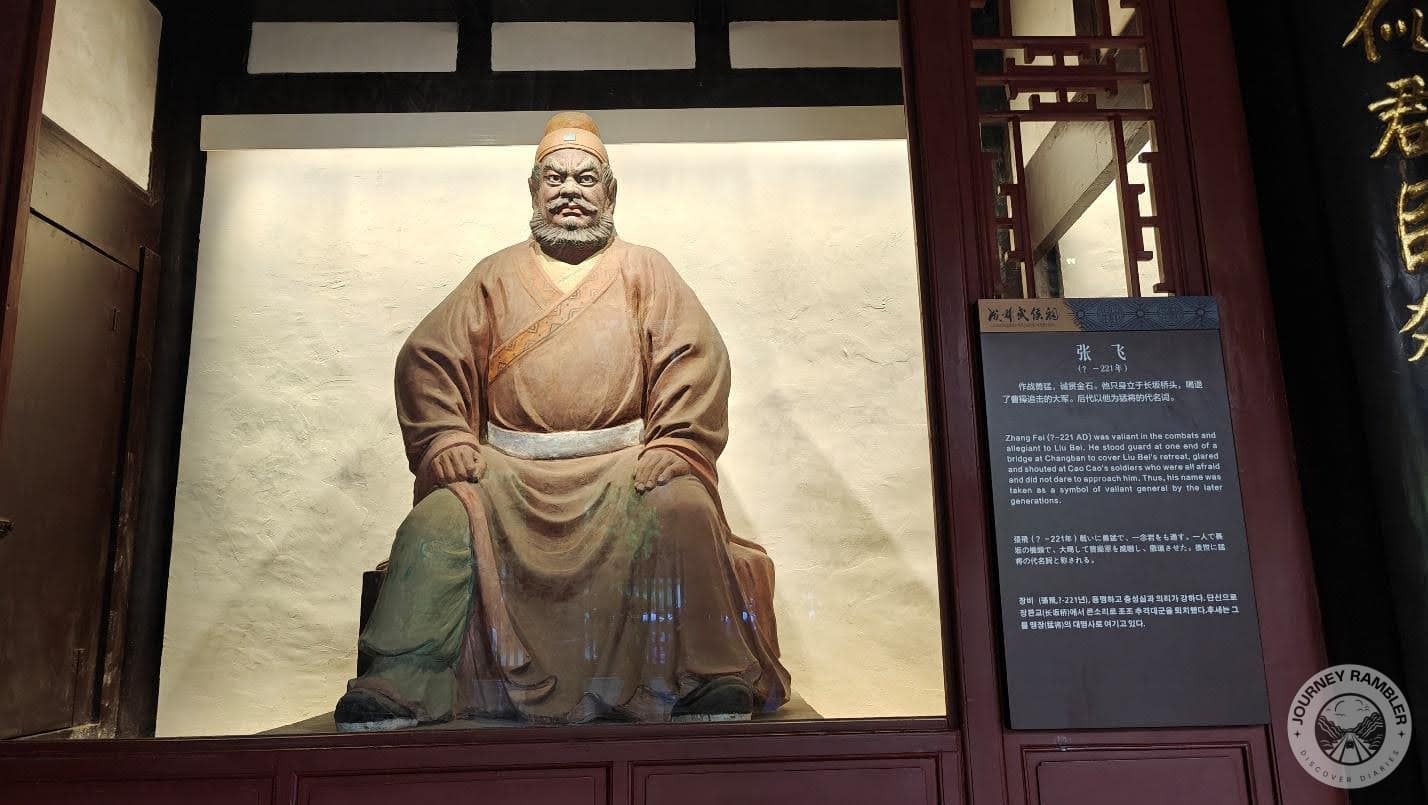
Zhang Fei’s statue here at the Three Sworn Brothers Temple looks drastically different from the one at the Liu Bei Hall. Though he still looks fearsome, he’s a lot less of a caricature than the other statue.
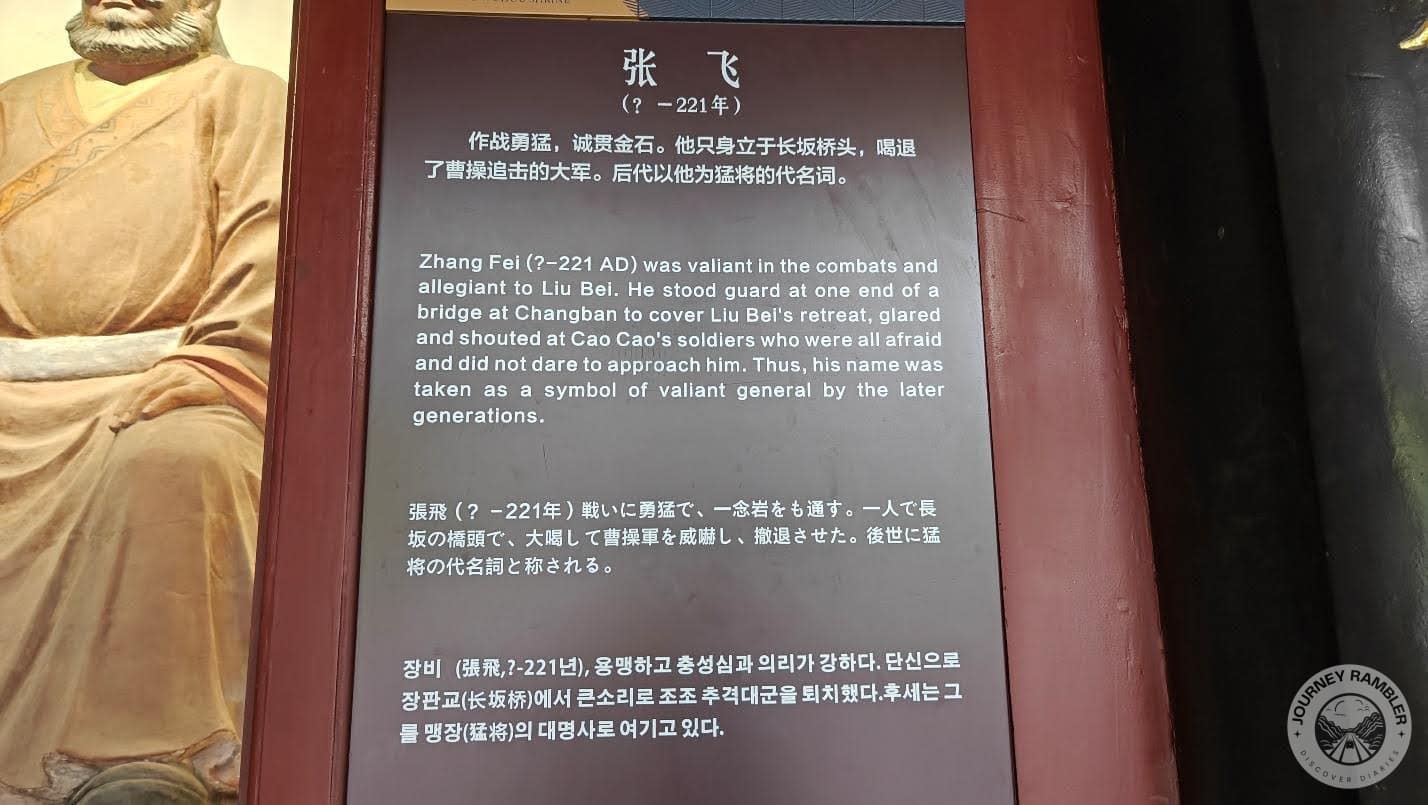
While Liu Bei and Guan Yu are universally revered, I don’t think the same can be said for Zhang Fei. He was by all accounts a disreputable person with his redeeming trait being the loyalty he displayed for Liu Bei. That being said, with loyalty being such a paramount value in Chinese culture, it’s not surprising that people can disregard a lot of his flaws and shortcomings.
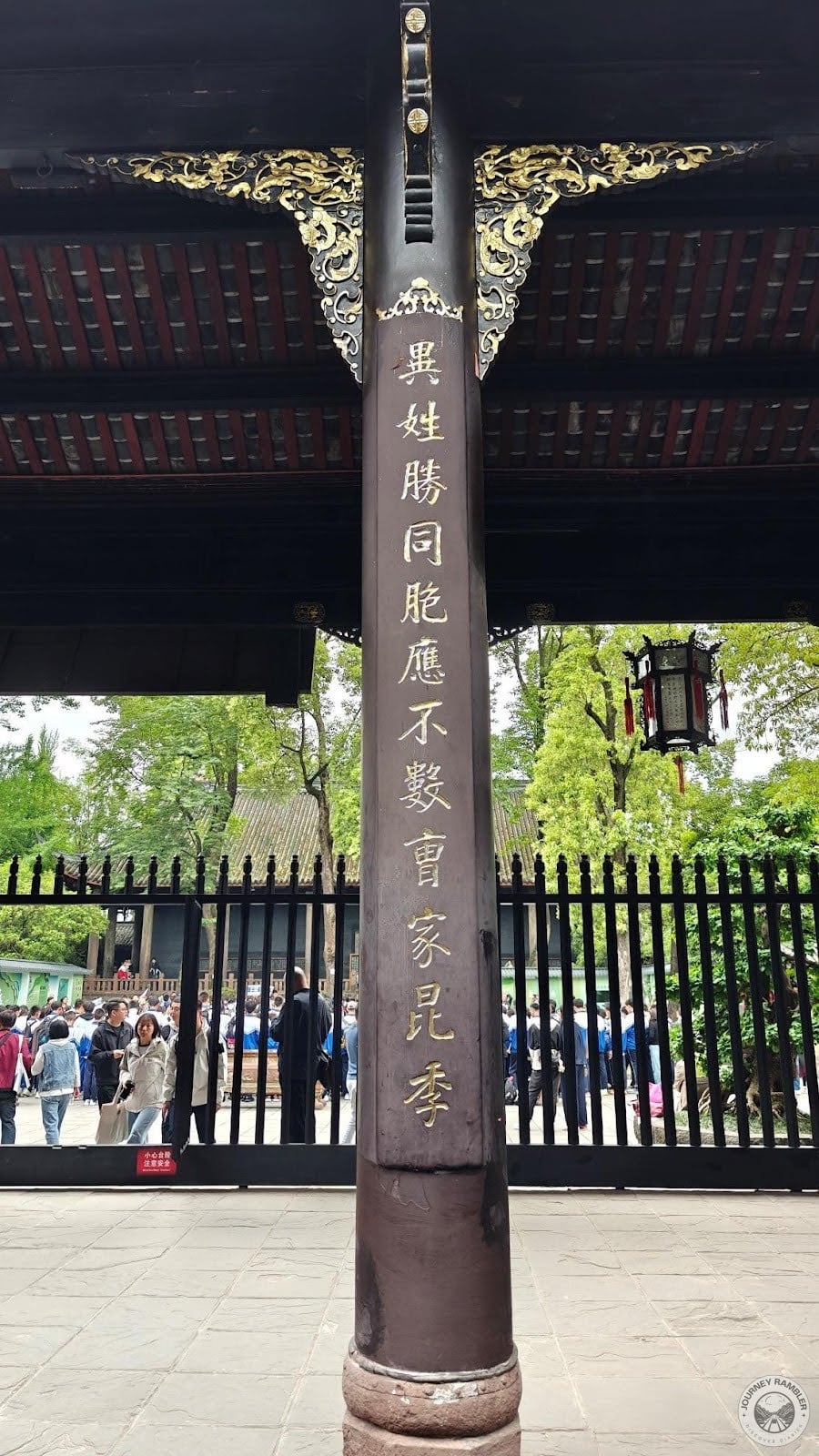
Here’s an interesting column here at the Three Sworn Brothers Temple that perfectly summarizes the relationship between Liu Bei, Guan Yu, and Zhang Fei. Using Google Lens, the characters roughly translate to: “People with different surnames can be better than blood brothers”. It alludes to the fact that the bond and vow of loyalty these three men had was even stronger than if they were related by blood.
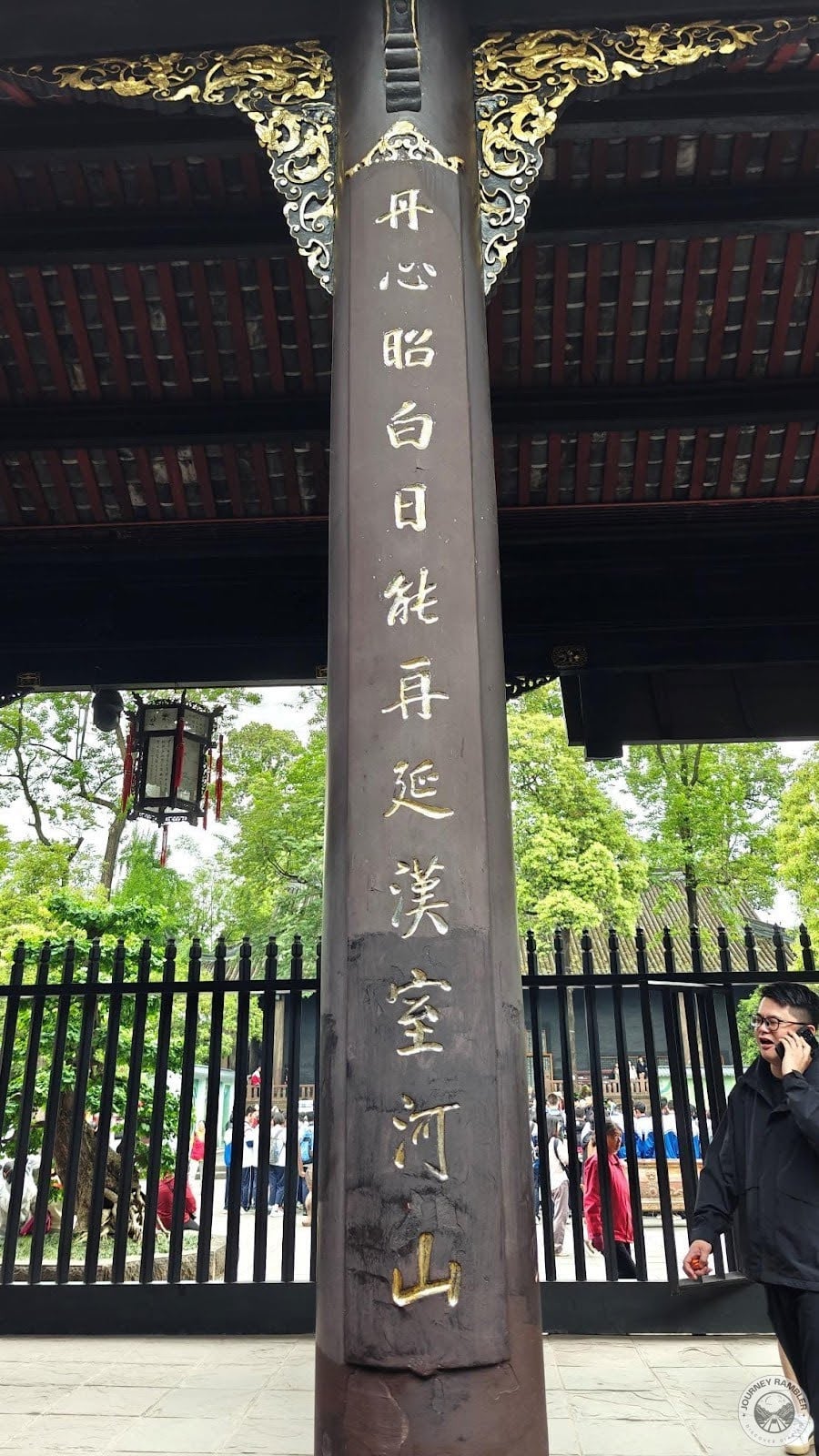
Here’s another column with an inscription that also relates to loyalty. It’s said to be attributed to Yang Jisheng and translates roughly to him likening his loyal heart to the shining of a bright sun and that he wished that he would extend the Han Dynasty’s rivers and mountains. In a way, these were also the sentiments that Liu Bei and his sworn brothers held.
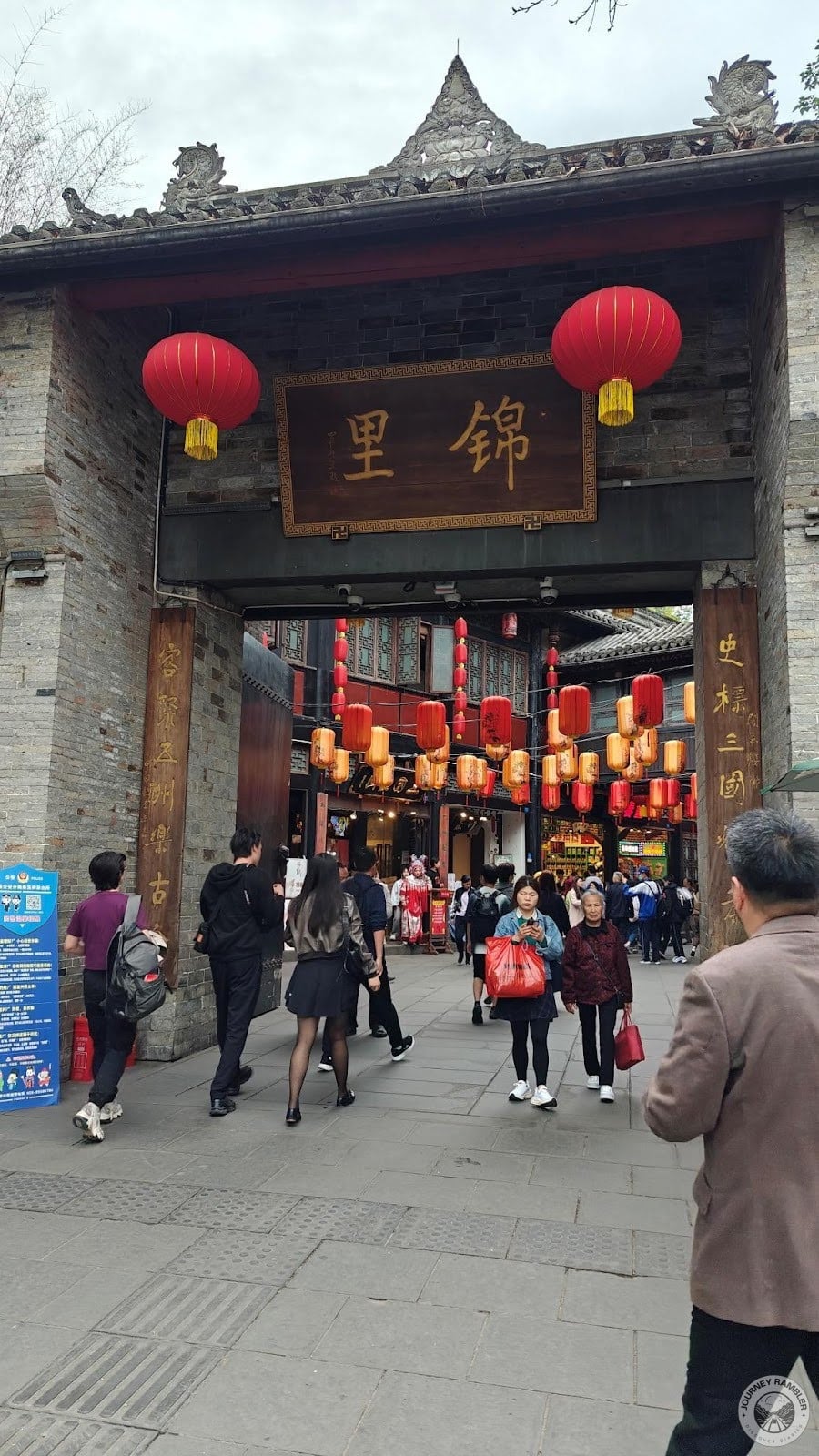
And with this my visit to Wuhou Shrine ended. After visiting all the notable areas here, I then went to the Jinli Ancient Street entrance to check out the vibrant street food culture there. As for my Wuhou Shrine experience, it was honestly tiring yet at the same time worth it. The tiring part was mainly the crowds and these were mostly isolated to particular areas of the shrine complex. For just 50 CNY I was able to enjoy scenic views, magnificent traditional buildings, as well as lessons in loyalty and history.
Are you a big fan of the Romance of the Three Kingdoms novel? If yes, then have you thought of going to Wuhou Shrine? Share what else you know about the novel and its main characters with our other readers down in the comments section!